Vanuatu vs Caribbean Passports: Fastest Route to Tax-Free Crypto


Crypto holders exploring a second passport often narrow the choice to two regions: Vanuatu and the Caribbean. Both offer citizenship by investment without residency requirements, but they differ sharply on speed, cost, and mobility.
For anyone holding digital assets, the calculation is not just about a new travel document. It touches banking access, tax exposure, and how comfortably wealth built in crypto can move across borders.
This comparison sets out what each route actually delivers in 2026, using verified figures rather than marketing claims, so the decision rests on facts rather than assumptions.
Key Takeaways
-
Vanuatu's citizenship by investment process is typically the fastest route to a second passport, often completing in 30 to 60 days.
-
Caribbean citizenship programs offer stronger historical visa-free travel networks but face ongoing scrutiny over EU and UK visa-waiver status.
-
Neither a Vanuatu passport nor a Caribbean passport eliminates tax residency obligations or CRS and FATCA reporting for crypto holders.
-
A direct cost comparison over five years reveals meaningful differences once government fees, due diligence, and family costs are included.
-
Geopolitical and reputational risk factors now shape bank account approval as much as passport strength itself.
Why Crypto Holders Are Comparing Vanuatu and Caribbean Citizenship
Digital asset investors face a specific problem. Wealth held in crypto is portable, but the person holding it is still tied to one passport and one tax system.
The appeal of a second passport for digital asset investors
A second passport through citizenship by investment offers a legal foothold elsewhere, useful for banking diversification, family security, and reducing reliance on a single jurisdiction's politics.
What tax-free access actually means in practice
"Tax-free" rarely means what marketing suggests. Vanuatu and most Caribbean states do not tax foreign income, but obtaining citizenship does not automatically change tax residency in the country where someone actually lives and works.
Vanuatu Citizenship by Investment: Speed and Structure
Vanuatu's Development Support Program remains the benchmark for speed among active citizenship by investment programs.
National development fund contribution and minimum investment
The minimum investment for a single applicant sits at US$130,000, paid as a contribution to Vanuatu's national development fund. Some licensed agents publish alternative structures, including a US$150,000 family route or a split US$110,000 plus US$50,000 redeemable-fund format, though these are agent-published variations rather than a single official fee table.
Processing time and remote application options
Processing time is typically 30 to 60 days, among the fastest in the industry. The entire application process can usually be completed remotely, with no residency or physical visit required before or during approval.
Due diligence and source of funds requirements
Applicants still undergo formal due diligence, including source of funds verification. Vanuatu's government does not accept Bitcoin directly. Licensed agents convert crypto holdings to fiat before remitting payment to the state.
Caribbean Citizenship Programs: St Kitts and Nevis, Antigua and Barbuda, Grenada, Dominica, St Lucia
The five Caribbean CBI programs share a similar structure but differ meaningfully on minimum investment and processing time.
Government donation versus real estate option
Each program offers a government donation route and a real estate option. Reported minimums are St Kitts and Nevis at US$250,000+, Antigua and Barbuda at US$230,000+, Dominica at US$200,000+, and St Lucia at US$240,000+. Grenada follows a comparable structure, with real estate typically requiring a higher outlay than the donation path.
Processing time and family members eligibility
Processing time generally runs several months, longer than Vanuatu's. All five programs allow family members, including spouses, children, and in some cases parents or siblings, to be added to a single application.
Passport strength and visa-free travel comparison
Caribbean passports have historically carried strong passport strength, with broad visa-free travel across dozens of destinations. Like Vanuatu, they rely on licensed intermediaries for crypto conversion, since none of these governments accept digital assets directly for payment.
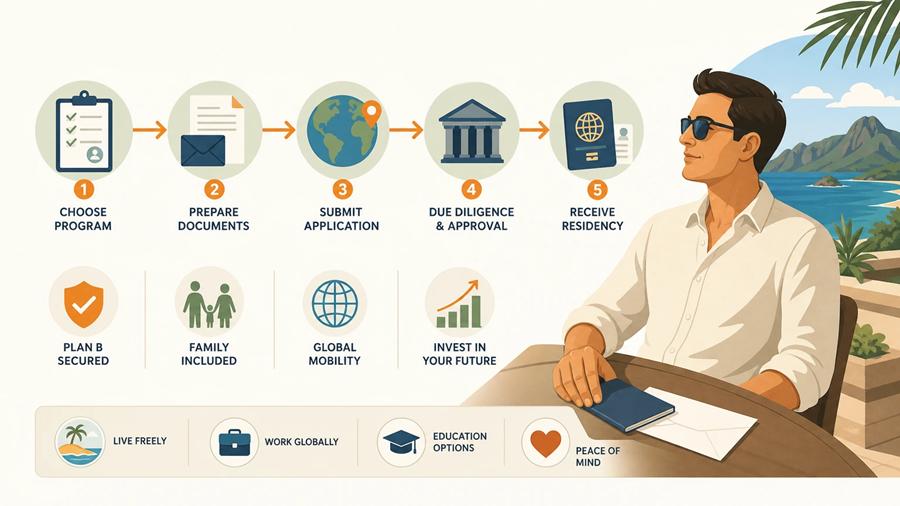
Applicants weighing dual citizenship implications, or comparing the Vanuatu second passport application process against a Caribbean route, should treat processing time and family cost as equally important as headline investment figures. Global mobility goals differ by family, and the right plan B strategy depends on individual travel patterns and long-term residency intentions, a matter best discussed with an experienced advisor before committing funds.
Five-Year Cost of Ownership: A Direct Comparison
Headline minimum investment figures rarely tell the full story. A realistic cost comparison has to include due diligence charges, per-person fees, and any renewal or maintenance costs that accumulate after approval.
For Vanuatu, one 2026 advisory guide puts a family-of-four government contribution at US$180,000, plus US$2,500 per person for birth registration and national ID, and a separate US$5,000 VFIU due diligence fee. That advisor also adds a 5% service charge on top. A single applicant using the standard Development Support Program route pays the US$130,000 minimum investment, with some agents quoting an all-in figure near US$135,000 once fees are bundled in. Pricing varies by agent and route, so applicants should request an itemized breakdown before committing funds.
What Identical Family Profiles Actually Pay
Caribbean programs sit higher at the entry point. St Kitts and Nevis starts above US$250,000, Antigua and Barbuda above US$230,000, Dominica above US$200,000, and St Lucia above US$240,000, figures that typically apply per family unit under the government donation route rather than per applicant.
None of the available sources compiles a single official 2026 fee schedule covering due diligence, passport issuance, medical exams, and renewal costs across all five Caribbean states. A precise five-year total therefore depends on the specific program and agent involved. What is consistent is that Vanuatu's entry cost remains lower than every Caribbean comparator, even after accounting for per-person and due diligence charges. Families weighing a five-year horizon should request a full written fee schedule from an advisor before comparing programs side by side.
EU and UK Visa-Waiver Status: What Changed in 2025 and 2026
Vanuatu's passport lost Schengen visa-free access in December 2024, a shift that materially changed its value for Europe-based travel. Some 2026 marketing materials still list Schengen and UK access among roughly 87 to 96 destinations, but this conflicts with the December 2024 suspension confirmed elsewhere. The more cautious and current reading is that Vanuatu citizenship no longer includes Schengen area or UK visa-free entry.
Caribbean passports are described in 2026 comparison guides as retaining broader visa-free travel, though no dated European Commission or UK Home Office notice in the available material confirms the current status for each of the five programs individually. Applicants should verify current waiver status directly before assuming any specific country list, since these arrangements shift without much public notice.
Geopolitical and Reputational Risk: FATF, EU Scrutiny, and Bank Accounts
None of the available sources places Vanuatu or the five Caribbean citizenship by investment states on the FATF grey list as of 2026. That said, passport validity and banking access are not the same thing, and crypto holders often discover this gap only after approval.
St Kitts and Nevis accepts crypto holdings as proof of net worth during due diligence, but actual payment must still be made in fiat currency. This mirrors the pattern across every program covered here: licensed agents convert crypto to fiat before remitting funds to any government. Banks conducting their own onboarding checks tend to scrutinize an applicant's transaction history and source of funds more closely than the citizenship document itself, which is why enhanced due diligence and account friction remain common even for holders of a strong second passport.
Tax Residency, CRS, and What Happens After You Get a Second Passport
A common misconception treats Vanuatu or Caribbean citizenship as an automatic tax haven arrangement. Neither outcome is accurate. Obtaining citizenship changes legal nationality; it does not by itself change tax residency, which most jurisdictions determine by physical presence, domicile, or center of vital interests.
Crypto holders remain subject to Common Reporting Standard and FATCA obligations in whichever country holds their tax residency, regardless of which passport they carry. A second passport does not erase existing reporting duties to a home country's tax authority. Dual citizenship itself is permitted by Vanuatu and all five Caribbean programs discussed here, but applicants must separately confirm whether their country of origin allows it, since some jurisdictions restrict or complicate dual nationality. Anyone planning a genuine change in tax residency should work through the mechanics with a qualified tax adviser rather than assuming citizenship alone achieves it.
Renunciation, Revocation, and Exit Considerations
A passport obtained through citizenship by investment is not permanent by default. Both Vanuatu citizenship and Caribbean citizenship can be revoked if authorities later find misrepresentation, fraud, or false statements during the original due diligence review.
Revocation is uncommon but not theoretical, and it typically follows discovery of undisclosed criminal history or falsified source of funds documentation. Renunciation works differently: it is a voluntary process an applicant initiates, usually for tax, legal, or personal reasons unrelated to wrongdoing. Anyone weighing a second passport as a long-term Plan B strategy should ask an advisor how each program handles both scenarios before applying.
Beyond the Passport: Education, Healthcare, and Relocation Reality
Families rarely relocate purely for a document. Vanuatu offers a slower pace and genuine natural beauty, but healthcare and education infrastructure remain limited compared to larger economies, and climate risk from cyclones is a real planning factor.
Caribbean nations vary meaningfully in this regard. St Lucia and Antigua and Barbuda have more developed tourism infrastructure, while Dominica and Grenada lean smaller and quieter. None of these five islands should be chosen assuming immediate first-world healthcare access.
Choosing the Right Plan B Strategy for Your Situation
Crypto holders weighing a Vanuatu passport against Caribbean citizenship should match the decision to actual goals: speed favors Vanuatu, while broader visa-free travel and family flexibility often favor Caribbean citizenship. Global Residence Index works directly with government due diligence bodies across both regions and can structure an application process suited to individual circumstances. Its parent firm, Vancis Capital, supports more complex global mobility and investment return planning for larger family groups.