Is MemeToro a Scam? 8 Concerns Checked Against the Evidence

Key Takeaways
MemeToro’s full platform is still being built, but its AI pipeline, tests and development work are public on GitHub.
$MT has a live, fixed-supply contract reviewed by three smart contract security providers.
Most of the questions around MemeToro come with being an early meme presale rather than evidence of fraud.
The evidence available in September 2026 doesn’t show that MemeToro is a scam project. Although there are still things that aren’t finished or fully public, which isn’t unusual at this stage of a presale, there’s still quite a lot that can already be checked independently, from the token contract and security reviews to the project’s open-source development.
8 MemeToro Concerns at a Glance
Concern | What it actually shows | Source | Status |
Anonymous team and legal status | The founders are not public, while the code and $MT contract are independently accessible | GitHub, BscScan, whitepaper | Open question |
Audit coverage | $MT has been reviewed by three smart contract security providers; future platform contracts remain work in progress | Coinsult, BlockSAFU, SolidProof, GitHub | Explained |
Owner wallet | One wallet handles a narrow set of pre-launch functions, while several broader token controls are absent | Contract, audit reports | Typical presale setup |
Product development | The complete launchpad is not live yet, but an early AI pipeline and contract work are already public | GitHub | In development |
FDV and vesting | The planned launch price implies a $62.23M FDV; presale buyers do not have a vesting schedule | Tokenomics | Market consideration |
Paid promotion | Some MemeToro coverage has been sponsored, as is common with presale marketing | Published coverage | Typical presale marketing |
Website trust scores | Low scores largely reflect MemeToro’s short online history and limited reputation data | ScamDoc, Gridinsoft | Explained |
Presale funds | Crypto flows are traceable, while card purchases mean two public contracts do not represent every payment route | Blockchain explorers, website | Partly verifiable |
What Is MemeToro and Where Does $MT Stand Now?
MemeToro is building an open-source memecoin launch platform on BNB Chain. The main idea is to put an AI agent at the beginning of the launch process: it follows news, social trends, culture and markets, works through possible meme concepts, and can either select an idea or reject the options it has been given.
A selected idea can then be turned into a fuller proposal with its reasoning, evidence, funding parameters and a machine-readable launch manifest. The longer-term plan is for public smart contracts to handle the actual funding and launch rules. MemeToro’s own GitHub is clear that the project is currently at an early MVP and architecture stage, rather than presenting the full system as finished.
Anyone digging into the project beyond that should also make sure they are looking at the right sources. The official MemeToro website and GitHub are the places to check, while sites using similar domains, such as memetoro.online, are unrelated to the project and can be used for scams. That makes checking the domain especially important before connecting a wallet or sending funds.
$MT is the platform’s native token and has a fixed supply of 1.2 billion. The current tokenomics allocate 857,936,900 MT, or roughly 71%, to the public sale.
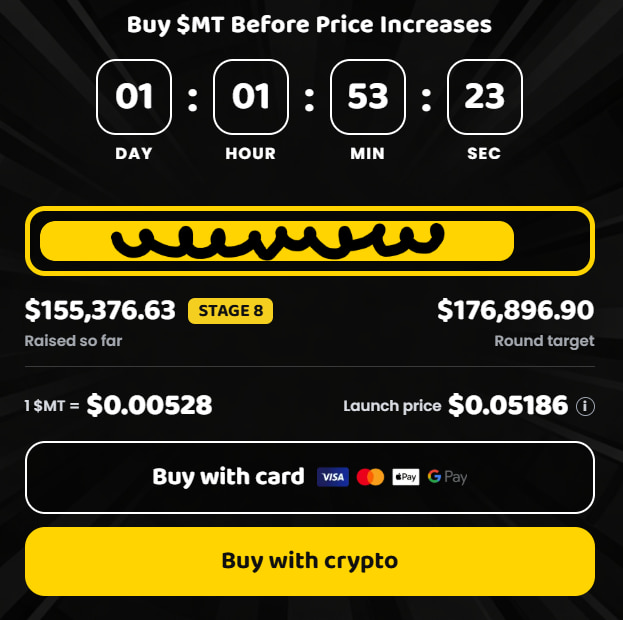
As of September X, 2026, MemeToro sits in Stage 8 at $0.00528 per $MT, with roughly $155,376 raised toward a $176,896 round target. The project lists $0.05186 as its planned launch price.
Does an Anonymous Team Make the MemeToro Scam Claims Stronger?
An anonymous team can limit how much background information is available about the people behind a project, but it does not make the presale fraudulent by default.
MemeToro’s founders are not publicly named, and there is no public team KYC certificate. That setup is fairly common across meme tokens and crypto presales, where teams often operate under private or pseudonymous identities.
So anonymity is more of a transparency limitation than evidence of a scam on its own.
Are MemeToro’s Contracts Unaudited?
Not all of MemeToro’s contracts are at the same stage. The deployed $MT token contract has already been reviewed by three smart contract security providers: Coinsult, BlockSAFU and SolidProof.
BlockSAFU reported zero critical, major, medium or minor code findings and one informational item.
Coinsult gave the $MT contract a 90% score with no low, medium or high-severity findings. Coinsult is involved in more than just the $MT contract review. Parts of the presale setup are handled through Coinsult rather than sitting entirely under MemeToro’s direct control, which adds some separation between the project team and the presale infrastructure. That kind of third-party involvement can be a positive from a control perspective, because it means the team does not have unilateral control over every part of the presale setup.
SolidProof gives MemeToro a TrustNet score of 58.65. Its report lists three medium and five low findings as pending, alongside optimization and informational notes, with no high or critical findings listed.
The important part is that those reviews cover the $MT token contract while MemeToro’s future fair-launch contracts are a different piece of the project. The README GitHub page currently describes them as draft, unaudited and not ready to handle real funds, and the roadmap places independent security reviews before any production use.
How Much Control Does the $MT Owner Actually Have?
The $MT owner wallet has control over a few launch-stage functions, mainly turning trading on and managing which addresses are exempt from the initial transfer restrictions. Beyond that, the contract keeps the owner’s powers fairly limited.
Once trading is enabled, it cannot simply be switched off again through the owner function. The contract also does not let the owner mint new tokens, change buy or sell taxes, blacklist holders, upgrade the contract through a proxy or alter individual balances.
That gives the owner enough control to handle the launch setup, without giving that wallet broad control over the token after trading begins.
Does MemeToro Have a Working Product?
Yes, in an early MVP form. MemeToro does not have the full launchpad running yet, but the public repository already contains working code that can be tested rather than just plans for what might be built later.
A stronger point is the testing around the current pipeline. The repository includes checks for fabricated or unsupported evidence, prompt-injection attempts and proposals that break the project’s own launch rules. That gives the current build something concrete to judge beyond screenshots or roadmap promises.
The repo is also quite open about where development stops today. The autonomous scheduling, live market inputs, production token launch flow and final fair-launch contracts are still ahead.
So the fairest description right now is working MVP, unfinished platform. There is already code doing part of the job MemeToro describes, while the wider system has to be completed.
Is MemeToro’s $62M Launch FDV Unusual?
The $62.23 million figure is not unusual and comes from fairly simple maths: MemeToro lists a planned launch price of $0.05186 and $MT has a maximum supply of 1.2 billion.
That gives the token a fully diluted valuation of about $62.23 million if the project-stated launch price is used across the full supply. It does not mean $62 million has been invested in MemeToro, nor does it mean the market will value every token at that price once trading begins.

The current tokenomics also give presale buyers full access to their $MT allocation at launch rather than putting those tokens through a separate vesting schedule. MemeToro takes a different approach with its 96 million $MT marketing and partnership allocation, which is vested over 24 months. Immediate access can mean more tokens are available to move once trading begins, so actual launch liquidity and holder behavior will matter. That is a market consideration rather than something that establishes whether the presale itself is genuine. MemeToro’s older whitepaper allocated roughly 50% of supply to the public sale, while the current website lists 857,936,900 MT, or about 71%. The live tokenomics therefore appear to reflect a newer distribution. Even then, 71% allocated to a public sale is not the same thing as 71% circulating at launch. The number tells us how large the public-sale pool is, not how many tokens will ultimately be sold or moving in the market. MemeToro has used paid media distribution, so articles about the project shouldn’t automatically be treated as independent validation. That part is hardly unusual for a crypto presale and tells us nothing new about the project. Teams trying to reach buyers before token launches routinely spend money on distribution, sponsored articles and press releases. The existence of marketing tells us that MemeToro is marketing its presale and that's pretty much it. They seem low simply because MemeToro is a young website. Gridinsoft’s latest report that gives MemeToro 50/100 score puts the domain age at around nine months and says the registration details are withheld. Its assessment also takes into account the fact that the site deals with cryptocurrency, AI-related content and prediction-market material. At the same time, the same report gives zero external-provider warnings and says the site does not currently look like a confirmed scam. ScamDoc’s lower 25% trust score similarly weighs the young domain, private WHOIS information and limited history heavily. Those services can be useful as an early reputation check, especially for phishing or obviously malicious domains. They aren’t the same thing as inspecting the $MT contract, following the project’s wallets or reading the code. In MemeToro’s case, the scores mostly tell us something already obvious from the timeline: this is a new project without years of online history behind it. The available figures show a difference between the website total and the amounts visible in two public presale contracts, but they do not show that funds are missing. One earlier article used a MemeToro website snapshot showing $118,562 raised against roughly $63,966 visible across identified BNB Chain and Ethereum presale contracts, leaving about $54,600 outside those two contract totals. MemeToro also accepts card payments, so purchases made through that route would not necessarily appear in the same on-chain contract totals. That means the public contracts show part of the payment flow, not every available way of buying into the presale. Transfers from project-linked wallets through bridges, swaps or a Binance deposit address have also been pointed to before. Those are all normal ways of moving or converting crypto, and seeing them on-chain does not by itself show that funds were taken out of the project or misused. The conclusion is that the difference of $54,000 represents missing money is not supported by the transaction data. A token contract able to mint an unlimited new supply, seize holder balances, introduce arbitrary transfer taxes or blacklist addresses would be a bigger warning that MemeToro is a scam. The deployed $MT contract does not contain those functions. The same would apply if supposedly finished platform contracts were already holding user funds without review. MemeToro’s GitHub instead labels the future fair-launch contracts as drafts, says not to use them with real funds and places security review before production deployment. No public development at all would also make an “AI launchpad” claim much harder to assess. Here, the early pipeline, test suite, connectors, manifests and development roadmap are publicly accessible. None of that guarantees how the project will perform after launch, but there is already enough public material to assess MemeToro on what it has actually built, not just on the fact that it is new or still in presale. MemeToro is early, so there are a few things that should become clearer as launch gets closer. The team remains anonymous, and any future third-party KYC would add another layer of verification without necessarily requiring the founders to identify themselves publicly. The next milestones to watch will be whether MemeToro reaches its planned testnet, contract-review and launch-liquidity stages on schedule. Then there is the token launch itself. Presale buyers will have access to their allocation without vesting, making the eventual holder distribution and launch liquidity more useful to watch than the headline public-sale allocation alone. $MT is also currently managed through a single owner wallet, so any move toward a multisig setup before or around launch would add an extra layer of protection around those launch-stage functions. Finally, the project’s legal and regulatory setup is not extensively documented publicly. That matters differently depending on where a buyer is located and which rules apply to the offer. Those are reasonable things to keep an eye on for an early-stage presale. They don’t change what can already be verified today.Does Paid Coverage Tell Us Anything About MemeToro?
Why Do MemeToro’s Website Trust Scores Look Low?
Do the Presale Numbers Show That Money Is Missing?
What Would Be a Bigger MemeToro Scam Warning?
What Is Still Worth Watching?







.webp)