NEAR Protocol Price Crash 8.3% After Exploit, What About User Funds?


Picture this. It's an ordinary trading day, NEAR is holding its range, and then within hours a chart that looked flat turns into a cliff. That's what happened when NEAR Intents, the cross-chain engine built on NEAR, got hit by an exploit that drained more than $3.8 million before anyone outside the team even knew something was wrong.
By the time NEAR Protocol price stopped falling, traders had watched the token lose 8.3% in a single stretch. Here's exactly what happened, where the stolen money went, and what NEAR is doing to make people whole.
Key Takeaways
NEAR Intents lost over $3.8 million to an exploit tied to a bug in its Omni deposit and withdrawal system, narrowed down to USDT on BSC, and the team has promised full reimbursement to every affected user.
NEAR Protocol price fell 8.3%, sliding from $5.51 down to $4.75 before steadying near $4.99, even as the core NEAR blockchain kept producing blocks with zero downtime.
NEAR ETF products still pulled in $8.08 million in daily net inflows on October 1, per SoSoValue data, a sign that not everyone hit the exit button.
The Moment Everything Went Sideways: What Triggered the Exploit?
Onchain investigator ZachXBT was the first to sound the alarm, spotting unusual outflows from a NEAR Intents BSC hot wallet that kept climbing past $3.8 million. The money didn't sit still. It moved straight to KuCoin and was then bridged into Bitcoin, a classic laundering shortcut that attackers lean on when they want distance between the hack and the cash-out.
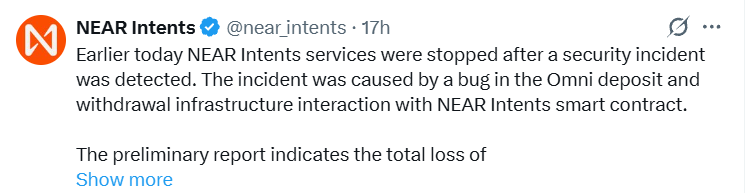
Source: X Post
NEAR Intents confirmed the breach shortly after, pinning it on a bug in how its Omni deposit and withdrawal infrastructure talks to its smart contracts. Co-founder Illia (root.near) later gave the clearest picture: the flaw was isolated to USDT on BSC, and SHIELD, the project's AI-driven outlier-detection layer, caught the strange activity and paused Intents before things got worse.
detection to fix, the whole thing took about an hour.
How Hard Did NEAR Protocol Price Actually Fall?
Numbers tell the story faster than words here. NEAR Protocol price is a classic case of sentiment moving quicker than facts, traders sold first and asked questions later.
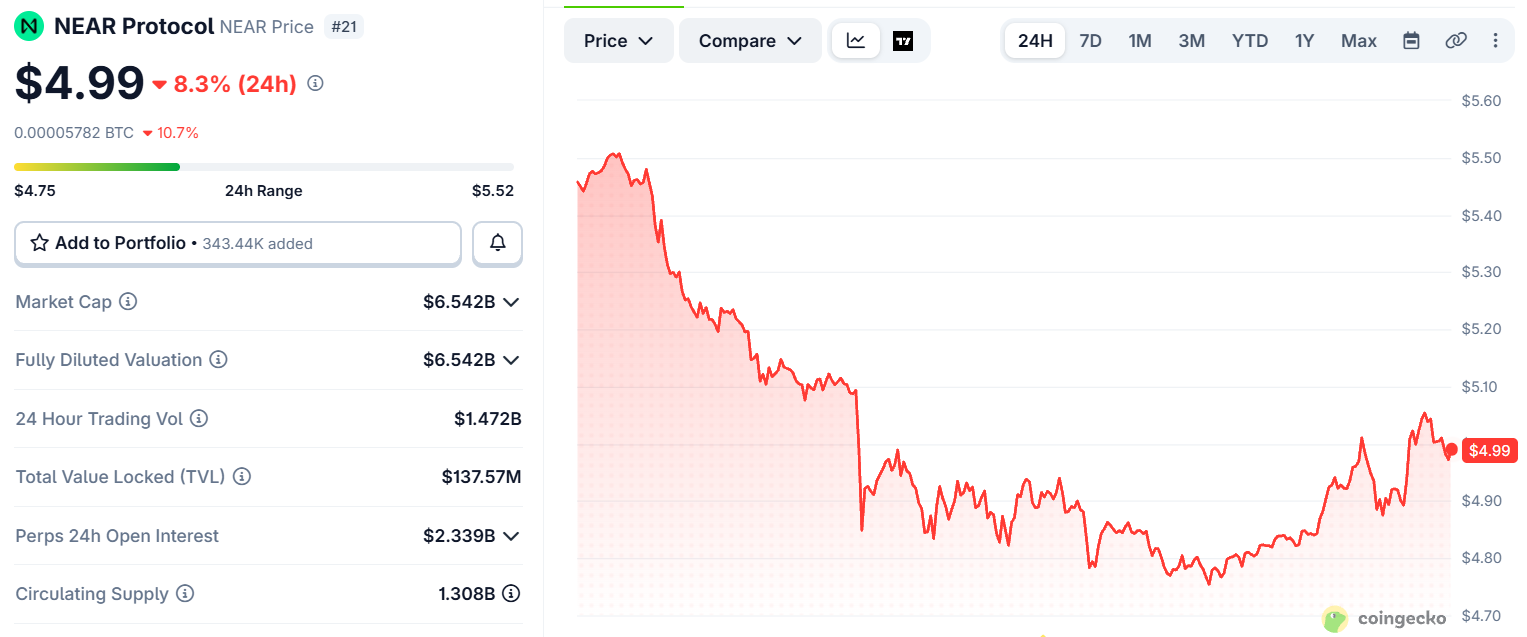
Source: Coingecko Data
Metric | Value |
Price (at writing) | $4.99 |
24-Hour Change | -8.3% |
Day's High | $5.51 |
Day's Low | $4.75 |
Market Cap | $6.542B |
24-Hour Trading Volume | $1.472B |
What About User Funds Stuck in NEAR Intents?
This is the part most people actually care about. NEAR Intents said every dollar lost will be reimbursed in full. Core services were expected back online within an hour of the announcement. But not every chain reopened at once. Deposits and withdrawals stayed frozen for roughly 12 hours on BSC, Polygon, TON, Optimism, Avalanche, Stellar, Monad, LayerX, Adi, Scroll, and Plasma while engineers finished patching the Omni infrastructure behind the scenes.
If your assets from those chains were sitting inside Intents, say in a HOT wallet or parked on near.com, the team said you'd be able to swap them into other assets once service resumed. Beyond the fix, Intents reported the incident to law enforcement and brought in blockchain analytics partners to trace the stolen funds and push for recovery.
Did NEAR Protocol Itself Get Hacked Too?
Short answer, no. Its official account was quick to draw a hard line: the blockchain never stopped, the native token was never touched, and blocks kept getting produced without a single gap.
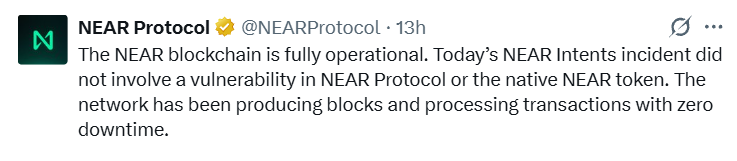
This was an Intents problem, not a protocol problem, and that distinction matters a lot when you're trying to figure out whether the price reflects a deeper issue or just a scare.
Why Did the Co-Founder Call This a Wake-Up Call?
Illia didn't downplay it. He pointed out that NEAR Intents now processes over $4 billion a month in trading and payments volume, which means a bug this size was always going to sting. He called it the first major exploit on Intents and connected it to a wider pattern, recent attacks on BitGet, Metamask wallet, and Lido, as proof that crypto is facing smarter, AI-equipped attackers than before.
His response wasn't just damage control. It is rolling out a formal verification system for its contracts, a method that mathematically checks code for entire classes of bugs before they ship, and plans to pair it with wider SHIELD monitoring. A full postmortem is coming in the following days.
What's Next?
The patch is live, most chains are back, and the compensation promise is public. What happens next comes down to execution. Will the postmortem hold up to scrutiny? Will the remaining chains reopen on schedule?
NEAR Protocol price will likely stay reactive to how those answers unfold, while the $8.08 million in ETF inflows on October 1, part of a $44.07 million cumulative net inflow and $55.57 million in total net assets according to SoSoValue, suggests a chunk of the market is choosing to wait this one out rather than run.
YMYL Disclaimer: This content is for informational purposes only and does not count as financial, investment, or trading advice. Cryptocurrency markets are highly volatile, and price can change sharply within hours. Always do your own research and consult a licensed financial advisor before making any investment decision.













