ApeMars Price Prediction: Can $APRZ Escape Low Liquidity Pressure?


ApeMars Price Prediction is back under the microscope, and the data raises an uncomfortable question: how does a token with less than $1 in 24-hour trading volume and one wallet controlling 85.47% of supply sustain any kind of recovery?
APRZ is currently trading around $0.0002894, holding above its immediate support zone and nudging toward resistance-1 on the 4-hour chart.
The official ecosystem remains active, with the claim portal live and the 23-stage presale structure still intact.
But technical setups and project activity can only carry so much weight when liquidity is this thin.
Can genuine buyer interest return, or does low liquidity remain the ceiling on every APRZ recovery attempt?
APRZ Market Snapshot: Price, Liquidity, and the Volume Problem
APRZ is trading at $0.0002894 on Orca (Solana), up 0.53% over the past 24 hours. Liquidity sits at $247K, with market cap and FDV both at $289K.
The trading activity behind that price, however, tells a more cautious story: just 2 transactions, 2 buyers, 0 sellers, and volume under $1 across the entire day.
Shorter timeframes (5M, 1H, 6H) all show 0% movement, meaning the 24-hour gain is isolated to a brief spike rather than sustained buying pressure building across sessions.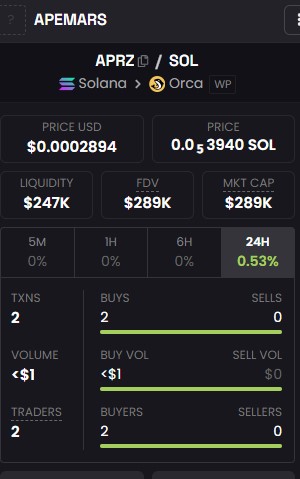
Source: Info by DexScreener
Metric | Current Data |
Price | $0.0002894 |
24H Change | +0.53% |
Liquidity | $247K |
Market Cap | $289K |
FDV | $289K |
24H Volume | <$1 |
Transactions | 2 (2 Buys, 0 Sells) |
Traders | 2 Buyers, 0 Sellers |
ApeMars Technical Analysis: Support, Resistance, and the EMA Picture
The 4-hour chart shows APRZ trading at $0.0002894, sitting just below resistance-1 near $0.0003000, with the EMA 20 currently at $0.0002830 acting as a short-term dynamic support reference.
Support-1 sits around $0.0002650, providing the first meaningful floor if the price pulls back, while support-2 near $0.0002436 marks the deeper safety net below that.
On the upside, Resistance-2 sits near $0.0003400, and Resistance-3 extends toward $0.0004000, both of which would require a significant volume increase to reach from current levels.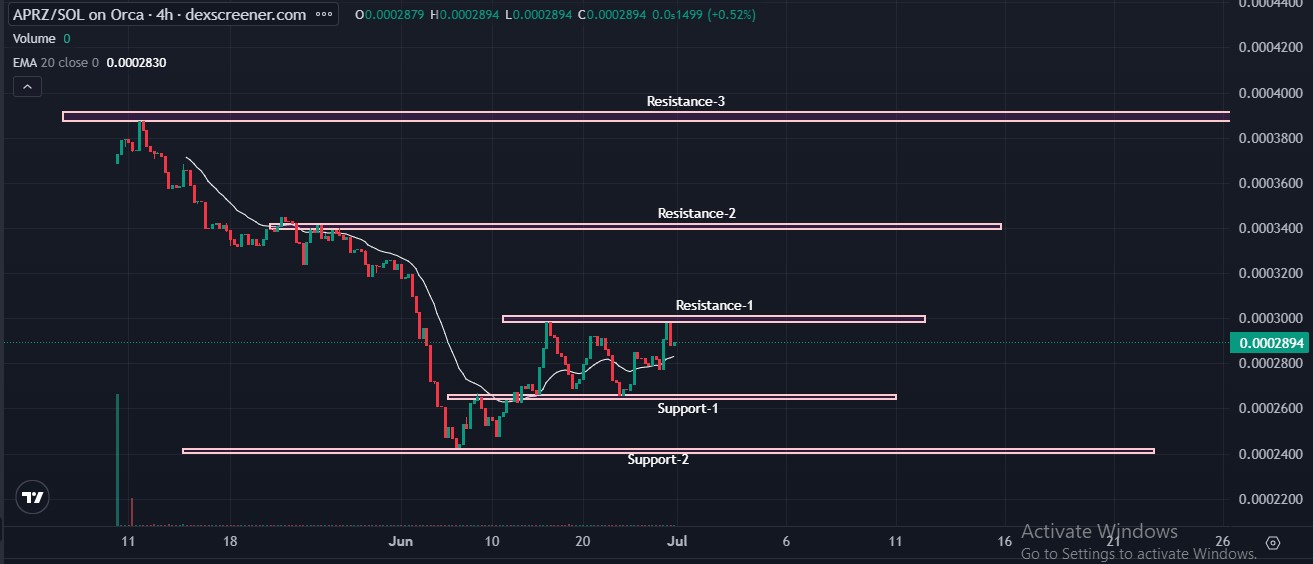
Source: Chart by DexScreener
Level | Price |
Resistance-3 | ~$0.0004 |
Resistance-2 | ~$0.0003400 |
Resistance-1 | ~$0.0003000 |
Current Price | $0.0002894 |
Support-1 | ~$0.0002650 |
Support-2 | ~$0.0002436 |
ApeMars Whale Concentration: Why 85.47% in One Wallet Matters
On-chain data from the official ApeMars ecosystem shows the token currently has just 46 holders, with the top wallet alone controlling 85.47% of total APRZ supply, valued at approximately $247.3K.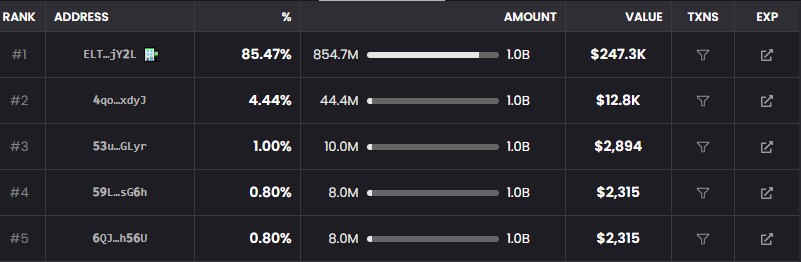
Source: Info by DexScreener
The second largest holder owns 4.44%, with remaining wallets each holding 1% or below.
This level of concentration creates a significant asymmetric risk for any APRZ recovery attempt. A single decision from that dominant wallet, whether to sell, transfer, or stake, can move price dramatically in either direction.
With daily trading volume sitting under $1 and only two active buyers recorded in the past 24 hours, even a modest sell from the top wallet could overwhelm available liquidity entirely, making whale behavior the single most important variable in the current ApeMars price prediction outlook.
What Is ApeMars Building? Ecosystem and Claim Portal Status
The official ApeMars website confirms the project remains active, with the Claim Live status displayed and a listing price of $0.0005 on the dashboard.
Source: ApeMars official website
The project frames itself as "The Official Crypto Mission to Mars," a narrative-driven meme coin spanning 23 presale stages and 225 million symbolic kilometers, powered by the Ape Space Administration.
The Buy Now, Claim, and Chart options remain accessible, with Referral, FAQs, and Whitepaper sections supporting the presale-to-listing framework.
APRZ currently trades well below the $0.0005 listing price, sitting roughly 42% below that level at current market rates.
Can APRZ Close the Gap to Its $0.0005 Listing Price?
APRZ is currently trading at $0.0002894, roughly 42% below the official $0.0005 listing price set by the ApeMars team.
Closing that gap would require APRZ to clear Resistance-1 near $0.0003000 and then push through Resistance-2 near $0.0003400 before even approaching the listing price level.
Each of those steps would need a meaningful increase in buyer participation and trading volume, neither of which is visible in current market data.
The listing price serves as a psychological target for existing holders, but reaching it through open market activity rather than thin-liquidity moves would require a fundamentally different level of trading interest than what the token has seen since launch.
Expert View: What ApeMars Price Prediction Analysts Are Watching
Analysts tracking ApeMars note that the technical setup is secondary to the liquidity and concentration problem.
A token where one wallet holds 85.47% of supply and daily volume sits under $1 cannot be analyzed the same way as a token with distributed holders and active market participation.
The EMA and resistance levels are useful as reference points, but a genuine ApeMars price prediction recovery requires two things to change simultaneously: volume must return in a meaningful and sustained way, and the dominant wallet must remain inactive.
Until both conditions are met, every resistance test should be treated as fragile, and any price move should be read in the context of how little activity is actually driving it.
Disclaimer
This article is for informational purposes only and does not constitute financial advice. Cryptocurrency investments carry significant risk, including total loss of capital. Always conduct your own research before making any financial decision.
2 months ago
In a digital economy where every blockchain transaction leaves a trail, recovery begins with intelligence-not guesswork. Zeus Crypto Recovery Services is a specialized digital asset investigation and recovery consultancy focused on helping individuals and organizations navigate the complexities of cryptocurrency loss. Our approach combines blockchain intelligence, digital forensic methodologies, transaction analysis, and strategic case management to assess recovery opportunities involving Bitcoin (BTC), USDT (Tether), Ethereum (ETH), and other digital assets. Every case is treated as unique, with a structured investigation designed to identify transaction pathways, evaluate available evidence, and determine practical next steps based on the circumstances. At Zeus Crypto Recovery Services, we understand that recovering digital assets requires precision, discretion, and a methodical process. Our team works closely with clients to organize technical evidence, analyze blockchain activity, and provide clear, professional guidance throughout each stage of the engagement. We prioritize transparency by setting realistic expectations and communicating openly about the investigative process and possible outcomes. Whether your cryptocurrency has been affected by unauthorized wallet access, fraudulent investment schemes, phishing attacks, exchange-related disputes, or mistaken transfers, Zeus Crypto Recovery Services provides experienced support rooted in technical expertise and ethical standards. Our objective is to equip clients with the knowledge, documentation, and investigative insight needed to pursue every viable recovery avenue. Our commitment extends beyond investigations. We help clients strengthen their digital security posture through practical recommendations designed to reduce future risks and protect valuable crypto holdings. Why People's Choose Zeus Crypto Recovery Services * Specialized blockchain investigation expertise * Comprehensive digital asset tracing and analysis * Confidential handling of every client engagement * Transparent communication and realistic case assessments * Professional support tailored to individual recovery needs * Commitment to integrity, accountability, and client trust Zeus Crypto Recovery Services is dedicated to helping clients move from uncertainty to informed action through professional blockchain investigations, responsible recovery strategies, and unwavering commitment to excellence in the evolving world of digital asset Reach out now to recover your digital assets. WhatsApp /Call : +447353848036 Website https://zeusrecoveryservices.com












.webp)