Bitcoin Crash: Price Drops to 4-Month Low – What's Next for BTC?


Bitcoin Price Forecast: Market Crash, Liquidations, and What’s Next?
Bitcoin’s Sharp Decline: What’s Driving the Crash?
Crypto Market Cap Drops To $2.85 Trillion As Crypto Markets Lose Over $500 Billion In The Last Week Bitcoin, the original cryptocurrency, has plummeted to a 4-month low of $82,200, down nearly 14% in a week. The abrupt price decline is causing record liquidations, with $770 billion erased in the past day.
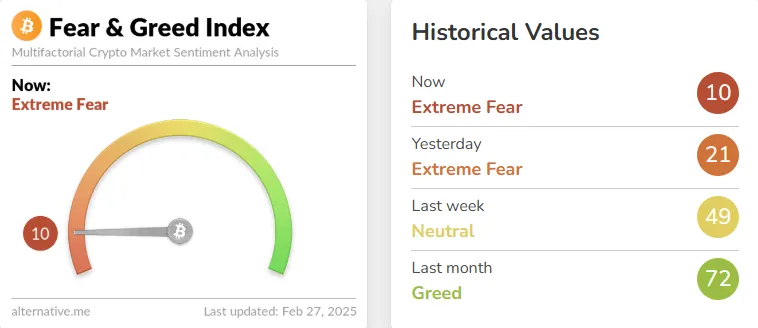
The Bitcoin Fear and Greed Index has dropped to 10, a reading not seen since June 2022, when it indicated extreme fear. Historically, such sentiment has represented great buying opportunities for long-term investors.
Key Factors Behind Bitcoin’s Price Drop – Explained
Several elements have contributed to Bitcoin’s recent sell-off:
1. Spot Bitcoin ETF Outflows Continue
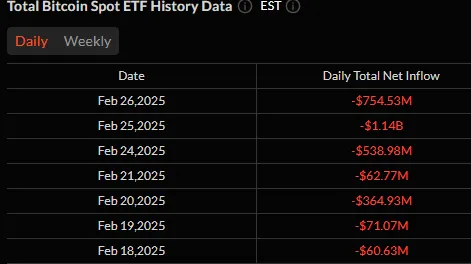
U.S. Spot Bitcoin ETFs have witnessed significant outflows for the seventh consecutive day, totaling nearly $2.99 billion in the past week. BlackRock’s IBIT experienced its largest single-day withdrawal since launch, adding to selling pressure. Recent data from SoSoValue indicates that 12 spot Bitcoin ETFs saw $754.53 million in net outflows on Feb. 26, compounding the bearish sentiment.
2. Bearish Technical Signals
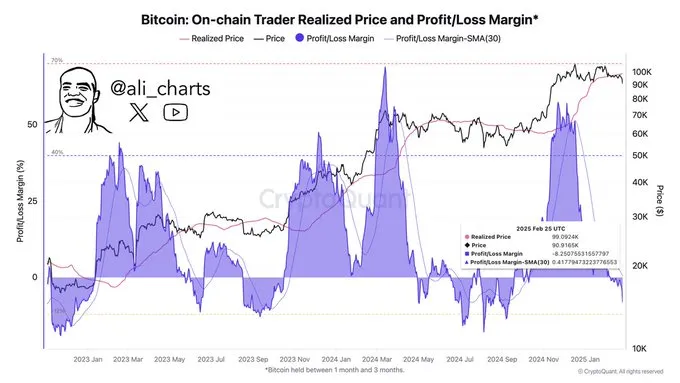
Bitcoin has broken out of its long-term channel, flashing bearish divergence against the Relative Strength Index (RSI) on the weekly chart. The last time BTC exhibited this pattern, a prolonged bear market followed. Additionally, traders’ realized loss margin is at -8.25%, nearing the historical buy zone of -12%.
3. Trade War Fears Impacting Risk Assets
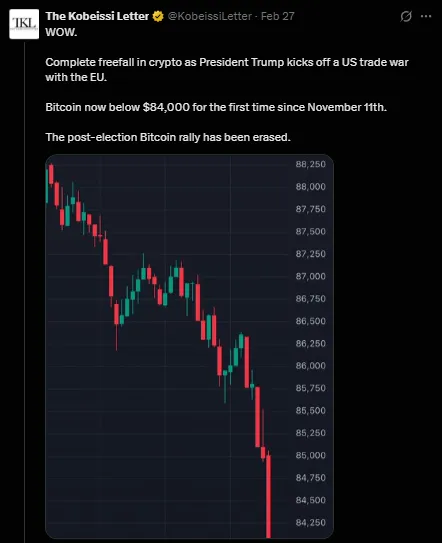
Important factors are geopolitical and macroeconomic. After former President Donald Trump's declaration of a 25% tariff on the European Union, the S&P 500 dipped $500 billion in market value. Bitcoin is considered a volatile asset and did not differ from this trend as it surpassed its slide below $84,000 for the first time since November 2023.
4. $5 Billion in Options Expiry on Feb. 28
A huge $5 billion worth of Bitcoin options are set to expire on Feb. 28, with $3.9 billion possibly set to expire worthless due to higher strike prices. That's likely to bring some extra market volatility as traders adjust their positions. At the same time, $1.3 billion in BTC has been transferred to exchanges, which could mean selling pressure.
Bitcoin Price Prediction: Can BTC Recover?
In the aftermath of the decline, Bitcoin is now probing its 200-day moving average (DMA) While the RSI is dropping into oversold territory a configuration that in the past has preceded significant bounces back up.
Bullish Case:
-
If BTC can hold the support in the $82,000-$84,000 area, then short-term recovery toward $90,000-$92,000 could be seen. Recent history suggests that extreme levels of fear represent market bottoms and may result in renewed buying interest.
Bearish Case:
-
In case the selling pressure persists and Bitcoin breaks down below its 200-DMA support, then the next crucial level to watch would be in between $78,500-$80,000. Another dip under this zone might bring more accelerating downside momentum.
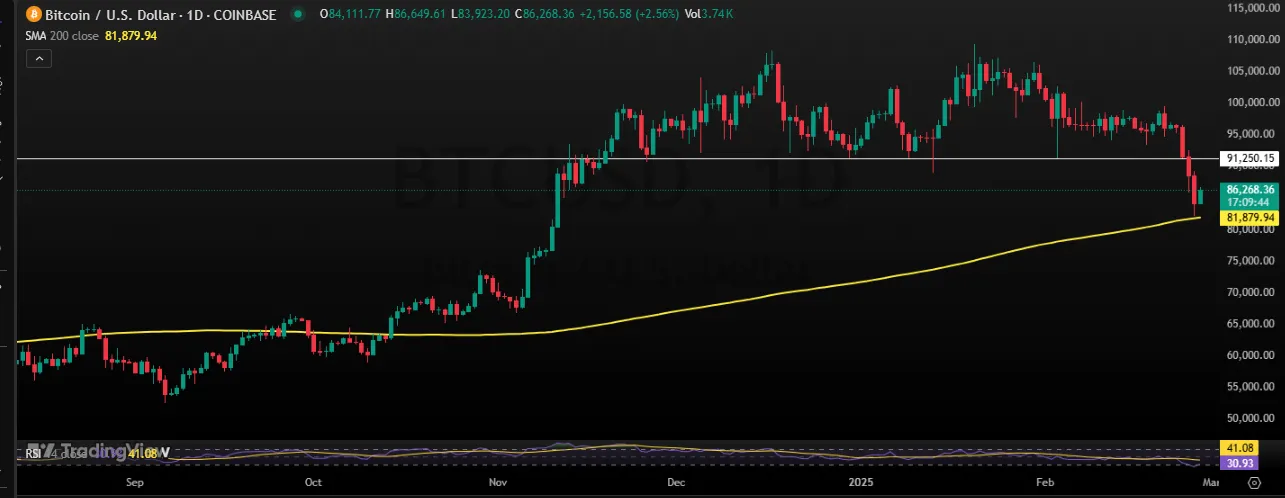
Source: TradingView
Final Thoughts
The recent plunge in Bitcoin prices reflects a confluence of macroeconomic fears, ETF redemptions, and technical fragility. There will be short-term volatility; however, long-term holders may well view this as an excellent potential buying opportunity. With important events such as the options expiry on Feb. 28th, traders should prepare for more market movement.











.jpg)