Bitcoin Price Historical Market Cycles Reveal a Repeating Pattern


Bitcoin's Market Cycles Reveal a Repeating Pattern
Bitcoin Price historical market cycle continues to reveal a repeating pattern that has captured the attention of investors for years. Periods of accumulation, rapid price expansion, and market corrections have consistently appeared across multiple cycles. While past performance does not guarantee future results, these recurring trends offer valuable insights into Bitcoin’s long-term market behavior
BTC is trading near $63,400 on June 4, 2026—down 48% from its October 2025 ATH of $126,198. Every prior Bitcoin halving cycle followed a pattern: 12–18 months to ATH, then 77–84% drawdown. The 2024 ATH hit in October 2025 — shallowest drawdown on record at just ~47% so far. Breaking news: Strategy (MicroStrategy) sold Bitcoin for the first time since 2022 on June 1, 2026. The pattern suggests either a late-2026 recovery or a prolonged bottom—key $65K support must hold. |
Bitcoin Price — June 4, 2026
METRIC | VALUE |
Current Price | ~$63,400(June 4, 2026) |
24h Trading Volume | $29.52B |
Market Cap | $1.34 Trillion |
Circulating Supply | 20,037,981 (95% of max) |
ATH (All-Time High) | $126,198 — October 6, 2025 |
Drop from ATH | ~47% drawdown (shallowest ever) |
Last Halving | April 20, 2024 (3.125 BTC/block) |
Dominance | ~58% |
RSI (Daily) | ~35 — approaching oversold |
Weekly RSI | Near historical bottom zones |
Key Support | $65,000 |
Key Resistance | $68,000 / $75,850 |
The Pattern That Has Defined Bitcoin for 15 Years
Bitcoin doesn't just move randomly. It breathes in cycles—and every cycle starts with a halving.
Since 2012, Bitcoin has completed four halving events. Each one cut the block reward in half, throttling new supply. Each one triggered a sequence: accumulation, breakout, euphoria, crash, reset. The timing varies. The magnitude varies. But the structure? It keeps repeating.
On June 4, 2026, BTC trades at roughly $63,400 — down 48% from the October 2025 ATH of $126,198. The question the entire market is asking: is this a mid-cycle dip or the start of a bear market? History gives us a framework to answer that.
The Four Cycles: What Actually Happened
Cycle 1 (2012 Halving) — The Genesis Proof
Block reward dropped from 50 to 25 BTC in November 2012. went from $12 to $1,163 by December 2013 — a 9,592% gain. The crash that followed wiped 85% of the peak price. Recovery took until late 2016. Total cycle: roughly 4 years.
Cycle 2 (2016 Halving) — The ICO Frenzy Peak
Reward cut to 12.5 BTC in July 2016. BTC peaked at $19,511 in December 2017 — about 17 months post-halving. The crash was 84%. Recovery took until 2020. The 4-year clock ticked precisely.
Cycle 3 (2020 Halving) — Institutional Entry
Reward cut to 6.25 BTC in May 2020. The ATH hit $69,000 in November 2021—roughly 18 months post-halving. Drawdown: 77%. Recovery: 2023–2024. First time institutional money played a major role, which softened the crash slightly.
Cycle 4 (2024 Halving) — ETF Era Arrival
Reward cut to 3.125 BTC in April 2024. ATH: $126,198 on October 6, 2025 — 18 months post-halving, matching historical cadence. Current drawdown as of June 2026: 47%. This is the smallest post-ATH correction ever recorded.
Why the smaller crash? Spot Bitcoin ETFs launched in January 2024 and changed the demand equation permanently. ETF daily demand runs at roughly 12 times daily mining supply. Institutional buyers now account for roughly 83% of Coinbase's trading volume, up from 50% in 2020. These buyers don't panic-sell like retail.
Cycle Comparison Table
Halving Year | Reward Cut | ATH | Months to ATH | Peak Drawdown | Recovery Time |
2012 | 50 25 BTC | $1,163 | ~13 months | -85% | ~3 years |
2016 | 25 12.5 BTC | $19,511 | ~17 months | -84% | ~3 years |
2020 | 12.5 6.25 BTC | $69,000 | ~18 months | -77% | ~2 years |
2024 | 6.25 3.125 BTC | $126,198 | ~18 months | -47% (so far) | TBD |
Breaking: Strategy Sells for First Time Since 2022
MARKET-MOVING NEWS — June 1, 2026 Strategy (formerly MicroStrategy), the world's largest corporate Bitcoin holder with 843,706 BTC, sold 32 Bitcoin between May 26–31, 2026 — its first sale since December 2022. Average sell price: $77,135. Total proceeds: $2.5 million, directed toward paying dividends on STRC preferred stock. Bitcoin fell 2% on the news. MSTR stock dropped 5.85%. Michael Saylor's response: "We will buy 10 to 20 Bitcoin for every one we sell." He reaffirmed that Strategy remains a net accumulator. The sale represents just 0.0038% of total holdings. Context: Strategy holds $843,700+ BTC purchased at an average cost of $75,699/coin. The company also raised $128.3M via at-the-market stock sales in the same week. A June 8 vote by STRC holders on dividend terms is the next catalyst to watch. |
Where the 2026 Cycle Stands Right Now
ATH: $126,198 (Oct 6, 2025). Current price: -$66,654. Drawdown: ~47%. Historical average drawdown post-ATH: 80%. This correction is the shallowest ever at this stage of the cycle.
Two scenarios are being debated across institutional research desks:
1. Cycle is evolving, not dead: ETF structural demand floors prices higher. The 47% correction replaces the 77–84% of the prior cycles. A recovery toward $100,000 by Q4 2026 fits this thesis. supply issuance is now below 0.8% annually — less than gold.
2. Bear market still active: If the October 2025 ATH truly marked the cycle peak, historical models point to a potential bottom around mid-October 2026 (~220 more days from late February 2026). That would imply further downside before recovery.
Technical Analysis
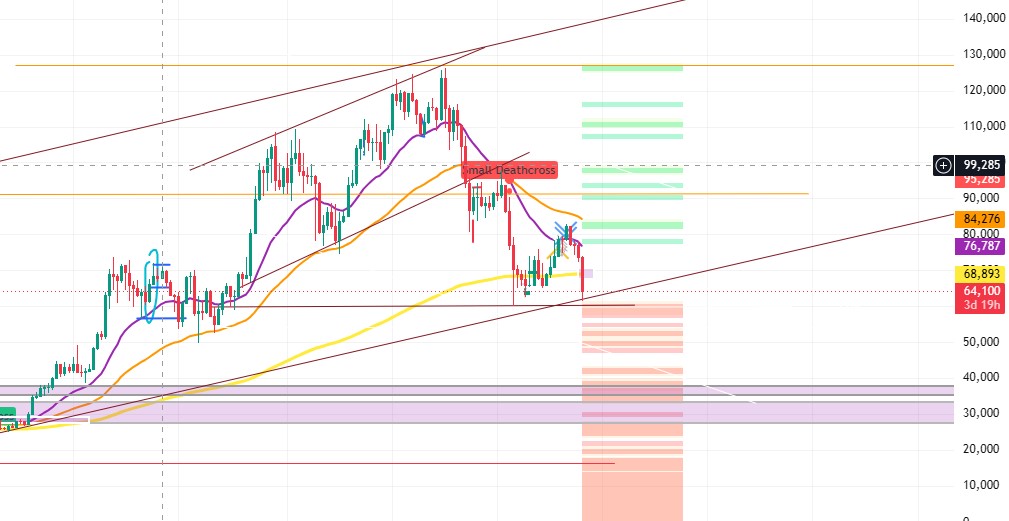
Short-Term:
testing a major trendline support. A break below this level could trigger further downside pressure, while holding above it may lead to a relief bounce toward higher resistance zones.
Long-Term:
The overall market structure remains bullish as long as Bitcoin stays above the macro support region. Historical cycles suggest that corrections within an uptrend often create opportunities before the next major expansion phase.
Support:
$64,000.
$60,000,
$55,000,
Resistance:
$76,787
$84,276
$95,286
The weekly RSI is approaching levels that historically marked important bottoms. The RSI suggests this correction is closer to its end than its beginning. A key trigger is the U.S. jobs report on June 6, 2026 — macro data is driving short-term direction.
Price Prediction Table: 2026–2030
Year | Bear Case | Base Case | Bull Case | Extreme Bull |
2026 (H2) | $45,000 | $72,000–$85,000 | $100,000–$115,000 | $130,000+ |
2027 | $38,000 | $60,000–$75,000 | $90,000–$110,000 | $140,000+ |
2028 | $50,000 | $80,000–$100,000 | $120,000–$150,000 | $180,000+ |
2029 | $55,000 | $85,000–$105,000 | $130,000–$160,000 | $200,000+ |
2030 | $40,000 | $90,000–$120,000 | $150,000–$200,000 | $250,000+ |
Predictions are based on historical cycle analysis and current market conditions. Not financial advice.
The ETF Factor: Why This Cycle Feels Different
Spot ETFs launched in January 2024. Within months, they absorbed years of mining output. Peak single-day ETF inflow: $3.24 billion (October 2025). Daily ETF demand runs at roughly 12 times the daily mining supply — a persistent bid that no prior cycle had.
This structural shift is why the 2024-cycle correction is running 47% instead of 77-84%. It also means the $65,000 support level carries more significance than any comparable level in past cycles — it's where long-term institutional cost basis converges.
Strive's counter-signal: While Strategy sold 32 BTC, Strive raised approximately $4.2 billion to buy more Bitcoin. The split among major holders — some selling, others doubling down — reflects genuine uncertainty about near-term direction. But the long-term institutional conviction remains intact.
Risk Assessment
RISK FACTOR | SEVERITY | IMPACT ON CYCLE |
Strategy / ETF outflows | HIGH | Immediate price pressure |
Break below $65,000 | HIGH | Opens $55K–$58K targets |
Macro/rate uncertainty | MEDIUM | June 6 jobs data key |
Bitcoin dominance >60% | MEDIUM | Capital is not rotating yet |
Regulatory headwinds | LOW-MEDIUM | U.S. clarity improving |
Mining profitability stress | LOW | Sub-0.8% annual issuance |
YMYL DISCLAIMER :
This article is for informational and educational purposes only. It does not constitute financial, investment, or trading advice. Cryptocurrency markets are highly volatile and carry a significant risk of capital loss. Always conduct your own research (DYOR) and consult a qualified financial advisor before making investment decisions. Past performance of Bitcoin cycles does not guarantee future results.
Also read: