Bitcoin vs Ethereum: ETH/BTC Ratio Hits 10-Month Low in 2026


Bitcoin vs Ethereum: The ETH/BTC Ratio Nobody Is Pricing In
The Bitcoin vs Ethereum gap keeps widening in 2026. And the number that explains it is one that most investors are not watching closely enough.
As per CryptoPatel , the ETH/BTC ratio sits at 0.02737 as of June 17, 2026. That means 1 Bitcoin buys roughly 37 ETH today. In June 2017, 1 BTC bought 7 ETH. In December 2021, it was 11. The direction has been one way for a long time.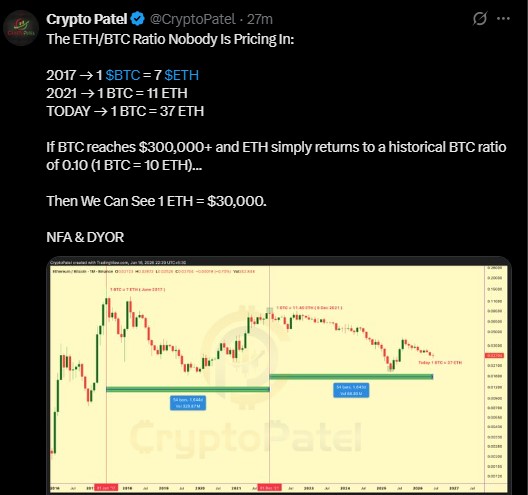
Why Is Ethereum Falling Faster Than Bitcoin in 2026?
Ethereum is down 40% year-to-date. Bitcoin has dropped around 25%. That gap is not random.
The ratio has fallen more than 35% from its August 2025 high of 0.043. ETH trades near $1,800, well below its all-time high of $4,952. Bitcoin dominance stands at 56.4%.
Five structural reasons explain the Bitcoin vs Ethereum divide:
1. Bitcoin ETFs have a much stronger bid. Spot Bitcoin ETFs launched in January 2024 and brought in billions from institutions.
U.S.-listed Ethereum ETFs have seen cumulative inflows of around $9.89 billion total, but they also logged a record consecutive days of net outflows through May 2026, draining around $540 million.
That streak ended June 8, 2026, with $82.37 million in single-day inflows, but one day of green does not confirm a trend reversal.
2. No corporate treasury floor under ETH. Companies like MicroStrategy hold Bitcoin on their balance sheets. That creates a consistent buyer at lower prices. Ethereum has no equivalent buyer of that scale soaking up supply.
3. Layer 2 networks are cannibalizing Ethereum's revenue. Networks like Base, Arbitrum, and Optimism process transactions cheaply. That reduces the fees burned on the main Ethereum chain.
The "ultrasound money" narrative, where ETH supply shrinks over time, has weakened because of this.
Ethereum's L1 processed a record 2.2 million daily transactions in early 2026, but most of that fee revenue does not flow back to ETH holders.
4. ETH moves more like a tech stock. Ethereum has a 0.78 correlation to the Nasdaq 100. Bitcoin's correlation is around 0.55. When macro sentiment turns risk-off, ETH gets sold harder.
The US-Iran macro shock in May-June 2026 is a recent example of this playing out in real time.
5. Glamsterdam is still not live. Ethereum's most ambitious upgrade since the Merge, targeting 10,000 TPS and a gas limit increase from 60 million to 200 million, was originally planned for June.
As of June 16, 2026, developers have just entered the final devnet phase and moved toward public testnets. Mainnet activation now targets late Q3 2026, with August as the most cited window. No firm date has been confirmed.
What Is the ETH/BTC Ratio and Why Does It Matter?
The ratio peaked at 0.086 in December 2021 during the DeFi and NFT boom. It then entered a long downtrend, bottoming near 0.018 in April 2025 during tariff-driven market stress.
It bounced 135% before sliding again. Now it sits at 0.02737, below the 200-week moving average of 0.048. The monthly chart shows two historical support zones. The current price is testing one of them right now.
What Happens to Ethereum If Bitcoin Reaches $300,000?
This is the scenario circulating in crypto circles right now.
If Bitcoin hits $300,000 and the ETH/BTC ratio simply returns to 0.10, a level near previous cycle peaks, then 1 ETH would be priced around $30,000. The math is straightforward. The question is whether the ratio can recover that far.
For that to happen, Ethereum needs to outperform Bitcoin meaningfully from current levels. That has not happened in 2026.
Will Ethereum Ever Recover Against Bitcoin?
Several catalysts are live right now. Some are already moving.
Glamsterdam upgrade. As of June 16, 2026, Ethereum developers entered the final devnet phase with all planned EIPs. Mainnet targets end-August 2026, with 10,000 TPS and 78% lower gas fees.
This is the single most important technical catalyst for the Bitcoin vs Ethereum ratio gap. But Ethereum has missed windows before. The market will not price it in early.
Today's FOMC decision. The Fed concludes its two-day meeting on June 17 under new Chair Kevin Warsh. Markets price a 99.60% probability of a hold at 3.50 to 3.75%. What matters is Warsh's press conference tone.
A dovish lean favors BTC near $68,000. A hawkish surprise drags it back toward $63,000. ETH would feel either move more sharply than Bitcoin, given its higher market beta.
US-Iran ceasefire framework. A preliminary deal was confirmed around June 14 to 15, reopening the Strait of Hormuz. Brent crude fell to $75. Cheaper oil reduces inflation pressure, which opens the door for eventual rate cuts.
Higher-beta assets like ETH historically benefit more than Bitcoin when macro conditions loosen. A formal signing is scheduled for June 19 in Switzerland. Durability remains the key risk.
ETH exchange reserves are at a 10-year low. As of June 16, 2026, Ethereum exchange reserves fell to 14.5 million ETH, a decade low per CryptoQuant.
Less ETH on exchanges means less immediate sell pressure. When real buying returns, there is less supply to absorb it.
For a confirmed reversal, the ETH/BTC ratio needs a weekly close above 0.030, and ETH/USD needs to reclaim $2,510 on a monthly basis. Neither has happened yet.
Is Ethereum a Better Investment Than Bitcoin in 2026?
Bitcoin has the cleaner story in 2026. Digital gold. Institutional flows. Corporate treasuries. Simple.
Ethereum is infrastructure. DeFi, stablecoins, real-world assets. But infrastructure takes longer to be priced in.
The Bitcoin vs Ethereum gap on the ETH/BTC chart says the market is paying a premium for Bitcoin's simplicity and discounting Ethereum's complexity.
Whether that changes depends entirely on what Ethereum delivers in the second half of 2026.
Disclaimer: This article is for informational purposes only and does not constitute financial or investment advice. Cryptocurrency markets are highly volatile. Past performance does not guarantee future results. Always do your own research and consult a licensed financial advisor before making investment decisions.








.jpg)




