Cardano Price Prediction: Can ADA Reach $1 by the End of 2026

Cardano Price Prediction: Is $1 Realistic in 2026
$1 by December 2026 is the base-to-bull case scenario, requiring successful Leios testnet results, GADA ETF approval, and CLARITY Act commodity classification — all of which have a realistic probability of occurring within the next 5 months. From $0.16, reaching $1 represents a 6.25x return — significant, but well within historical altcoin rotation ranges in the same calendar year.
Trump's strategic reserve mention affects ADA
In March 2026, the Trump administration named ADA alongside BTC, ETH, SOL, and XRP in a proposed US Strategic Crypto Reserve. While this is a policy proposal rather than an enacted law, being on this list creates a powerful legitimacy signal for institutional investors — it positions one of five assets the US government considers strategically significant. This narrative supports price floors and institutional consideration even before any formal purchase.
Cardano is worth buying in June 2026
At $0.16 with the catalyst stack described in this article, Cardano offers an asymmetric risk-reward ratio that is difficult to find in the large-cap crypto space. The downside to the structural floor ($0.1274) is approximately -20% from the current price. The upside to the base-case 2026 target ($0.50–$1.00) is 3–6x. Bull case ($1.50–$2.00 by year-end) represents 9–12x. This type of asymmetry—capped downside, significant upside—is what 'dark horse' investing is about. As always, position sizing relative to risk tolerance is everything.
Technical Analysis 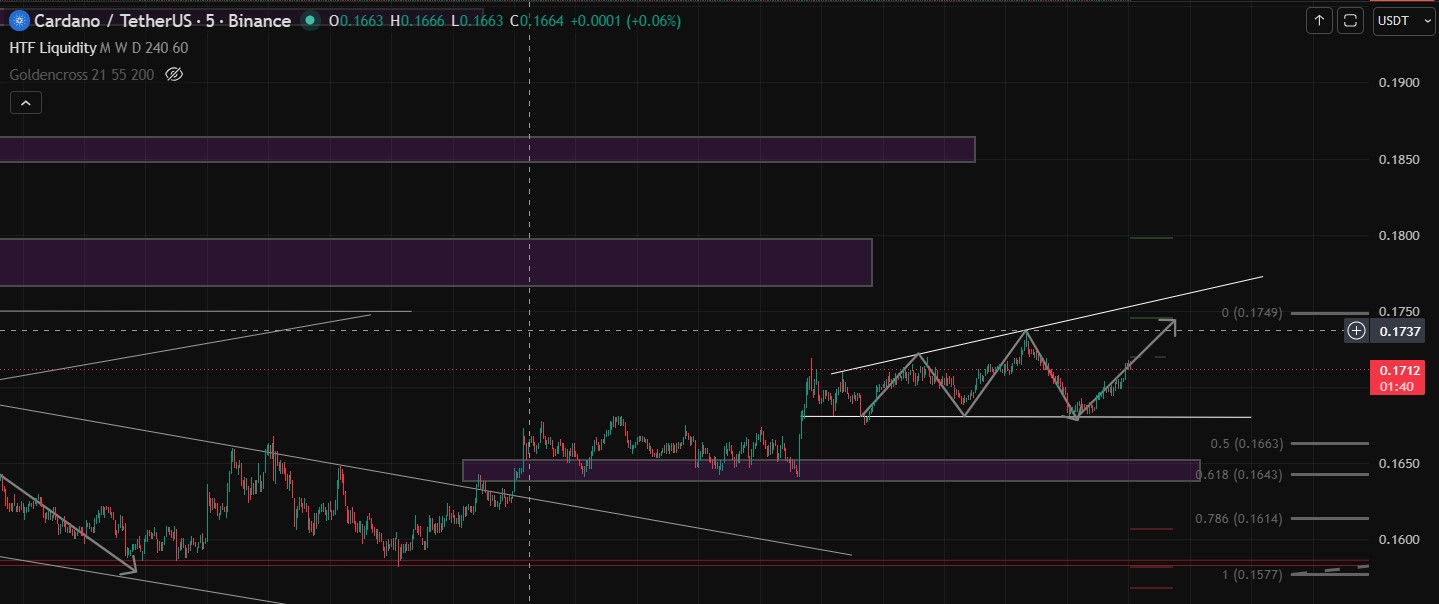
Support
$0.1663
$0.1643
$0.1614
$0.1577
Resistance
$0.1749
$0.1800
$0.1850
$0.1900
Short Term: ADA/USDT remains bullish in the short term and could move toward $0.1749-$0.1800 if the ascending pattern holds above key support.
Long Term: Long-term structure suggests a recovery trend, with a potential move toward $0.1850-$0.1900 if buyers maintain control above the demand zone.
The Bear Case — Why Cardano Could Stay Down
Intellectual honesty requires acknowledging the genuine risks. The dark horse thesis fails if these conditions persist:
• DeFi TVL Trap: Cardano's DeFi TVL remains a fraction of Ethereum's and even Solana's. If Leios arrives but developers still prefer other chains, the technical upgrade means nothing commercially.
• Legacy Chain Risk: If Cardano fails to capture a meaningful share of the RWA (Real World Asset) market or decentralized identity sector by end-2026, it risks permanent 'legacy chain' status — technically superior but commercially marginalized.
• SEC Overhang: The 2023 SEC Binance complaint naming ADA as a potential unregistered security has no final ruling as of June 2026. An adverse outcome could trigger a 30-40% drop.
• Slow DeFi Growth: Cardano's DeFi TVL growth relative to Solana and Ethereum L2s remains the 'Bear Case' anchor — per BYDFi analysis, this is the primary downside scenario.
• Capitulation Risk: If ADA breaks below $0.1274 (61.8% Fibonacci floor), the next structural support is very thin — potentially $0.08–$0.10. Staked holder unbonding could accelerate such a move.
• Macro Deterioration: A global risk-off environment driven by recession fears or dollar strengthening would suppress all altcoins regardless of fundamentals.
Historical Comparison — Who Did This Before?
Every cycle has produced a dark horse. Understanding the pattern helps contextualize the ADA thesis:
Asset | Cycle | Despair Low | Cycle Peak | Return |
Ethereum (ETH) | 2018–2021 | $80 (Dec 2018) | $4,878 (Nov 2021) | +6,000% |
Solana (SOL) | 2022–2024 | $8 (Dec 2022) | $293 (Nov 2024) | +3,562% |
Cardano (ADA) | 2018–2021 | $0.02 (Dec 2018) | $3.10 (Sept 2021) | +15,400% |
Cardano (ADA) | 2026–? (Current) | ~$0.13–$0.16 | TBD — see scenarios above | TBD |
Cardano itself was a dark horse in 2018–2021. From $0.02 to $3.10 is a 15,400% return. The network was far less developed then than it is today — no smart contracts, no DeFi, no governance. The ADA of June 2026 has all of those things live, plus Leios and Van Rossem pending. The question is whether the market is willing to recognize it before the narrative fully breaks through.
The Altcoin Rotation Thesis — When, Why, and Why ADA?
In every crypto cycle, capital follows a predictable flow: Bitcoin leads → Ethereum second → Large-cap altcoins third → Mid/small-cap altcoins last. This 'altcoin rotation' has been flagged by multiple analysts as expected in late Q2 to Q3 2026. The question is which altcoins capture the most capital when rotation begins.
Why ADA is a Natural Rotation Target:
• Name recognition: Cardano remains one of the most searched crypto projects globally despite its price decline — brand awareness is already built
• Narrative contrast: ' Cardano was left for dead, and now it's shipping Leios' is exactly the kind of story retail investors respond to in a rotation
• Low entry price: At $0.16, retail investors can buy thousands of ADA — the psychological appeal of accumulating a large number of tokens matters in retail flows
• Staking yield: 4%+ ADA staking APY with no lock-up provides a return floor that pure speculative assets cannot offer
• Trump strategic reserve narrative: Being named alongside BTC, ETH, SOL, XRP in a US strategic reserve proposal provides a legitimacy signal to new investors
• ETF pipeline: GADA ETF approaching decision date provides institutional FOMO catalyst similar to BTC ETF effect on BTC price in late 2023
YMYL Disclaimer
IMPORTANT: This article is for informational and educational purposes only and does not constitute financial, investment, legal, or tax advice. Cryptocurrency investments — particularly altcoins — carry substantial risk of total loss. ADA's current price of ~$0.16 reflects a 93%+ decline from its all-time high and carries significant further downside risk.