Citrea Airdrop Price Prediction: CTR Hits 5 Exchanges on May 26


The Citrea airdrop price prediction just got a lot more interesting.
Today, May 26, 2026, CTR went live for trading on Binance Alpha, KuCoin (World Premiere), MEXC, Gate.io, and Gate DEX all starting from 13:00 UTC.
That kind of multi-exchange rollout on a single day is not something you see every week. And Kraken has already added CTR to its roadmap, so the exchange story is not finished.
Citrea is not a random new token. It is Bitcoin's first ZK rollup, a Layer 2 solution that makes Bitcoin programmable without touching its consensus rules. The mainnet went live in January 2026.
The CTR token followed in May. And now, with the genesis airdrop distribution happening alongside today's listings, thousands of early users are watching the Citrea airdrop price prediction very closely.
This is a real project with real infrastructure. The question is where CTR goes from here.
What Is Citrea? Why the Mainnet Launch Matters
Most Bitcoin Layer 2 projects make big promises. Citrea actually delivered.
The mainnet went live in early 2026, making Citrea the first fully programmable platform secured directly by Bitcoin.
It uses zero-knowledge proofs to process transactions off-chain, then settles them on Bitcoin through a system called BitVM2. No changes to Bitcoin's core. No compromises on security.
Three things sit at the center of Citrea's infrastructure:
Citrea and Bitcoin Apps (Bapps): The ZK rollup enables what the team calls "Bapps," Bitcoin-native applications that inherit Bitcoin's security.
Think of it like Ethereum DApps, but built directly on Bitcoin's security layer. DEXs, money markets, and yield protocols—they are all live on Citrea's mainnet today.
cBTC via the Clementine Bridge: This is where the trust-minimized part comes in. Users bridge BTC to Citrea through Clementine, which is built on BitVM2.
he bridged BTC to become cBTC on Citrea, still backed 1:1, just usable in DeFi applications. This is not a wrapped token in the traditional sense. It is the most secure BTC bridge built to date.
ctUSD Stablecoin: Citrea also has a native stablecoin. ctUSD is backed 1:1 by short-term U.S. Treasury bills and cash equivalents. MoonPay handles the issuance.
It is designed to align with the GENIUS Act, the incoming stablecoin regulation framework in the U.S. The $50M+ institutional liquidity commitment from Galaxy Digital and others was specifically to deepen cBTC and ctUSD liquidity pools.
This context matters for the Citrea airdrop price prediction because the token is not purely speculative. It sits inside a working ecosystem.
Exchange Listings: What Happened Today
Five platforms. One day. 13:00 UTC start time.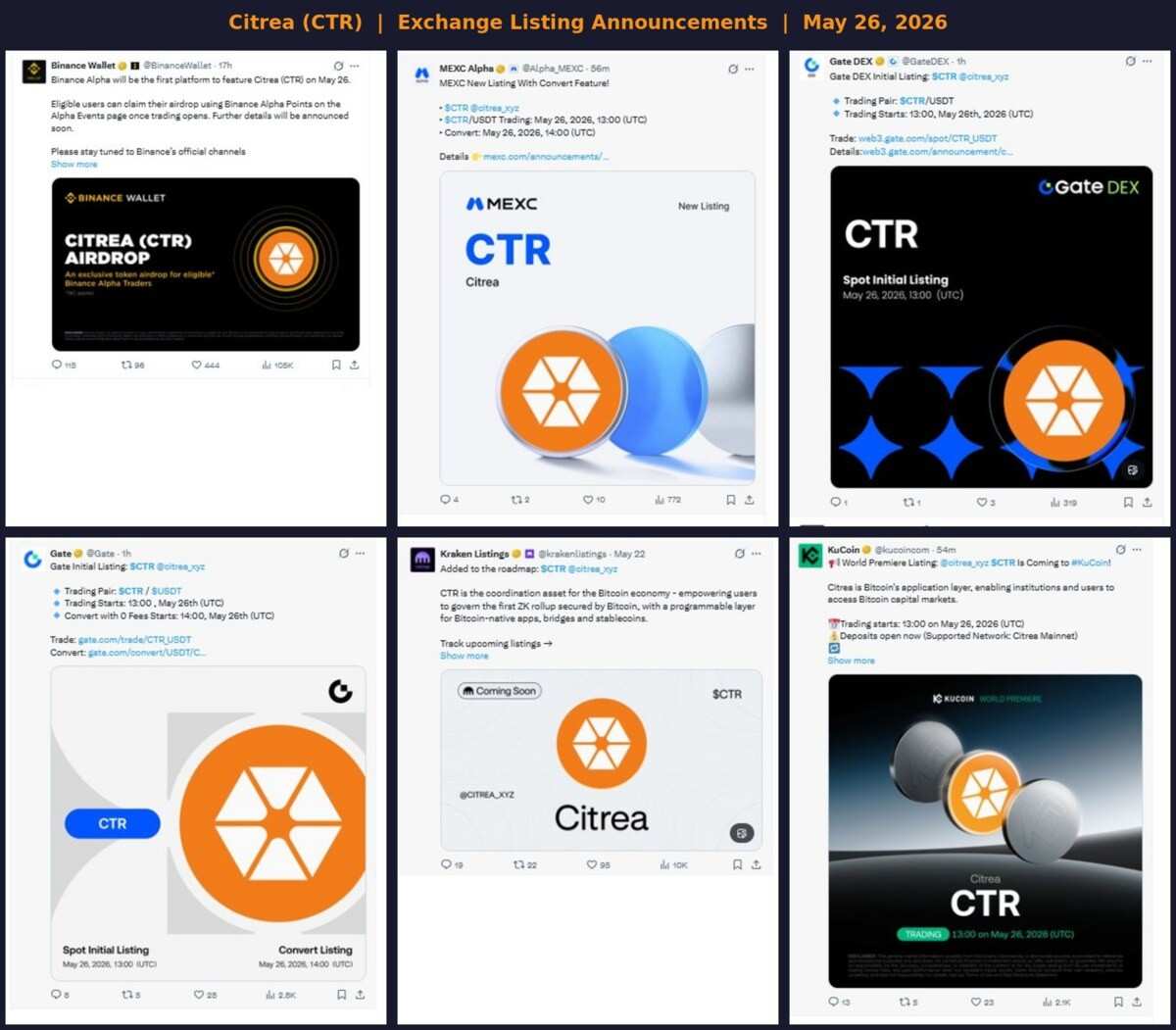
Binance Alpha was first to announce. Binance described CTR as the first token to feature through Binance Alpha on May 26.
Eligible users can claim their airdrop using Binance Alpha Points on the Alpha Events page once trading opens. With over 105,000 impressions on the announcement tweet, the retail attention is already there.
KuCoin called it a World Premiere Listing. Trading started at 13:00 UTC with CTR/USDT pair. KuCoin described Citrea as "Bitcoin's application layer, enabling institutions and users to access Bitcoin capital markets."
Deposits went live early for users on the Citrea Mainnet network.
MEXC listed CTR/USDT at 13:00 UTC and opened the Convert feature from 14:00 UTC. The MEXC announcement came just an hour before trading began, which is typical of MEXC's rollout style for new tokens.
Gate.io and Gate DEX both went live simultaneously at 13:00 UTC. Gate DEX added CTR/USDT as a Spot Initial Listing.
Gate.io added both spot trading and a zero-fee Convert option starting 14:00 UTC.
Kraken has CTR on its roadmap but not live yet. The Kraken Listings account confirmed it on May 22, calling CTR the "coordination asset for the Bitcoin economy."
That listing, when it arrives, will add another significant layer of liquidity.
Five listings in one day with a sixth incoming—this is a stronger launch setup than most tokens see across their entire first month.
CTR Tokenomics: The Numbers Behind the Citrea Airdrop Price Prediction
Understanding the token distribution is essential before looking at any Citrea price prediction.
| Metric | Detail |
|---|---|
| Total Supply | 10 Billion CTR |
| Community Allocation | 60% (6 Billion CTR) |
| Genesis Airdrop | 12% of total supply |
| xCTR Governance Treasury | 25.16% |
| Ecosystem Development | 22.83% |
| Investors | 19.35% (4-year lock, 1-year cliff) |
| Early Contributors | 20.66% (4-year lock, 1-year cliff) |
| Early Staker Bonus | 10 Million CTR over first 3 months |
The 60% community allocation is significant. Most DeFi tokens launch with 40% or less going to the community.
Citrea flipped that. Investors and contributors hold 40%, but both are under a four-year vesting schedule with a one-year cliff. That means no early investor dumping in the first year.
The genesis airdrop snapshot was taken on May 5, 2026 at block 6919313. Registration ran from May 11 to May 17. Claims go live at TGE which is tomorrow.
xCTR is the staked version of CTR. When you stake CTR, you get xCTR, which gives governance voting rights. Active voters earn liquidity emissions. Passive stakers only earn from unstaking penalty fees.
The design deliberately pushes users toward engagement rather than passive holding.
Funding background: Chainway Labs raised a $14 million Series A led by Founders Fund (Peter Thiel's fund), with Galaxy Digital, Delphi Digital, Maven 11, and notable individual backers like Erik Voorhees and Balaji Srinivasan.
Citrea Airdrop Price Prediction 2026: Bear, Base, and Bull Case
Since CTR is listing today and live price data is forming in real time, any Citrea airdrop price prediction for 2026 has to be framed around a few key variables: how the airdrop recipients behave, whether the $50M institutional liquidity holds, and whether Bitcoin market sentiment stays supportive.
The token is launching with strong fundamentals but also with a significant airdrop distribution hitting the market at the same time as exchange listings.
That creates natural selling pressure in the short term; airdrop recipients who were not long-term believers will take profits early. This is normal. It happened with similar launches.
Here is how the three scenarios break down:
| Scenario | Price Range (2026) | Key Condition |
|---|---|---|
| Bear Case | $0.04 to $0.08 | Heavy airdrop selling, thin post-listing volume |
| Base Case | $0.10 to $0.20 | Stable liquidity, ecosystem growth, Kraken listing |
| Bull Case | $0.25 to $0.45 | BTC bull run continues, TVL growth, new major listings |
| Super Bull | $0.50 to $0.80 | Coinbase listing, $1B+ TVL, institutional adoption spike |
The bear case is not the base assumption here; it is a risk scenario. Citrea's investor lock-up structure significantly reduces early selling from the 40% institutional allocation.
The real question is what the 12% airdrop supply does in the first 30 days.
Key price levels to watch after listing:
-
First support zone: The level where airdrop selling stabilizes likely around the $0.08 to $0.10 range if listing momentum holds
-
Resistance zone: Initial liquidity resistance forms wherever the first wave of sellers sits monitor $0.15 to $0.18 as the near-term ceiling
-
Confirmation level: A close above $0.20 with sustained volume would validate the base case for the rest of 2026
-
Invalidation: A drop below $0.05 with rising sell volume would signal that airdrop pressure is dominating and a longer consolidation period is ahead
The Kraken listing , when it comes, is a meaningful catalyst.
Kraken's user base overlaps heavily with serious crypto holders rather than retail traders; that kind of listing tends to add depth rather than just volume spikes.
Citrea Price Prediction 2030: Long-Term View
If Citrea executes on its roadmap, the long-term Citrea price prediction has a reasonable bull case.
Bitcoin Layer 2 adoption is still early. The entire sector is where Ethereum Layer 2 solutions were in 2021.
Citrea has first-mover advantage as the only ZK rollup that settles directly on Bitcoin with trust-minimized bridge infrastructure. If Bitcoin DeFi grows to even a fraction of Ethereum DeFi's current size, the TVL potential is enormous.
By 2030, assuming:
-
Bitcoin Layer 2 total TVL reaches $10B+ (still conservative vs Ethereum L2 today)
-
Citrea captures 15 to 25% of that TVL
-
CTR staking demand rises with ecosystem activity
A realistic Citrea price prediction for 2030 lands between $0.80 and $2.50, depending on overall market conditions.
The super bull scenario, Bitcoin ETF inflows continuing, institutional DeFi adoption, GENIUS Act creating a compliant stablecoin runway for ctUSD could push higher. But $0.80 to $2.50 is the range an analyst would call defensible today.
Expert View
CoinGabbar analysts tracking the Citrea airdrop price prediction note that the combination of trust-minimized infrastructure, a community-first 60% token allocation, and five simultaneous exchange listings creates a stronger launch setup than most Bitcoin Layer 2 tokens have seen.
The four-year investor lock-up removes one of the most common downside risks for new token launches.
Near-term price action will be shaped primarily by how airdrop recipients allocate, not by institutional selling.
The base case for CTR in 2026 is $0.10 to $0.20 if Bitcoin market sentiment stays neutral to positive.
The key metric to watch is not the price chart. It is the Citrea ecosystem TVL. As long as cBTC and ctUSD liquidity deepens and Bapp activity grows, the Citrea airdrop price prediction holds its upside.
Disclaimer: This article is for informational purposes only and does not constitute financial or investment advice. Cryptocurrency markets are highly volatile and unpredictable. The Citrea airdrop price prediction scenarios presented here are analytical estimates, not guarantees. Always conduct independent research and consult a qualified financial advisor before making investment decisions. Past performance is not indicative of future results.










.webp)




