Ethereum Price Prediction 2026: ETH Q4 Recovery Bounce Possible Now


What is the current Ethereum price, and why is it falling?
ETH is down hard in 2026. The world's second-largest blockchain just posted something its traders have never seen before: three consecutive quarters in negative territory.
Quarter 1 tanked 29.26%. Quarter 2 dropped another 18.45%. Now Quarter 3 follows the same pattern. ETH sits around $1,720, a brutal retreat from prior levels.
The culprit isn't any single event. Instead, it's a cascade of macro headwinds hitting crypto simultaneously. Broader market weakness dragged the entire sector lower.
Ethereum, with its higher beta, absorbed more pain than Bitcoin. Derivative traders got liquidated. Fear spread. That's how three-quarter beatdowns happen.
But here's the rub: this level of pain rarely persists forever in crypto cycles.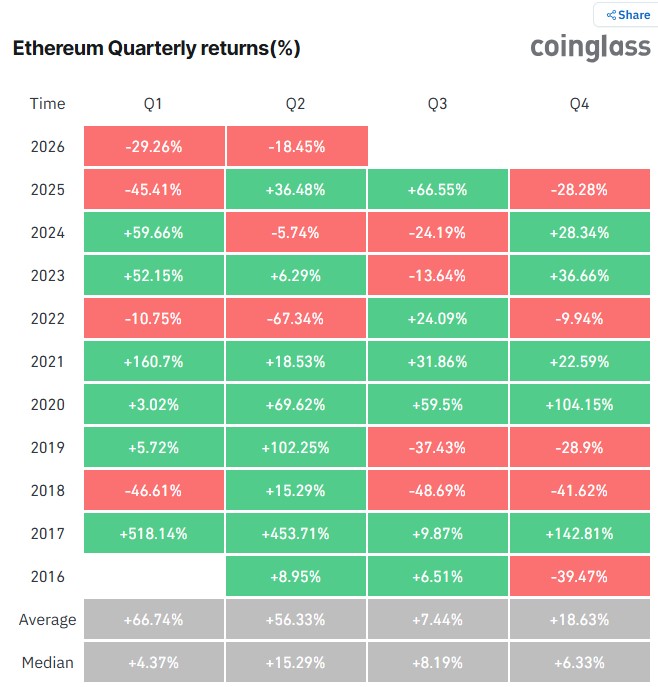
Why did Ethereum fall below its support channel in 2026?
As per the analyst, the weekly timeframe tells a wild story. The altcoin broke below a support channel that had held since early 2025. This mirrors an identical move where ETH shot above the upper resistance in April 2025. That surge eventually reversed hard.
Now it's happening in reverse. Price plunged below the lower boundary. The move screams capitulation. Weak hands sold. Leverage got crushed. The technical picture looked genuinely scary.
What's fascinating? The previous deviation above resistance eventually retested that level and bounced.
Channel symmetry suggests today's breakdown could mirror that pattern in reverse. Price overshoots on both sides. Then it corrects back to equilibrium.
Futures volume tells part of the story. Open interest hit $27.67B with a 74.88% jump. That's not normal selling volume. It's traders actively positioning.
The long-to-short ratio on Binance reached 1.7732, meaning more bulls than bears. That's contradictory to the price action.
When derivatives data disagrees with spot price, usually the weaker signal (price) eventually follows the stronger signal (positioning).
Has Ethereum ever had three negative quarters before?
No. This is unprecedented in ETH's history. That alone makes traders nervous. But history also teaches important lessons when you dig deeper.
As per CoinGlass data, look at 2022. Ethereum posted four straight negative quarters. It went: -10.75% (Q1), -67.34% (Q2), +24.09% (Q3), -9.94% (Q4). Brutal year. But 2023 answered with +52.15% (Q1), +6.29% (Q2), and is building momentum.
The pattern: crypto doesn't stay down forever. The bigger the bust, the sharper the recovery typically is. It's compressed timescales that matter. We're talking weeks to months, not years.
Options volume exploded 111.66% to $814.58M. Why would traders buy call options during a crash? Hedging before bounces. Institutions' position for reversals during extremes. That behavior suggests smart money expects recovery, not further declines.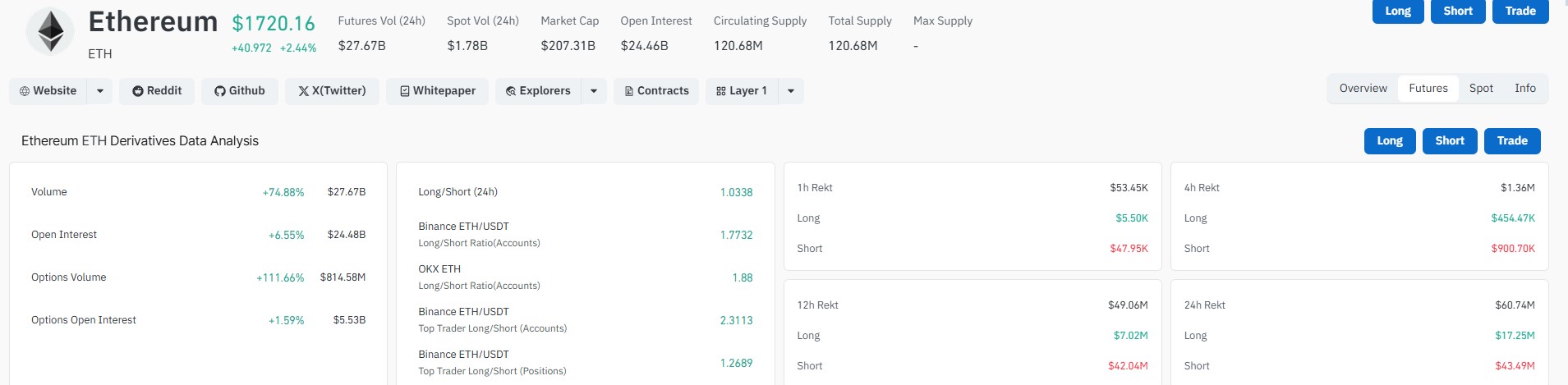
What technical levels matter for Ethereum recovery?
The chart shows two ascending trendlines that still hold. The lower support sits near $1,666. That's the hard floor. If that breaks, targets drop toward $1,500. Unlikely in the near term, but possible if macro conditions deteriorate.
The bounce target is $2,000 to $2,200. That's the first meaningful resistance overhead. If ETH clears that, the recovery continues toward $3,000 to $3,250. That's the middle of the channel structure established since 2020.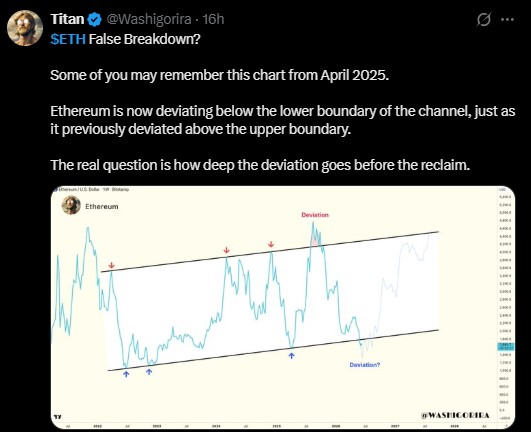
Here's what matters: Ethereum's overall bullish structure remains intact. The deviation is painful but not destructive. It's like a strong wind bending a tree, not uprooting it.
Quarterly return averages across Ethereum's history: Q1 averages +66.74%, Q2 averages +56.33%, Q3 averages +7.44%, and Q4 averages +18.63%. Q3 is the weakest quarter historically. Q4 rebounds. If that pattern holds, the three-quarter red streak breaks in October or November.
When could Ethereum bounce back, and what would trigger it?
Timing is everything in crypto. The current deviation started in late Q2 2026. Looking at the 2022-2023 cycle, the full turnaround took roughly six months from absolute bottom to confirmed recovery.
That math suggests October 2026 through January 2027 for recovery play. Not fast, but not years away either.
Catalysts include regulatory clarity on ETH staking rewards. The Ethereum Foundation has pending discussions with regulators on tax treatment.
Clarity here could unlock institutional buying. Layer-2 scaling improvements also matter. Arbitrum and Optimism keep shipping features that make Ethereum transactions cheaper. More adoption there means more utility.
Macroeconomic shifts matter most. If the Federal Reserve cuts rates or inflation data improves, risk assets rip higher.
Ethereum correlates with Bitcoin at roughly 0.65 to 0.75, meaning when Bitcoin moves, Ethereum usually follows within 15-25% magnification.
The honest scenario: If the Fed signals rate cuts and inflation stabilizes, Ethereum could bounce 30-50% off current levels in Q4. That wouldn't be unusual. That would be normal for this asset class.
Is this a false breakdown, or is Ethereum heading lower?
The chart specifically asks this question. False breakdowns happen constantly in crypto. Price smashes through support, shakes out weak traders, then reverses hard. It's a textbook.
The evidence leans toward a false breakdown. Channel symmetry with the April 2025 deviation suggests mirror mechanics.
Derivatives positioning shows more longs than shorts despite lower prices. Options positioning hints at bounce expectation, not further decline.
But crypto isn't predictable. A real-world shock could extend losses. Regulatory crackdowns. Bank collapses. Systemic risk events. Those could push lower toward $1,200-$1,400. It's possible. Just not the most likely path based on current technicals and historical patterns.
The three-quarter red streak is real and uncomfortable. But Ethereum has survived worse. The recovery setup is forming now, not tomorrow.
How do traders typically play Ethereum recovery bounces?
Most wait for confirmation. They don't buy the bottom because nobody knows where the bottom is. Instead, they watch for prices to bounce, test resistance, and break through with volume. That's where the lower-risk entries form.
Support at $1,666 breaking is the warning signal. Bounce to $2,000 to $2,200 is the decision point. If that holds as new support, then traders scale in. If that breaks lower, the bear case accelerates.
The risk-reward at current levels is skewed toward upside for patient traders. But "patient" means waiting weeks, not days. Crypto moves fast, but recovery cycles move slowly.
What happens if Ethereum stays below $2,000 through Q4?
If Ethereum holds above $2000, then the bearish case gains merit. A failure to break overhead resistance would suggest the three-quarter decline extends into Q4. That would be unusual but not impossible. Market structures break all the time.
The probability math favors recovery. But probabilities aren't guarantees. Ethereum could surprise everyone. That's the risk with predictions in this space.
What matters: stay nimble. Have a plan. Set stops. Size positions appropriately. These are basic rules that prevent catastrophic losses when predictions go wrong.
Final Take on Ethereum's 2026 Outlook
The three-quarter red streak is ugly and unprecedented. But crypto histories are short, timescales are compressed, and recovery often comes fast.
The technical setup, derivatives positioning, and historical patterns all hint at Q4 bounce territory.
That doesn't mean guaranteed gains. It means risk-reward leans long. It means institutions appear to be positioning for upside. It means the pain could be near its peak.
For traders holding bags, the wait is brutal. For fresh money, entries are forming. For institutions, the setup looks interesting for Q4 positioning.
The channel deviation will resolve. History suggests upside resolution is more likely than downside extension. But crypto always reserves the right to surprise.
Financial Risk Warning: This article is for informational purposes only and does not constitute investment advice, financial advice, or a recommendation to buy, sell, or hold any cryptocurrency. Cryptocurrency markets are highly volatile and carry substantial risk of loss. Always conduct your own research (DYOR) and consult with a qualified financial advisor before making investment decisions.









.jpg)