Little Pepe Listing Delay No Fixed Presale End Date Published


Little Pepe Listing Delay presale is 98.4% sold out.
Little Pepe (LILPEPE) has confirmed April 30, 2026, as its official listing date — and with one day to go, the LILPEPE presale is 98.4% sold out. The project has raised over $28.17 million out of a $28.775 million Stage 13 target, making it one of the strongest meme token presales of 2026. CertiK's audit of the smart contract returned a score of 95.49 out of 100, and the project's $777,000 giveaway attracted over 222,400 entries. On paper, this looks like a textbook launch.
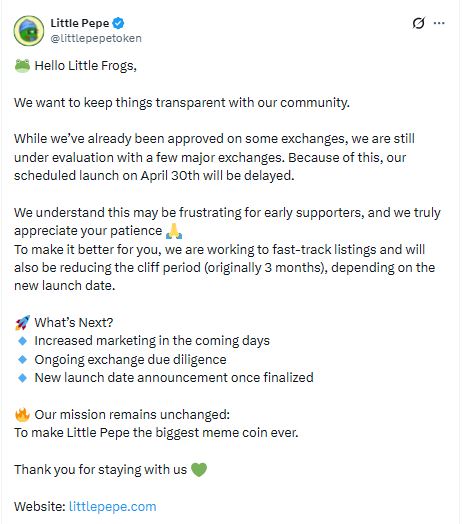
But the phrase 'little pepe listing delay' is trending for a reason. Beneath the countdown clock lies a set of five specific unresolved data gaps — missing CEX names, a 5x supply mismatch on CoinMarketCap, no official presale end date, a vesting cliff that locks all presale buyers out of trading on Day 1, and an active fake token warning from the project itself. This article breaks down every one of these signals with verified sources and live April 29, 2026 data, followed by a full 7-scenario LILPEPE price prediction model, LILPEPE tokenomics analysis, LILPEPE vesting schedule breakdown, and a step-by-step guide on how to verify the official LILPEPE Uniswap contract address safely.
Little Pepe Listing Delay Signals Nobody Is Reporting
While mainstream crypto media is running countdown articles, our research desk has documented five specific signals that indicate LILPEPE's listing experience could be very different from what the countdown suggests. None of these confirm a delay — but every one of them increases the probability of a difficult first 48 hours for uninformed buyers.
Signal 1: Zero CEX Name Confirmed — Only a Whitepaper Paragraph
As of April 29, 2026, the Little Pepe team has not publicly named a single centralized exchange partner. The project whitepaper references CEX listings and reserves 10 billion LILPEPE (10% of total supply) as a CEX reserve allocation — but a whitepaper paragraph and a confirmed live listing are fundamentally different events.
Binance, Bybit, and OKX are circulating in community Telegram groups, but none of these platforms have issued an official spot listing announcement. MEXC mirrored a project post about the April 30 date, which fuels speculation — but mirroring a tweet is not a listing confirmation.
The exchange venue determines early liquidity depth, price stability, and accessible buyer volume. A Uniswap-only launch versus a Binance launch is not a stylistic difference — it is a 5x–10x difference in tradeable volume on Day 1.
Listing Delay Risk: HIGH. No CEX confirmation despite 10B token reserve allocation. Watch official X account for any exchange name drop before April 30. Last checked: April 29, 2026.
Signal 2: CoinMarketCap Shows 100B Circulating — Official Page Says 20B
CoinMarketCap currently lists LILPEPE with a self-reported circulating supply of 100 billion tokens — the entire total supply. The official Little Pepe vesting page at littlepepe.com states that initial circulating supply at TGE should be 20 billion tokens, representing 20% of the total supply.
This is a 5x discrepancy between what the world's most-used crypto tracker shows and what the project's own legal documentation states. While this may be an administrative filing error by the project team rather than intentional misrepresentation, it is precisely the type of data inconsistency that algorithmic screening tools at Binance and similar platforms flag before approving a spot listing.
Until the CMC page is corrected to reflect the 20 billion TGE circulation figure, any analyst using CMC data to calculate LILPEPE's market cap or listing valuation will produce incorrect numbers.
Signal 3: No Fixed Presale End Date Published
The April 30 listing date and the presale end date are two separate events — and only one has been officially confirmed. The project's official pages do not publish a fixed presale cutoff date. The mechanism states that token claims open only after all presale rounds sell out. Stage 13 is at 98.4% capacity, leaving approximately 278 million tokens unsold as of April 29, 2026.
At current purchase pace, this should sell out within hours. However, any slowdown in late-stage buying could theoretically push the final sellout past the listing date, creating a mechanical conflict between the live Uniswap pool and an unclosed presale — leaving buyers unable to claim tokens while the token is already publicly trading.
Signal 4: LILPEPE Vesting Schedule — 0% at TGE, 3-Month Cliff
This is the single most important detail that retail buyers consistently miss, and it directly answers the question 'is little pepe legit?' from a tokenomics standpoint. The answer is yes — the vesting is legitimate and intentionally restrictive. If you purchased LILPEPE during the presale at $0.0022, you will not be able to sell, transfer, or move your tokens on April 30, 2026.
The official LILPEPE vesting schedule is: zero percent unlocked at Token Generation Event, followed by a mandatory three-month cliff period, then five percent of your total presale allocation released every thirty days thereafter. Full vesting requires approximately twenty months from claim date. This structure is actually price-supportive in theory — because none of the 26.5 billion presale tokens can hit the open market on Day 1.
But the psychological impact of a locked position during high volatility is significant. Presale buyers watching the price drop below their $0.0022 entry with no ability to exit is a known panic trigger in previous presale cycles.
LILPEPE Vesting Schedule Summary: 0% at TGE → 3-month cliff → 5% monthly release → ~20 months to full unlock. Source: littlepepe.com/tokenomics — last verified April 29, 2026.
Signal 5: Fake LILPEPE Tokens Already Active on DEXs
The official Little Pepe website explicitly warns buyers that fake LILPEPE tokens already exist on decentralized exchanges. This is not speculative — it is an active warning published on the official how-to-buy page. Any token appearing as LILPEPE on Uniswap, PancakeSwap, or any other DEX before the official contract address is published on littlepepe.com is a scam token deployed by bad actors to front-run retail buyers.
This pattern — deploying fake contracts ahead of a hyped listing — has been responsible for tens of millions of dollars in retail losses across the 2024–2026 meme coin cycle. The LILPEPE Uniswap contract address has not been officially published as of April 29, 2026. Do not interact with any contract that is not explicitly listed on the official project website.
SCAM ALERT: DO NOT buy LILPEPE from any DEX until the official contract address is published at littlepepe.com. Verify on Etherscan (etherscan.io) before any transaction. Fake tokens may share the same ticker symbol.
CRITICAL: The official Little Pepe website states fake LILPEPE tokens already exist on DEXs. There is no legitimate LILPEPE token on any DEX before April 30, 2026 via the official contract. Any token you buy before the official launch is a scam.
DISCLAMIER : Cryptocurrency investments are highly volatile, speculative, and unregulated, carrying a high risk of total loss. Content provided is for informational purposes only, not financial advice.