Pepeto Price Prediction: 3 Hacks, Why Investors Eyeing AlphaPepe Now


Pepeto price prediction has taken a sharp turn. Three domain attacks in thirty days, $10.2 million raised, and a presale sitting under $348,000 from the finish line.
That is the Pepeto news today, and it reads very differently depending on which side of the trade you are on.
For conviction holders who rode through every attack, the numbers look fine. The presale never stopped.
The smart contract was never touched. For new buyers looking at this right now, the story is harder.
An infrastructure under repeated attack, a Binance listing still unconfirmed, and a listing day that fires without warning make this a more complex entry than it was three months ago.
Both readings are valid. The real question is what actually happens when this token hits an exchange.
Pepeto News Today: Where the Presale Stands Right Now
As of May 29, 2026,
Pepeto has raised $10,213,059 against a hard cap of $10,561,135. Under $348,000 remains.
Current token price is $0.0000001873.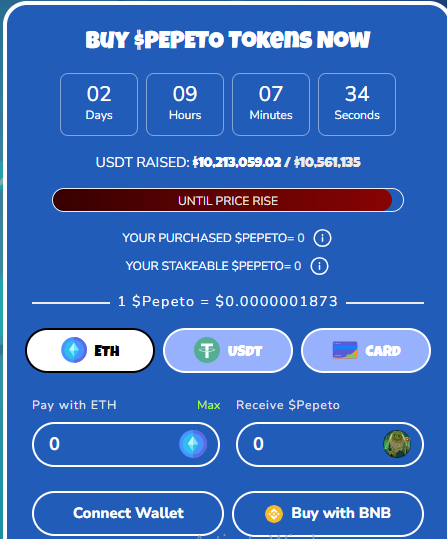
The Pepeto presale end date has no fixed calendar entry. That is by design. The Pepeto launch date fires automatically through a self-executing smart contract the moment the final presale token sells.
The team calls this the "Day of Judgment." No announcement goes out. No tweet drops first. The buy window shuts, token claims open for every presale wallet, and exchange listings follow within days to weeks.
At current inflow pace, late June or early July 2026 is the most realistic window. Q3 2026 is what most analysts are tracking.
The CoinMarketCap preview page is already live. CMC does not activate those pages for projects that are months away from listing.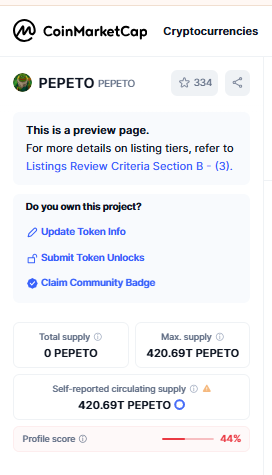
That page going live without a team announcement is a preparation signal, not confirmation.
Uniswap listing is the only confirmed exchange entry right now. Binance listing remains unconfirmed as of today, despite heavy community speculation.
Pepeto Listing Update: The Domain Attack Timeline
The pepeto listing update conversation has been inseparable from the domain attack story for the past month. Here is what actually happened.
April 28 -- pepeto.io goes dark. Team moves to pepetoswap.com the same day. Presale continues without a confirmed slowdown.
May 9 -- pepetoswap.com is hit. Team announces the second attack publicly on X. Operations shift to pepetocoin.com. The statement from the team was direct: coordinated attacks from parties threatened by their zero-fee exchange model.
May 27 -- pepetocoin.com starts returning DNS errors right as a price rise countdown under seven hours was showing.
A fourth issue followed shortly after, with pepetocoin.net flagging as suspicious on some browsers.
The smart contracts are on Ethereum. None of these attacks touched the contract code. The SolidProof and Coinsult audits remain valid.
Your tokens and presale funds are not stored on any website. That distinction matters and most coverage missed it.
What these attacks do reveal is a pattern of reactive security rather than proactive infrastructure planning.
A team that anticipated this level of targeting would have pre-purchased 20 backup domains and configured automatic rerouting so users never noticed a thing.
Instead, each attack produced visible downtime, trending searches, and community panic.
That behavior tells you something about how the backend is being managed heading into the most critical phase of this project.
Pepeto Launch Date: What "Day of Judgment" Actually Means
Most retail investors searching for the pepeto launch date are expecting a calendar announcement. That is not how this works.
The Pepeto launch date is a smart contract trigger event. When the last presale token sells, the contract executes automatically.
There is no human switch to flip. Token claims open immediately for every presale wallet.
Exchange listings follow in the days and weeks after that. The entire mechanism is on-chain, which means it happens the moment the math says it should.
At current daily inflow velocity, the presale closes sometime between late June and mid-July 2026. If inflows slow further, that window extends.
Four independent risks can push the date: slower final-batch buying from a more cautious late-stage pool, exchange due diligence running past TGE, PepetoSwap mainnet still in beta with no published launch date, and an undisclosed Uniswap liquidity pool size that nobody has confirmed yet.
That last point matters more than most Pepeto price prediction articles acknowledge.
A small liquidity pool crashes hard on day one. A deep pool absorbs selling pressure without moving the price much. Until that number is public, day-one behavior is genuinely unpredictable.
Is Pepeto Legit? The Infrastructure and Product Reality
The legitimate side of this project is real. PepetoSwap zero-fee exchange has 15,000 daily testers running in beta.
A cross-chain bridge is built. Staking at 172% annual yield is live for presale participants. Both SolidProof and Coinsult audits are completed and published. The 420 trillion total supply was not a random number.
PEPE launched with the same supply in 2023 with zero utility and hit an $11 billion market cap at peak. Pepeto is entering with that supply structure plus actual products.
The co-founder is described as the original PEPE ecosystem builder. A former Binance executive sits on the advisory board.
Neither of those claims has been independently verified by external media. That open question adds narrative uncertainty even if it has not slowed fundraising.
Pepeto Price Prediction 2026: What Hack FUD Does to Listing Day
This is the part of the Pepeto price prediction that fundamentals alone cannot answer.
Hack FUD has a measurable historical impact on listing day price behavior.
Projects entering exchange listing with unresolved security narratives or visible infrastructure problems have historically seen 20 to 40% drops in the first 24 hours compared to clean launches.
Not because the product is bad. Because fear moves faster than fundamentals on day one. Presale holders have emotional attachment to the project.
Exchange day buyers who see a domain attack narrative on Google have zero attachment and sell faster.
The presale community held through three attacks. That is real conviction. But the audience changes the moment PEPETO goes live on Uniswap and later on CEXs.
Scenario Table:
The base case is still intact if the team handles listing infrastructure better than they handled domain infrastructure.
Watch the first 48 hours of CMC volume after the listing goes live. If daily volume crosses $5 million with price holding above presale entry, the bear case is off the table.
If volume spikes and price dumps immediately, the hack FUD narrative played out exactly as historical patterns said it would.
Pepeto vs AlphaPepe: The Clean Alternative Getting Louder
While Pepeto was managing its third domain crisis, AlphaPepe quietly moved to Stage 17 of its presale with zero security incidents on record.
AlphaPepe right now carries a BlockSAFU audit at a perfect 10/10 score. AlphaSwap, its AI-powered DEX, is live with over 1,000 active users before any exchange listing.
A Tier-1 CEX listing is in discussion with the name not yet revealed. PancakeSwap listing is also confirmed.
The project has 8,300 holders, a June 1 USDT rewards pool deadline, and no domain attacks, no hacks, and no infrastructure failures in its history.
For investors specifically asking about meme coin behavior after a hack, AlphaPepe presents the cleanest technical setup available right now. No FUD overhang.
No community controversy around security. A live product, an audited contract, and a confirmed exchange pipeline.
Bear case for Stage 17 ALPE buyers is near breakeven. Base case is 1.2x to 3x from current presale price. Bull case with Tier-1 CEX announcement landing is 5x to 9x.
Where Gruntle Fits In This Picture
Gruntle operates in a completely different lane. It is not building a DEX. It is not trying to mirror PEPE supply.
The $GRUNTLE presale recently had $18K left before a stage close, with $104K raised and exchange listing update pending. The same week, Mastercard's backing of Chainlink added a credibility signal to the broader meme coin space that gave Gruntle positive sentiment overflow.
The Gruntle price prediction thesis is simpler than either Pepeto or AlphaPepe. Smaller raise, smaller float, stage-by-stage price appreciation locked in before listing.
Lower launch liquidity is the main risk. Less dilution and a tighter community is the upside.
For investors who want meme coin exposure without the hack narrative and without the complexity of an AI DEX, Gruntle is the lower-stakes alternative with a straightforward entry.
Pepeto Price Prediction: Expert View
CoinGabbar analysts tracking the pepeto listing update note that three domain attacks in thirty days, while survived without fundraising disruption, create a specific listing-day risk that product fundamentals alone cannot neutralize.
Exchange day buyers price in risk faster than presale holders, and an unresolved infrastructure narrative gives first-day sellers a story to trade against that has nothing to do with token supply math or swap volume.
The pepeto cross-chain bridge, the 172% staking APY, and the zero-fee exchange model are real product differentiators.
None of those matter on hour one of listing if the FUD narrative controls the headline.
AlphaPepe offers the structurally cleaner setup for investors whose primary concern is security and execution clarity.
Pepeto offers the larger community, the supply psychology bet, and the presale entry price that will not exist once the contract fires.
Both projects can succeed. They are not competing for the same buyer type. Pepeto is a community size and supply psychology bet. AlphaPepe is a product traction and clean infrastructure bet.
Which one matters more on listing day is the question every investor has to answer before the Day of Judgment executes on its own.
Disclaimer: This Pepeto price prediction article is for informational purposes only and does not constitute financial advice or an investment recommendation. All price scenarios are analyst estimates based on publicly available data at time of publication. Cryptocurrency markets carry extreme risk including the total loss of capital. Always conduct independent research and consult a qualified financial advisor before any investment decision. CoinGabbar does not recommend buying, selling, or holding any specific cryptocurrency.
Also read: