Pi Network Price Prediction: A Plot Twist the Market Didn't Expect


Pi Network: Market Didn't Expect ATL
The Chart Says One Thing. The pattern says another.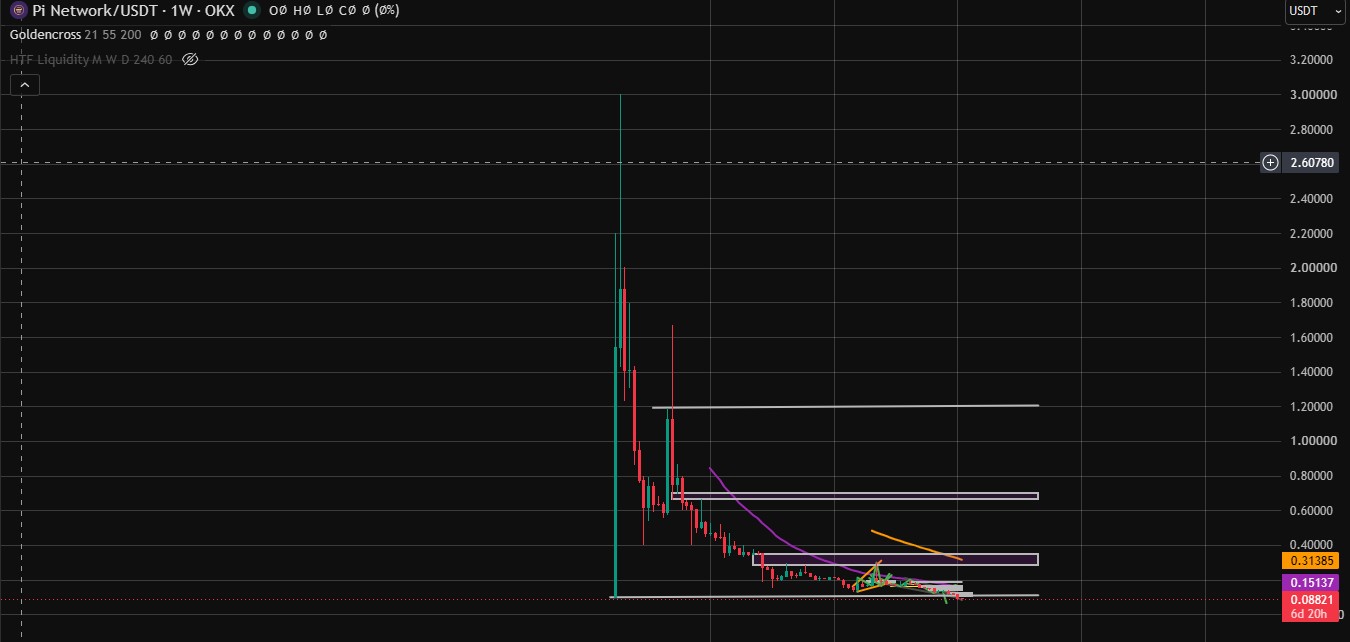
Here is the plot twist nobody expected: Pi Network hit a new all-time low of $0.08475 on -July 12, 2026, five days ago. Three days before that, the Pi2Day 2026 event launched three new products: SoloHost, Sign-In, and Verify.
The market's response to those product launches was to push the price to a new ATL. And then quietly, without headlines, the weekly candlestick closed with a bullish engulfing pattern on -July 10, 2026.
Bullish engulfing on a weekly chart, after hitting ATL territory, with RSI at 21.65 (deep oversold), is one of the most statistically significant reversal signals in technical analysis. It does not guarantee a bounce.
Nothing in crypto guarantees anything. But it is the kind of setup that institutional traders write research notes about. 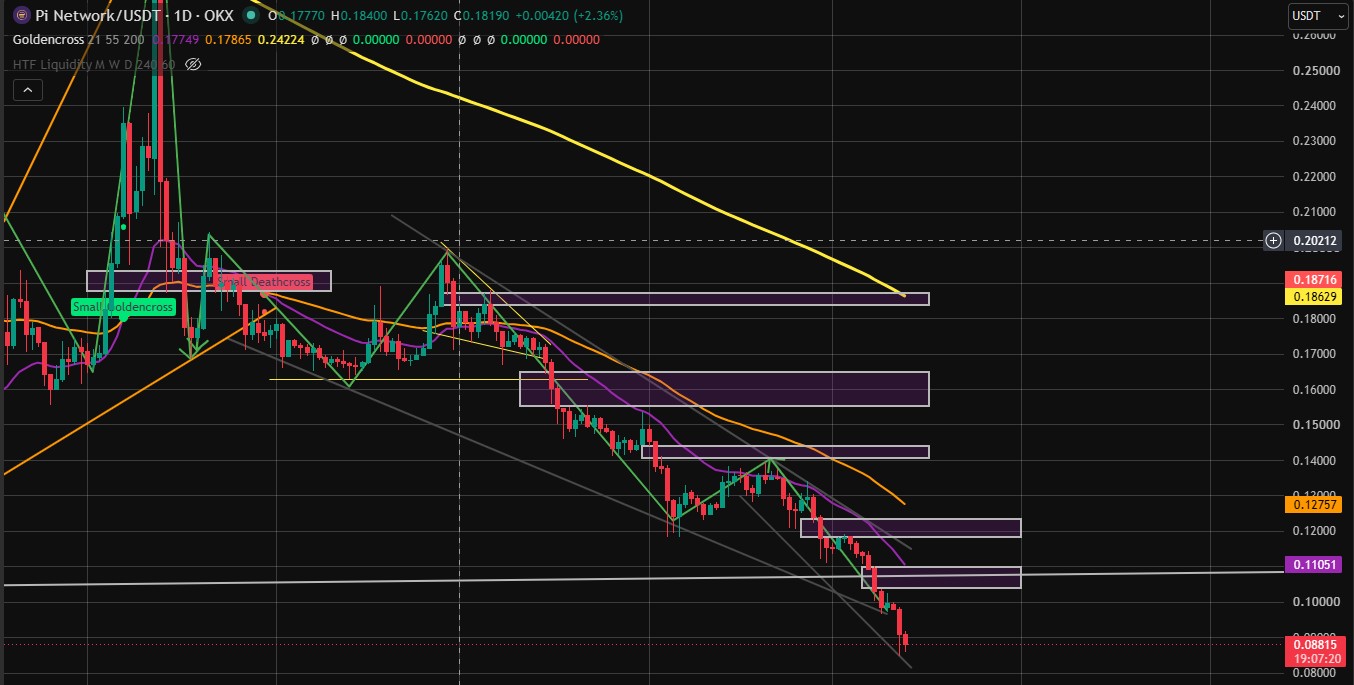
And $Pi Network, on July 13, 2026, is sitting right inside that setup, trading at $0.08726–$0.114 with 60 million registered users, three new products, and an RSI reading that historically precedes violent upside moves when catalysts finally land.
The plot twist is not that recovered. It has not recovered yet. The plot twist is that the conditions for a recovery are cleaner on date 13 than they have been at any prior point in trading history, and almost nobody is talking about that.
The market is focused on the ATL. The pattern is building something else beneath it.
Pi Network Breaking News, July 13, 2026
Weekly Bullish Engulfing Confirmed : The Signal Nobody Reported
On July 10, 2026, the $Pi Network weekly chart shows a bullish engulfing candlestick pattern, the first such pattern since$PI began public trading.
A bullish engulfing on the weekly timeframe, forming at an ATL with RSI at 21.65, is textbook accumulation signal territory.
Under this pattern, analysts state that $PI could revisit its recently set all-time high of $3.00 if the pattern confirms with follow-through buying volume over the next 2–3 weeks.
The pattern does not confirm unless trades above $0.1228 (20-day EMA) with meaningful volume. Watching this specific level over the next 7–10 trading days is the key technical test. A close above $0.1228 triggers the pattern confirmation. A close below $0.08590 invalidates it.
Pi2Day 2026 Three Products That Changed the Narrative (June 28)
SoloHost: An open, permissionless framework inside Pi Desktop that turns 420,000+ Pioneer-operated nodes into a distributed computing layer.
Developers can build and list self-hosted applications for local AI workloads. The top 100 node operators contribute computing resources to complete AI tasks, turning passive infrastructure into an active, productive utility for the first time.
Sign-In: Network's OAuth equivalent, a login-with-Pi button for supported third-party websites and apps outside the Browser.
This gives external platforms access to verified identity layer and 60M+ user base as a ready-made sign-in audience. The AI era needs verified human identity systems, and Pi Sign-In positions the network as that layer.
Verify: An external identity verification service that charges fees denominated in $PI tokens. This is the first real fee-mechanism in Pi Network's history.
A service that requires users to spend $PI creates genuine, recurring, non-speculative token demand structurally different from every prior PI use case.
App Studio July 8 Update: Backend Storage + AI Planning Tools
On the same day it hit its Low ($0.1025 on July), Pi Network pushed its App Studio update, adding persistent backend storage for all newly created apps. 
Developers can now build applications where user-specific data is saved across sessions, a capability that was previously missing and blocked professional-grade development on the platform.
An AI-assisted app planning phase was also added; developers describe their app idea in plain language and receive structured planning support from a built-in AI assistant.
GitHub commit activity on July 6 confirmed ongoing technical progress across Python, Rust, and PHP SDKs.
The ATL Supply Collision: 103.7 Million Tokens vs Three New Products
July 2026 is defined by one equation: 103.7 million $PI tokens unlocking (27 million more than June) against three new utility products that, for the first time, create actual fee-driven token demand.
The ATL on July represents the supply side winning that collision in the short term. The weekly bullish engulfing suggests demand may be beginning to absorb the pressure.
(July 9 analysis) described it precisely: 'Usage turns before price does, if it turns at all.' The metric to watch is not price; it is $PiVerify adoption data, $Pi Sign-In third-party integrations, and SoloHost developer uptake. If those numbers move, price follows. They are the leading indicators.
Foundation Wallet Concentration: The Insider Risk
On-chain analysis from PIScan reveals that only 21 wallets hold over 10 million $PI each. The Pi Foundation's largest single wallet reportedly controls over 52 billion PI tokens in a network with 10.91 billion tokens in circulation.
This concentration means the Foundation holds more than 5x the entire circulating supply. Any decision about Foundation wallet activity creates immediate market implications that retail holders cannot anticipate or control.
Over 80% of the 16.7 million migrated users hold fewer than 10 tokens. The distribution reality is the opposite of the decentralization narrative; a handful of wallets control the effective float, while the vast majority of Pioneers have economically negligible positions.
Pi Network Price Prediction: July 2026 to 2030
Short-Term: July to December 2026
Scenario / Timeframe | Bear / Low | Base Case | Bull / High |
July 2026 | $0.085 | $0.100 – $0.122 | $0.135 |
August 2026 | $0.078 | $0.117 | $0.150 |
Sept 2026 | $0.079 | $0.130 | $0.175 |
Oct – Nov 2026 | $0.085 | $0.160 – $0.200 | $0.320 |
Dec 2026 | $0.078 | $0.185 – $0.280 | $0.370 |
End 2026 (full) | $0.078 | $0.224 | $0.370 – $0.850 |
Long-Term: 2027 to 2030
Scenario / Timeframe | Bear / Low | Base Case | Bull / High |
2027 | $0.090 | $0.181 – $0.313 | $0.583 |
2028 | $0.108 | $0.146 – $0.207 | $0.626 |
2029 | $0.168 | $0.850 | $2.64 |
2030 | $0.168 | $2.09 – $3.00 | $22.00 |
2032 | $0.297 | $1.71 | $5.43 |
DISCLAIMER: A speculative early-stage token with elevated uncertainty due to short trading history, unlock pressure, and Foundation wallet concentration. Weekly bullish engulfing pattern is unconfirmed without follow-through volume. Not financial advice. DYOR.