Rollblock Price Prediction: CEX Delay Weighs on Sentiment

A live casino with more than 12,000 games is still taking bets.
The token meant to capture that activity is doing the opposite of thriving.
That gap between a working product and a struggling market is the real story behind this Rollblock price prediction, and it raises an obvious question: if the platform is functioning as designed, why has the token fallen so far behind it?
What Was Rollblock Actually Built to Do?
The project's pitch was straightforward. Rollblock is a GambleFi platform built on Ethereum, and its published model ties weekly casino revenue directly to token holders through buybacks, burns, and staking payouts, an on-chain structure meant to give RBLK real exposure to how much the platform earns.
That framework drew enough early interest to raise roughly $12.3 million during presale, well before the token ever traded publicly. Rollblock then made its market debut on Uniswap on May 18, 2026, the moment its price discovery, and its struggles, actually began.
What Has Price Action Looked Like Since Launch?
The chart since then hasn't offered much for holders to point to. Rather than settling into a range or building toward a recovery, RBLK has spent its post-launch months grinding lower in small, choppy moves, red and green candles trading places without either side gaining lasting control.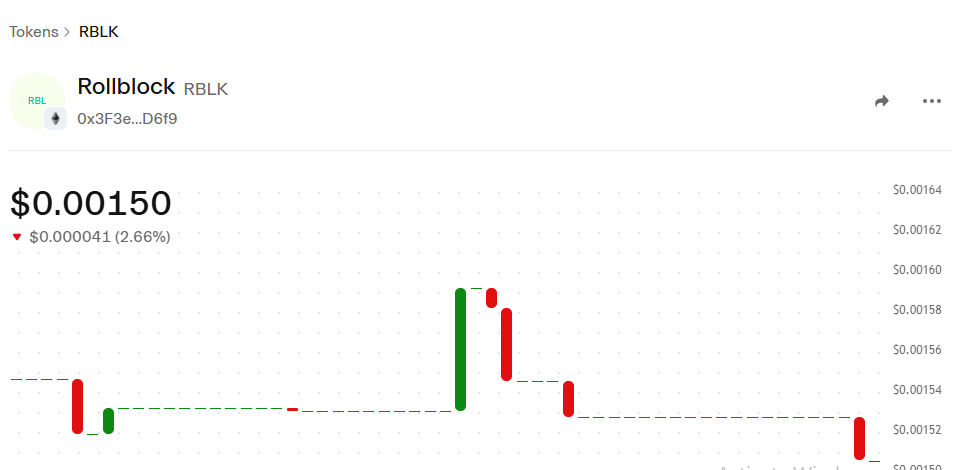
The latest session added to that pattern, with the token down $0.000041, or 2.66%, to $0.00150.
Set against its own 52-week range, the scale of the drop becomes clearer. RBLK's high over that period sits at $0.0365, while its low is $0.00109, and current price sits far closer to the bottom of that band, a decline of more than 80% from where the token once traded.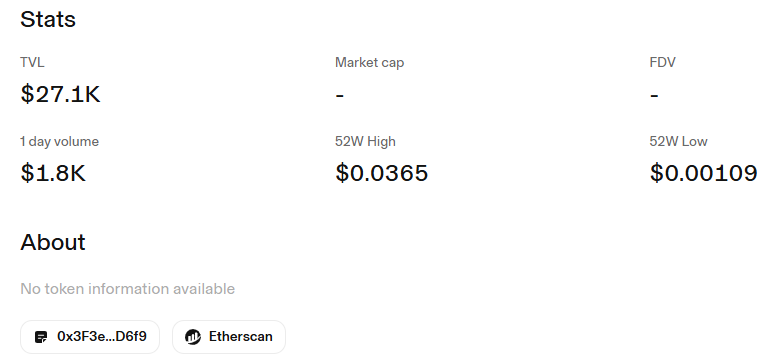
Source: rollblock uniswap.org as of July 25, 2026.
Liquidity tells a similar story: total value locked comes in at just $27.1K, with daily volume around $1.8K. Numbers that thin mean a single trade of a few hundred dollars can move price more than it would on a deeper market.
market cap and FDV figures weren't listed at all, a gap that itself says something about how little visibility the token currently has.
Why Hasn't Rollblock Shown Up on a Centralized Exchange?
For a lot of holders watching this token, the missing headline isn't a price target, it's a listing.
Rollblock's own roadmap pointed to a Phase 2 window, running from late June through mid-July 2026, earmarked for a centralized exchange debut.
That window has since closed, and neither June 25 nor June 30, two dates the community had circled, brought any confirmation.
What matters here isn't just that the deadline passed. It's that no follow-up explanation has surfaced to say why, or when holders might expect news instead.
That absence leaves a vacuum, and vacuums in low-liquidity markets tend to get filled with doubt rather than patience.
What Does On-Chain Activity Reveal?
Blockchain records don't lie, but they also don't tell the whole story on their own, and that's worth keeping in mind before drawing conclusions from a narrow slice of transactions.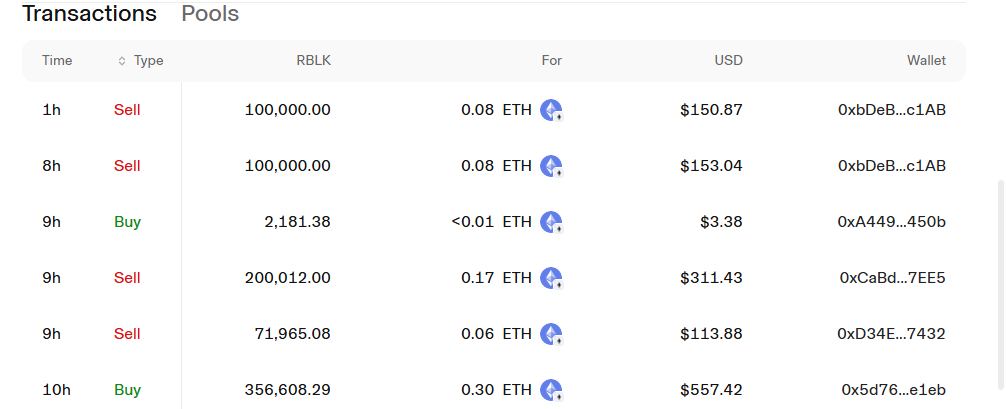
Within a recent window of roughly ten hours, the ledger shows two separate 100,000 RBLK sells from the same wallet, along with additional sell orders ranging from about 70,000 to 200,000 tokens spread across other addresses.
Buying hasn't disappeared entirely; one order for more than 356,000 RBLK shows up in the same stretch.
Taken together, it's a snapshot rather than a trend line, one window into a market where a small number of wallets can shape short-term price swings simply because there isn't much depth to absorb them.
What Should Holders Be Watching From Here?
The path forward carries its own set of pressure points.
Scheduled token unlocks are set to continue through September 2026, adding more supply into a market that's already thin.
Rollblock's published tokenomics describe a burn mechanism funded by weekly casino profits, though the actual scale of tokens removed through that process each week hasn't been independently confirmed anywhere in the data reviewed here.
Community conversation, for its part, has leaned toward frustration lately, centered more on missed deadlines and low liquidity than on any fresh reason for optimism, and no major update from the project has emerged recently to shift that tone.
The Bigger Picture
Strip away the noise and Rollblock's situation comes down to a simple mismatch.
The casino keeps running, generating the kind of ongoing activity a revenue-sharing token was designed around, while the token itself remains hostage to thin liquidity, an overdue listing milestone, and a market still waiting for a reason to believe.
A working product hasn't been enough to change that equation, and until an exchange listing materializes or trading conditions genuinely shift, RBLK's price is likely to keep answering to liquidity and sentiment first, and to the platform's fundamentals only after.
Disclaimer: This article is for informational and educational purposes only and should not be considered financial or investment advice. Cryptocurrency markets, and low-liquidity tokens in particular, are highly volatile and carry significant risk. The observations in this article are based on a limited snapshot of publicly available information and should not be treated as a complete or independently verified account of the project. Readers should conduct their own research (DYOR) and consult a qualified financial advisor before making any investment decisions.