SEALCOIN Listing Stalls as Binance Delays QAIT Airdrop: What Next?


The SEALCOIN listing went live on KuCoin and Gate.io on May 28. Three exchanges in one day was the headline. But 24 hours later, the story has changed completely.
Binance Alpha officially delayed the QAIT airdrop. No new time given.
Just a tweet from Binance Wallet saying "please wait for the official announcement." That single message hit harder than any sell order could.
QAIT is now trading around $0.014, more than 50% below its TGE price of $0.03.
The SEALCOIN listing that was supposed to bring three-exchange momentum has so far delivered a sharp correction instead. So what actually happened, and where does QAIT go from here?
SEALCOIN Listing Was Live But Binance Was Not
KuCoin tagged this as a World Premiere event. Gate.io added spot and convert trading simultaneously. Both went live at 13:00 UTC on May 28 as planned.
The SEALCOIN listing on KuCoin attracted early premium hunters; volume spiked, and price touched $0.0194 as ATH within hours.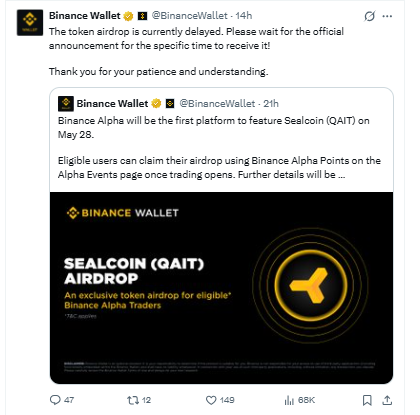
Then Binance Alpha announced the delay.
When Binance is expected to drive a big airdrop wave and then pulls back at the last moment, the market reacts immediately.
Airdrop hunters who were holding QAIT in anticipation of the Binance wave started reducing positions.
Liquidity on KuCoin and Gate.io was already thin, with a circulating supply of only 500 million out of a total of 10 billion QAIT. Even moderate sell pressure moved price hard.
The ATL on listing day was $0.006. Price recovered to the $0.014 range but has not reclaimed anything close to TGE price. That gap tells its own story.
Why Binance Alpha Delays Hit Differently
Binance Alpha is not just another exchange listing. It functions as a discovery platform where Alpha Points holders get first access. These are active Binance users, not random airdrop farmers.
When Binance commits to featuring a token and then delays, two things happen.
First, the specific buyer pool that was priced into the token disappears from the equation temporarily. Second, existing holders start wondering if the delay signals a deeper problem with the project or with exchange compliance checks.
In reality, Binance Alpha delays happen for various reasons, most of them administrative.
Similar situations played out with other Binance Alpha listings in 2026 where delays were followed by a rescheduled drop within 24 to 72 hours. But the market does not wait for context. It sells first.
For QAIT specifically, the delay removed the biggest short-term demand catalyst on the same day the SEALCOIN listing was supposed to build momentum across all three platforms.
What the Chart Says at $0.014
The current price zone is interesting. QAIT has now traded below TGE price for most of its short existence on exchanges.
As per CoinMarketCap data, volume over the last 24 hours has been enormous relative to market cap; the Vol/MCap ratio sits above 1000%. That is extreme activity for a token this size.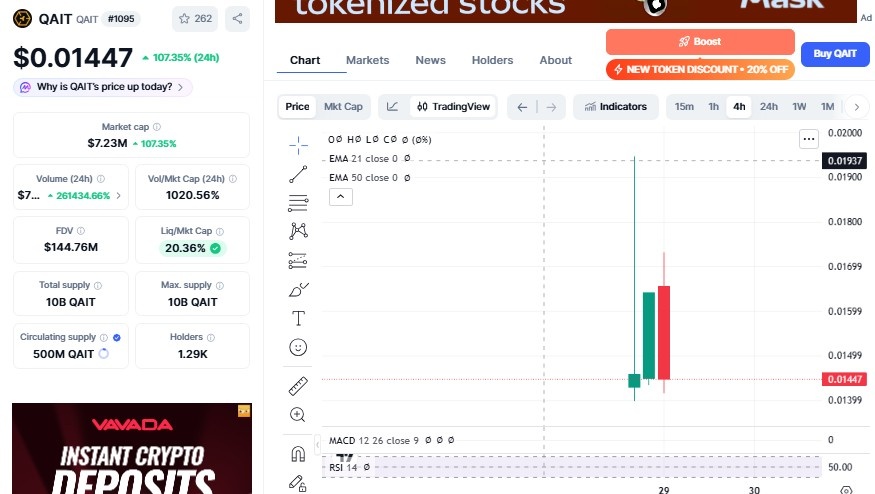
High volume at these levels usually means one of two things. Either genuine buyers are accumulating at the discount, or airdrop recipients and early holders are distributing.
With only 1,290 holders currently and a circulating supply of 500 million, the holder base is very small. Any concentrated selling shows up brutally in price.
RSI on the 4-hour chart was not in oversold territory when the images were captured, sitting around the 50 level.
That neutral reading suggests the selling pressure has not fully exhausted itself yet. The MACD showed early signs of flattening.
$0.014 to $0.015 is the current consolidation zone. The level to watch is $0.012. A clean break below that on volume would likely see QAIT test $0.008 to $0.010 before finding real support.
On the upside, $0.020 is the first meaningful resistance. That was the approximate zone where the initial KuCoin premiere buyers entered.
Getting back above $0.020 would require either a confirmed Binance Alpha rescheduled date or some external catalyst from the WISeKey ecosystem.
QAIT Price Prediction 2026: Three Scenarios After the Delay
Bear Case: $0.008 to $0.015
Binance Alpha delay extends beyond 72 hours without communication. Broader DePIN token sentiment stays cold in Q2 2026.
Thin liquidity and a small holder base mean any large wallet exit creates outsized moves down. QAIT struggles to hold $0.014 and drifts lower.
The SEALCOIN listing narrative fully unwinds without the Binance catalyst to revive it.
Base Case: $0.025 to $0.06
Binance confirms a new airdrop date within the next few days. Alpha Points holders claim QAIT, some hold, some sell, but net demand increases total holders from 1,290 toward 5,000 plus.
KuCoin and Gate.io volumes stabilize.
TGE price at $0.03 gets reclaimed on a weekly close. Price builds a base, and the SEALCOIN listing story transitions from "listing hype" to "DePIN utility" by Q3 2026.
Bull Case: $0.08 to $0.20
Binance Alpha reschedules quickly, and the airdrop goes smoothly. A major WISeKey enterprise client announces SEALCOIN integration.
PoSy pool demand locks additional QAIT out of circulation. With fixed 10 billion supply and real lock-up pressure, thin float dynamics could push price sharply higher.
The SEALCOIN listing that looked like a failure on Day 1 becomes the entry point everyone wished they had used.
Key Levels Traders Are Watching
$0.030 is TGE price and the psychological line that matters most. Every trader uses this as the reference. A daily close above $0.030 on volume would significantly change the sentiment picture.
$0.020 is immediate resistance.
The first wave of KuCoin premiere buyers entered near this zone. Reclaiming it matters before targeting TGE price.
$0.012 is the downside level to watch. Losing this on a daily close opens up $0.008 which was near the listing day low zone.
For context, the impact of multi-exchange listing delays on new token price action has been well documented in 2026. Tokens that survived early selling pressure and held key support levels have generally recovered when the delayed catalyst eventually arrived.
Expert View
CoinGabbar analysts tracking the SEALCOIN listing note that the Binance Alpha delay is a short-term disruption, not a project-level problem.
The fundamentals of QAIT have not changed in 24 hours.
WISeKey remains a NASDAQ-listed company with real semiconductor infrastructure.
The $30M crypto treasury inclusion from SEALSQ, the Davos 2026 space transaction demonstration, and the fixed 10 billion supply with PoSy lock-up mechanics are all still intact.
The SEALCOIN listing price correction from $0.019 ATH to $0.014 reflects airdrop uncertainty, not a change in project fundamentals. Binance Alpha delays in 2026 have historically resolved within 48 to 96 hours.
If that pattern holds, the demand wave that was supposed to arrive on May 28 simply gets pushed a few days out.
The real QAIT price prediction for 2026 is not what happens this week. It is whether IoT device onboarding through the PoSy mechanism generates measurable real demand by Q3 and Q4.
That is the number that determines whether the base case or bull case plays out.
Short term, $0.014 is where the market is pricing in maximum Binance uncertainty. When that uncertainty clears, price tends to move fast.
Disclaimer: This SEALCOIN listing and QAIT price prediction article is for informational purposes only and does not constitute financial or investment advice. Cryptocurrency markets are highly volatile. All price targets and technical levels are based on publicly available data at the time of publication. Always conduct your own research and consult a licensed financial advisor before making any investment decisions. CoinGabbar does not recommend buying, selling, or holding any cryptocurrency.