Solana Price Prediction 2027: Could SOL Target $200 Next?


Solana Price Prediction 2027:
It hit $260 at its peak. Now it is sitting at $72 with a chart that has been grinding sideways and down for months.
But if you pull up the weekly chart and actually look at what is forming, the story gets more interesting than the price suggests
SOL Right Now — What the Numbers Say
Metric | Value |
Current Price | $72.89 |
Market Cap | $42.33B |
24h Volume | $2.33B (+38.66%) |
FDV | $45.67B |
Total Supply | 629.33M SOL |
Circulating Supply | 580.76M SOL |
The volume jump of nearly 39% in 24 hours while price is only up 1.7% is worth flagging.
That kind of volume without a meaningful price move is usually accumulation buyers absorbing sell pressure without letting price run yet.
The Weekly Trendline Nobody Is Respecting Yet
On the SOL/USDT weekly chart, there is a descending trendline running from the September 2024 highs downward.
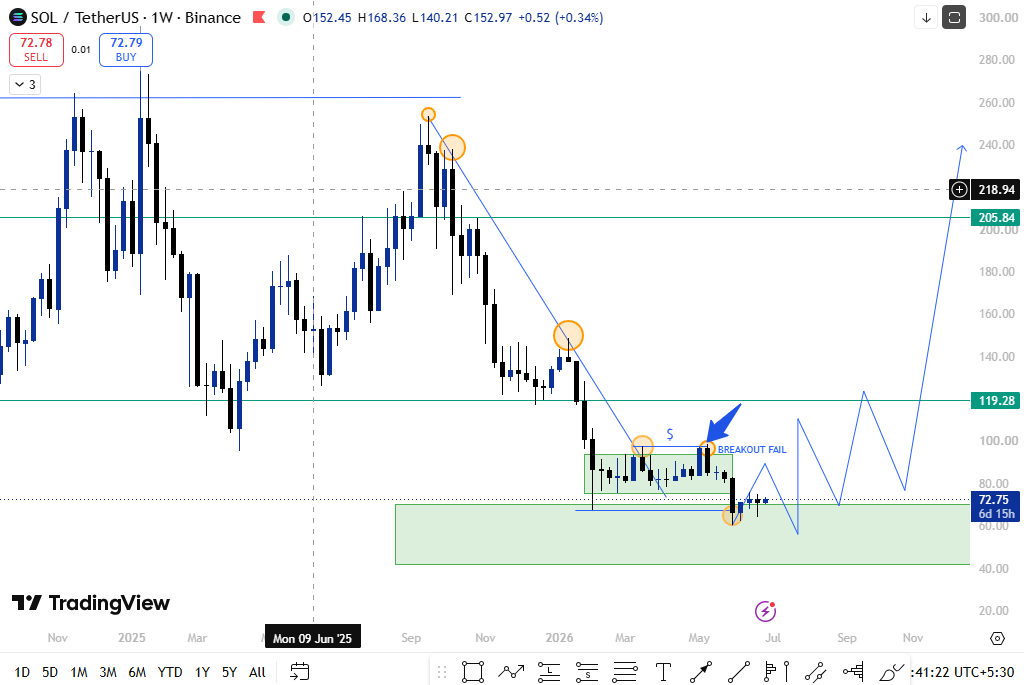
It has been acting as a ceiling every time Solana has tried to recover. The market has tested this trendline four separate times now. four times sellers have shown up at that level and pushed the price back down.
That trendline currently sits around the $90 to $100 zone depending on when the next test happens.
The $119.28 level marked on the chart is the next major resistance; above that is a horizontal level that has flipped from support to resistance and will need to be cleared for any serious upside to develop.
Below current price, the green demand zone on the chart stretches from roughly $40 to $75. SOL is sitting right at the upper edge of that zone. That is the area where buyers have historically stepped in to support the price.
Four Tests. One Failed Breakout. What Comes Next?
Here is where it gets important to pay attention to detail.
The chart shows that SOL recently attempted a breakout above the descending trendline.
It pushed above the resistance level and held for a brief period—and then failed. The "BREAKOUT FAIL" label on the chart marks exactly where that happened, around the $90 to $100 area in late May to early June 2026.
A failed breakout is not automatically bearish. In many cases it is the market flushing out the weak hands before the real move happens.
The pattern you often see is price breaks out, weak buyers pile in, price gets pushed back below the level, those buyers panic sell, and then the real breakout comes with stronger hands behind it and holds.
The question is whether that is what is setting up here or whether SOL is about to test the lower end of that green demand zone near $40 to $50 before the next real attempt comes.
The chart actually shows both scenarios mapped out: a dip toward $55 to $65 before another run at the trendline or a direct retest and breakout attempt from current levels. Either way, the trendline is the level everything revolves around.
Why the Failed Breakout Actually Matters More Than You Think
Most people see a failed breakout and immediately assume the asset is broken. That is the wrong way to read it.
What the failed breakout told the market is exactly where the resistance is. It confirmed the trendline is real. It showed that sellers are defending that zone. And it shook out a lot of people who bought the initial breakout and got stopped out.
Markets rarely give clean entries. The failed breakout cleaned up the chart and reset sentiment. The people left holding SOL at $73 are not weak hands who bought a breakout; they are people who understand the setup and are waiting for the real confirmation.
Four tests of the same trendline with sellers defending it every single time also mean something else: each test builds buying pressure underneath.
The more times a resistance level is tested, the more energy builds up on the other side of it. When it finally breaks with conviction, the move tends to be violent.
What Happens If SOL Closes Above $100 Weekly?
This is the key number. Not $90. Not $95. A weekly candle close above $100 with real volume behind it.
That level matters for three reasons. One, it is a round psychological number that gets attention from retail and institutions alike. Two, it is roughly where the descending trendline will sit at the time of the next meaningful test.
Three, it is the level that needs to flip from resistance to support for the broader upside to open up.
If SOL closes a weekly candle above $100 and then retests it from above and holds, the chart opens up toward $119.28 as the first major target.
That level is clearly marked on the chart as horizontal resistance. Breaking that and closing above it would then point toward the $200-plus zone where the arrow on the chart is pointing somewhere in the $205 to $240 range based on the measured move and previous highs.
A 257% move from current levels of $73 would put SOL at around $265. That is not the base case — that is the extended bull run scenario if everything lines up in 2027.
Solana Price Prediction Table 2026 to 2027
Timeframe | Scenario | Min Target | Max Target | Key Trigger |
Q3 2026 | Base Building | $55 | $85 | The trendline holds; there's no breakdown |
Q4 2026 | Recovery Phase | $85 | $120 | Weekly close above $100 confirmed |
Q1 2027 | Bull Run Entry | $120 | $175 | $119 flips to support; BTC leads |
Q2 2027 | Cycle Peak Zone | $175 | $265 | Full breakout, altcoin season |
Risk and Reward : The Honest Version
Factor | Bull Case | Bear Case |
Weekly Trendline Breakout | $200 plus move opens up | The sixth test fails, drops to $40 to $50 |
$100 Weekly Close | Confirms breakout is real | Gets rejected again at $90 to $95 |
Failed Breakout Recovery | Classic fakeout before real move | Distribution pattern, lower lows ahead |
Bitcoin Bull Cycle 2027 | SOL amplifies BTC move 3x to 4x | BTC stalls, SOL bleeds with alts |
Green Demand Zone Holding | $55 to $75 acts as strong floor | Loses zone, tests $40 |
One Level to Watch Before You Do Anything
Weekly close above $100. That is it. Everything else is noise until that happens.
Not an intraday spike to $98. Not a daily close above $100. A full weekly candle close Sunday to Sunday above $100 with volume noticeably higher than the recent weekly averages.
That is the signal the trendline is breaking for real this time and not just another false alarm.
On the downside, a weekly close below $55 would be the warning sign that the demand zone is giving way and the $40 level is next.
That would push the bullish timeline back significantly and suggest the market needs more time before any serious recovery begins.
Solana has consistently ranked among the most active blockchain networks by daily transactions and user activity over recent years. The fundamentals have not broken down; the price has.
That gap between usage and price tends to close eventually. The weekly chart is telling you the setup is forming. The trendline test number four has happened.
The failed breakout has cleaned up the weak hands. What comes next depends entirely on whether buyers can push and hold above $100 on the weekly.
Watch that level. Let the chart do the talking.
Expert view
Market analysts note that Solana is approaching a decisive point after four tests of a descending weekly trendline. Historically, repeated resistance tests can weaken selling pressure, although confirmation remains necessary.
A sustained weekly close above $100 may strengthen the bullish outlook, while a breakdown below $55 could delay the recovery thesis.
Disclaimer: This article is written for educational and informational purposes only. Nothing here is financial advice. Cryptocurrency markets are volatile and unpredictable. All analysis is based on publicly visible chart data and historical patterns. Always do your own research before making any financial decisions.