SpaceX Stock Price Prediction: SPCX Sinks 35%, Eyes August Earnings


SpaceX stock (SPCX) closed at $145.30 on July 10, down 4.51% on the day. Pre-market trading on July 13 showed shares slipping further to $143.81.
That is a steep fall from the all-time high of $225.64, hit just weeks after the company's Nasdaq debut. SPCX has now dropped roughly 35% from that peak.
The 52-week range tells the story on its own. Shares have swung between $145.07 and $225.64 since the SpaceX IPO priced at $135.
Why did SPCX fall so fast?
The SpaceX IPO on June 12 was the largest in history. Shares priced at $135, opened near $150, and by the following week touched $225 intraday.
At that point, SPCX briefly passed Amazon and Microsoft by market value. Investors were not just buying a rocket company. Many treated it as an AI stock.
"Everyone saw SpaceX as an AI story," said Willy Lee, an investor at Neosteller, a platform for private company investing.
That excitement has cooled. The 30-minute chart shows a clear downtrend since mid-June, with the price grinding below its 20, 50, and 100 EMA lines.
The RSI reading of 32.30 sits close to oversold territory, suggesting sellers have been in control but may be running out of room to push lower.
Is SPCX stock oversold right now?
Technical readings suggest the stock is near, but not fully at, oversold levels.
Indicator | Value | Signal |
RSI (14) | 32.30 | Approaching oversold |
EMA 20 | 148.92 | Price below, bearish |
EMA 50 | 150.75 | Price below, bearish |
EMA 100 | 154.25 | Price below, bearish |
Support (chart) | ~145.00 | Being tested |
Derivatives data adds another layer. Liquidation figures over the past 24 hours show $2.69 million in losses, with short sellers making up a small fraction of that total compared to long positions.
This points to leveraged traders betting on a bounce and getting burned as the price kept sliding.
Long/short account ratios on Binance and OKX remain above 4:1 and 7:1, respectively, meaning most retail accounts are still positioned for a move higher, even after the drawdown.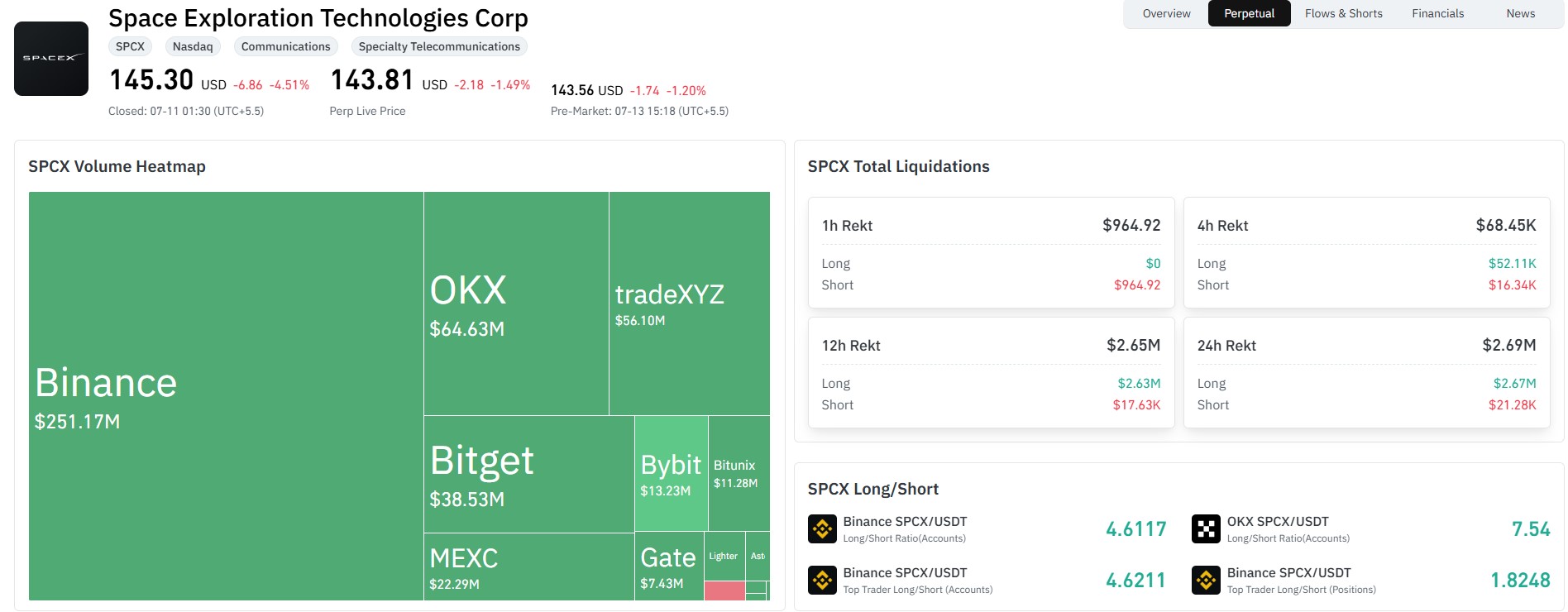
What is the SpaceX stock price prediction for 2026?
Wall Street has not thrown in the towel. Morgan Stanley, a lead underwriter on the SpaceX IPO, initiated coverage with a $300 price target. That would mark a 33% jump from the stock's all-time high, not just its current price.
The bank's view rests on SpaceX's long-term growth story rather than short-term chart action.
The company reported $18 billion in revenue last year, according to IPO disclosures, while Musk has talked about a $1 trillion revenue target down the road, a gap analysts will be watching closely.
Market cap still stood near $1.9 trillion intraday as of Friday, despite the pullback.
When is the SpaceX earnings date?
SpaceX has not confirmed an exact date, but analysts widely expect the first public earnings report around August 6, 2026.
That date matters for another reason. It roughly lines up with the end of the IPO lock-up period, when employees holding shares from compensation packages become free to sell.
A wave of insider selling around that time could add fresh pressure to the stock.
SpaceX stock forecast: key levels to watch
Short-term traders are watching the $145 area as a support zone, since that is where the stock closed out the week and roughly matches its 52-week low.
A break below could open the door to further downside, while a reclaim of the $154 EMA cluster would be an early signal that buyers are stepping back in. Longer-term, the August earnings date and lock-up expiry are likely to be the next real catalysts, more so than daily price swings.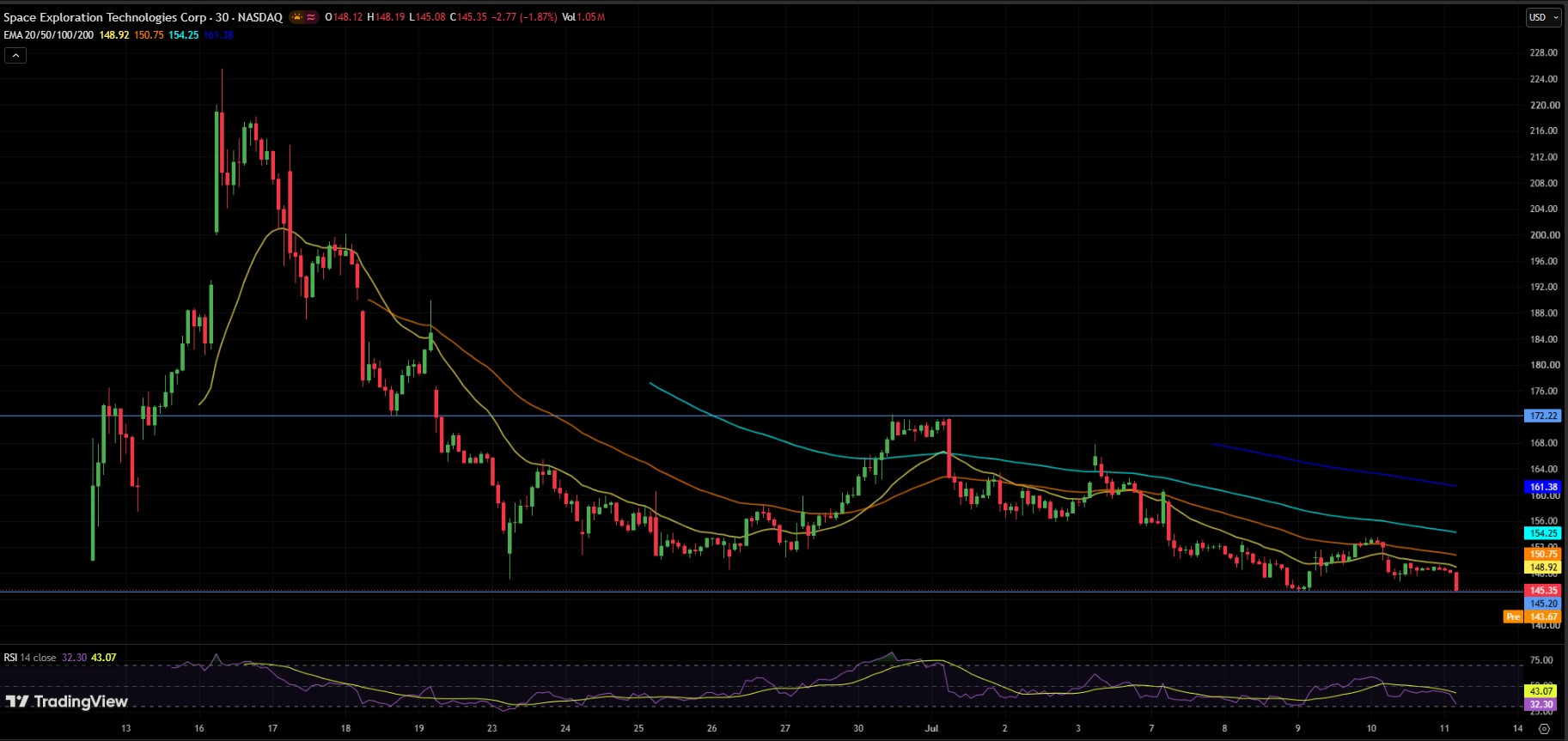
None of this guarantees a specific direction. SPCX remains a newly listed, high-volatility stock, and sentiment can shift quickly around headline risk, including a recent hack affecting SpaceX-linked crypto accounts that has added to broader jitters.
Disclaimer: This article is for informational purposes only and does not constitute financial, investment, or trading advice. Crypto markets are highly volatile, and past performance does not guarantee future results. Always do your own research and consult a licensed financial advisor before making investment decisions.