SpaceX Wins $1.6B US Space Force Deal, Can SpaceX Stock Recover Now?


SpaceX stock (SPCX) is having a rough summer. Shares hit a fresh all-time low of $107.01 this week, then bounced back to close at $116.41.
That is still nearly 50% below the June peak of $225.64, and it puts SPCX at the center of this year's biggest lockup story on Wall Street.
Two dates now matter most for the stock. Earnings land on August 4. The lockup expiration follows on August 6. Traders want to know if the worst is over, or if the real test is still ahead.
Why is SpaceX stock falling right now?
SpaceX debuted on the Nasdaq on June 12 at $135 a share, then jumped to an all-time high of $225.64 within days. That briefly pushed its market cap above $3 trillion, ahead of Amazon and Microsoft.
Since then, SPCX has given back more than half its gains. Market cap has slid from $3 trillion to roughly $1.5 trillion, a drop of more than $1.5 trillion in paper value in about six weeks.
Some of the pressure traces back to a shift away from Falcon 9, long the company's steady moneymaker, as it leans harder into Starship.
A mostly successful 13th Starship test flight last week, which deployed 20 Starlink V3 satellites and landed softly in the ocean, did little to stop the slide.
What is the SpaceX lockup expiration on August 6?
Right now, only about 4.9% of shares can actually be traded. The other 95% are still locked up from the IPO.
That changes fast in August. Restrictions on about 911.5 million shares lift on August 6, just two days after the company reports its first earnings since going public. More shares are set to unlock through the rest of the year.
Timing | What unlocks | Why it matters |
Now | ~4.9% of shares tradable | Float is still very thin |
Aug 6 (2 days after earnings) | ~911.5 million shares (~20% of locked float, per market estimates) | Largest single unlock event so far |
September | ~14% of locked float (est.) | Next insider tranche |
October | ~14% of locked float (est.) | Employee tranche |
November | ~28% of locked float (est.) | Biggest scheduled release |
By December | Tradable float estimated near 40% | Based on current unlock estimates, not guaranteed |
More supply hitting a stock that is already falling has traders on edge. If early holders sell into a weak market, that could add fresh pressure on SpaceX stock just as it tries to find a floor.
Is Cathie Wood's ARKK fund buying the dip?
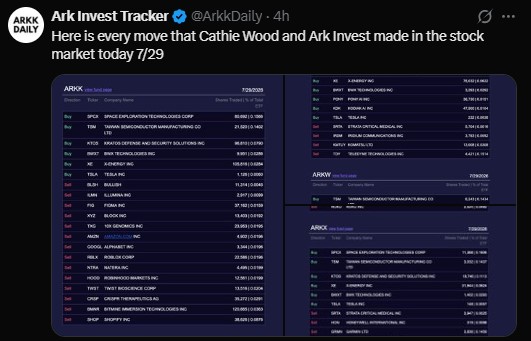
Not everyone is running for the exits. Ark Invest's ARKK fund logged a buy order for SPCX on July 29, adding 80,692 shares, worth about 0.1566% of the fund.
The same day, ARKK also picked up a small stake in Tesla (TSLA), buying 1,126 shares, or 0.0060% of the fund. Other buys that day included Taiwan Semiconductor, Kratos Defense, BWX Technologies, and X-Energy, showing continued interest in space and defense names.
Ticker | Company | Shares bought (7/29) | % of ARKK |
SPCX | Space Exploration Technologies Corp | 80,692 | 0.1566% |
TSLA | Tesla | 1,126 | 0.0060% |
What is the new SpaceX Space Force contract worth?
On the fundamentals side, SpaceX just won $1.6 billion from the U.S. Space Force for 18 Falcon 9 launches through 2027.
The missions will carry Pentagon satellites built to detect and track airborne threats, launching from Vandenberg Space Force Base.
The deal adds to a run of military contracts this year and ties into the Golden Dome missile defense program. It is a reminder that, even under pressure, the government side of the business keeps growing.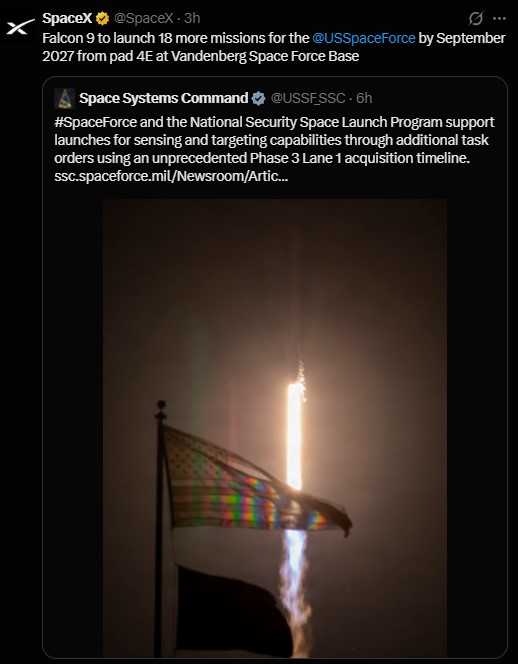
What does the stock chart show right now?
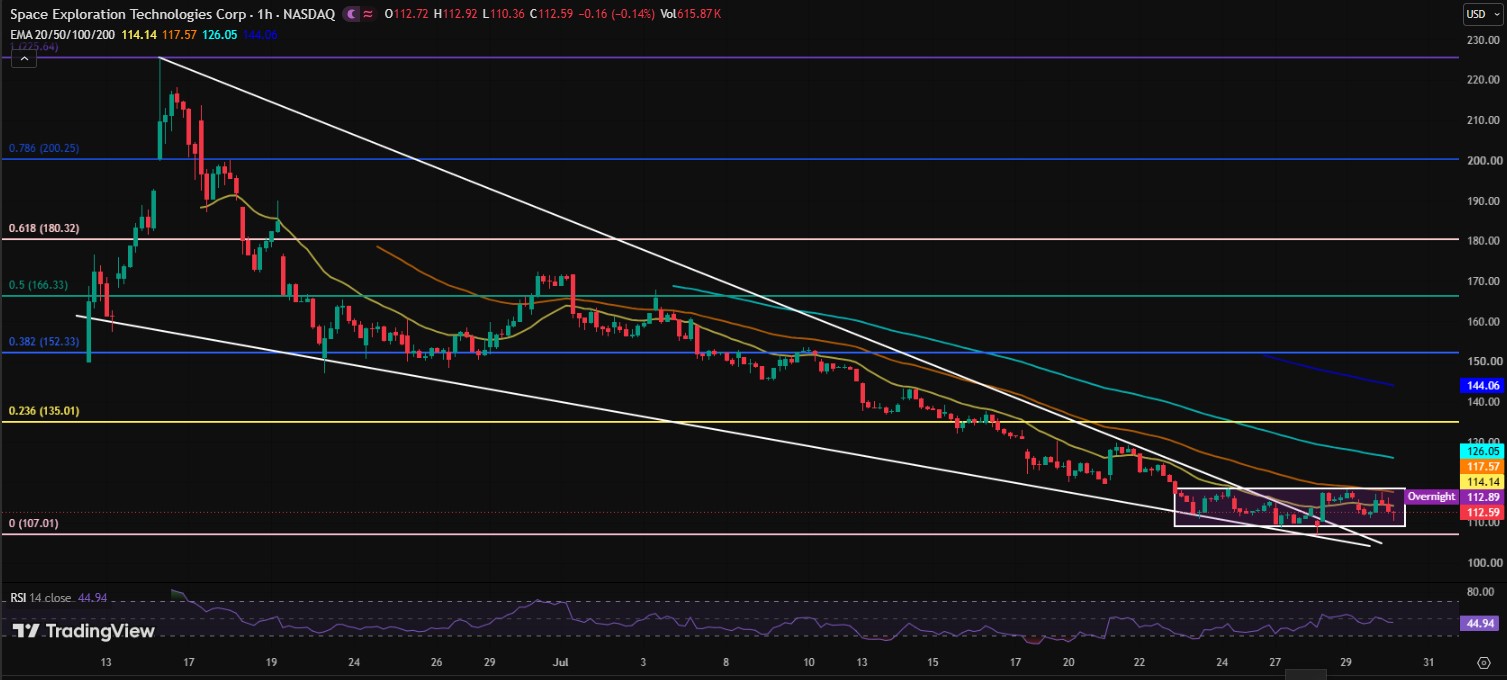
On the chart, SPCX is forming a falling wedge, a pattern where price makes lower highs and lower lows, but the drops get smaller over time. That often points to fading bearish momentum.
Shares are boxed in between $110 and $118 for now. A clean break above $118 on strong volume would be the first real sign of a turnaround. A break below $110 would likely send shares back toward the $107 low.
Level | Type | Possible next move |
$152 | 0.382 Fibonacci | Upside target if $135 clears |
$135 | 0.236 Fibonacci / old IPO price | Upside target if $126 clears |
$126 | Near-term resistance | First target on a breakout above $118 |
$118 | Wedge resistance | Break above signals possible reversal |
$110 | Wedge support | Loss of this level risks a retest lower |
$107 | Prior all-time low | Next support if $110 fails |
What is the SpaceX stock price prediction for 2026?
Wall Street is still mostly bullish on paper. The average 12-month price target sits near $236.71. Estimates range widely, though, from as low as $62 to as high as $800, showing how split opinions are on the stock's true value.
Alexander Morris, CEO of F/m Investments, has said the company has few real competitors and an "intergalactic-sized moat," but added that the AI spending tied to the stock is a big source of the recent swings.
Nobody can say for sure where the stock goes next. A lot may come down to how smoothly the market absorbs the August unlock, and whether Starship's progress starts to matter more than the short-term chart.
Disclaimer
This article is for informational purposes only and should not be taken as financial or investment advice. Past performance and analyst price targets do not guarantee future results. Always do your own research and consult a licensed financial advisor before making any investment decisions.








.jpg)