Strategy (MSTR) Stock Falls 5.09% as Strategy STRC Hits Record Low $89

MSTR Drops 5% as Strategy's Bitcoin Funding Stock Hits $89 Record Low
Strategy's preferred stock funding machine just seized up — and MSTR is paying the price.
Key Takeaways:
Strategy (MSTR) Stock fell 5.09% to $116.56 on June 18, 2026
STRC preferred stock hit a record low of $89, pausing Strategy's Bitcoin-buying ATM program
The Fed dot plot now shows 9 of 18 members expecting a rate hike before year-end
Strategy sold 32 BTC in May — its first Bitcoin sale since 2022 — to fund STRC dividends
MSTR Slides to Eight-Month Low
Strategy (MSTR) Stock closed at $116.56 on Wednesday, shedding $6.25 or 5.09% in a single session. It opened at $123.01, briefly touched $125.42, then fell to an intraday low of $116.36.
Volume reached 18.05 million shares. Premarket on June 18 showed MSTR recovering slightly to $118.58, as per CoinStats.
The technical picture is unambiguously bearish. RSI (14) sits at 35.71, approaching oversold territory.
All three major moving averages — MA-20 at $121.91, MA-50 at $125.35, and MA-200 at $196.21 — stack overhead in a classic downtrend formation.
MSTR has now dropped over 67% from its October 2025 high above $360.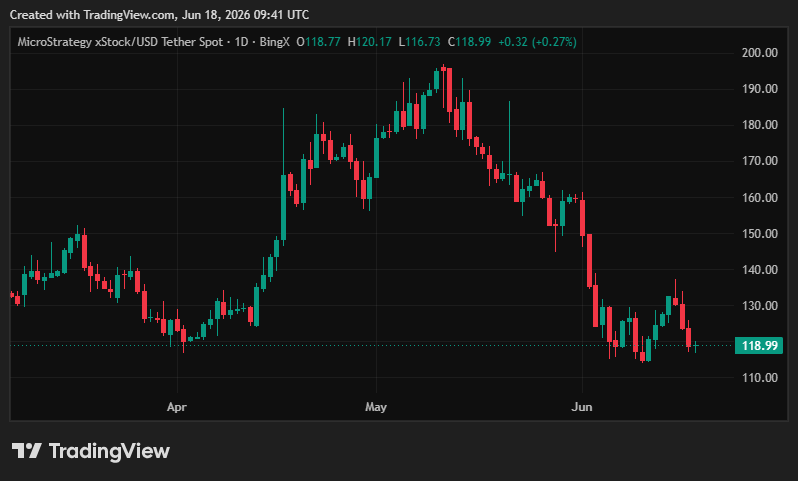
STRC Breaks Below Its Own IPO Price
The sharper story is happening in Strategy's preferred stock. STRC — the Variable Rate Series A Perpetual Stretch Preferred Stock — closed at $89 on June 17, touching an intraday low of $88.50.
Both are records since it launched in July 2025 near its $100 IPO price.
STRC is engineered to hold near $100 par through a monthly-adjusted variable dividend, currently yielding 12.9% annually. It hasn't traded at par since May 15.
The mechanism matters: when STRC trades above $100, Strategy issues new shares through its at-the-market program and converts the proceeds into Bitcoin. That pipeline is now shut.
On June 17 alone, STRC saw $417.5 million in trading volume — a sign of intense market stress, not routine activity.
Adding competitive pressure, Strive's SATA preferred stock trades above $99 with a 13.69% yield, pulling income investors away from Strategy's product.
Strategy Breaks the "Never Sell" Pledge
The STRC selloff didn't happen in isolation. In late May, Strategy sold 32 Bitcoin for approximately $2.5 million to fund STRC dividend payments — the company's first Bitcoin sale since 2022 and a direct break from Chairman Michael Saylor's longstanding commitment never to liquidate holdings.
Strategy currently holds approximately 846,842 BTC at an average cost of $75,658 per coin. With Bitcoin near $64,000, the portfolio carries a paper loss of roughly $11,658 per coin.
The company's USD reserve has declined from $2.25 billion at the start of 2026 to approximately $1.1 billion.
Analysts at Benchmark and TD Cowen say a full "death spiral" remains unlikely, though reserve erosion is a metric investors are now tracking closely.
A Hawkish Fed Tightens the Screws on Bitcoin
The Federal Reserve voted 12-0 to hold rates at 3.50%–3.75% on June 17. The headline decision was no surprise. The dot plot was.
Nine of 18 FOMC members now project at least one rate hike before year-end 2026. PCE inflation was revised sharply to 3.6% from a prior 2.7%. New Fed Chair Kevin Warsh eliminated forward guidance from the statement entirely.
Bitcoin dropped toward $63,000 in the aftermath, triggering $122 million in crypto liquidations.
For Strategy (MSTR) Stock, the logic is direct: higher rates increase the opportunity cost of holding a non-yielding asset like Bitcoin, hitting the core thesis on which the entire balance sheet is built.
Price Targets and What Comes Next
Key technical levels to watch:
Support: $114.73 (daily pivot S1), $119.83 (volume cluster)
Resistance: $125.35 (MA-50), then $129–$145 overhead
52-week low: $104.17
Fourteen Wall Street analysts maintain an average 12-month price target of $351.54 for MSTR — implying over 200% upside from current levels. Another analyst models a 2026 range of $124.03–$226.65.
Both scenarios hinge on a Bitcoin recovery well above $75,000. The near-term catalyst is simpler: if it cannot reclaim its $100 par value, Strategy's primary Bitcoin-buying engine stays offline — and MSTR has little fundamental tailwind without it.
This article is for informational purposes only and does not constitute investment or financial advice. Always conduct your own research and consult a licensed financial advisor before making investment decisions.
3 days ago
HOW CAN I EASILY RESTORE MY STOLEN FUNDS? GET IN TOUCH WITH WIZARD GEO COORDINATES RECOVERY HACKER I want to use this Medium to say big thanks to WIZARD GEO COORDINATES RECOVERY HACKER. I met someone online. He told me how he was making money in the crypto world and got me involved. At first, I was making money until I invested up to $525,000 in this investment scheme. When it came time to take my profit after the end of the contract, they asked for a commission, which I paid another $15,000. They kept asking for more until I talked to a friend about it. She promised to speak to her husband, who happened to know a company specializing in recovering assets lost through fake investment companies. They gave me the contact for WIZARD GEO COORDINATES RECOVERY HACKER. After reaching out to them, they asked for all the necessary details about the investment and got to work. They kept giving me follow-up updates, and I can’t describe my relief when they called me after two days to say that my investment and profit had been completely recovered. I just had to post this on every page I can to let people know that they can still recover their lost investment. I highly recommend WIZARD GEO COORDINATES RECOVERY HACKER. You can contact them on Telegram @Geocoordinateshacker or Email: them at Email: geovcoordinateshacker@gmail.com Website; https://geovcoordinateshac.wixsite.com/geo-coordinates-hack

1 week ago
I have been scammed by many recovery companies, and I can assure you that it is almost impossible to recover cryptocurrency that has been stolen or sent to the wrong address. Believe it or not, finding a legitimate recovery company like WEB WIZARD FUND RECOVERY without falling for a scam is difficult. I speak from personal experience: fundrecoverywebwizard@mail.com is a reliable option—perhaps not 100% guaranteed, but they will never leave you stranded.

1 week ago
I have been scammed by many recovery companies, and I can assure you that it is almost impossible to recover cryptocurrency that has been stolen or sent to the wrong address. Believe it or not, finding a legitimate recovery company like WEB WIZARD FUND RECOVERY without falling for a scam is difficult. I speak from personal experience: fundrecoverywebwizard@ mail.com is a reliable option—perhaps not 100% guaranteed, but they will never leave you stranded.
1 month ago
LOST YOUR CRYPTO? YOU WANT TO RECOVER YOUR STOLEN BTC? CONTACT WIZARD GEO COORDINATES RECOVERY HACKER It is truly amazing what you can achieve with the right information. I’m truly grateful for the service of WIZARD GEO COORDINATES RECOVERY HACKER, which was able to recover my cryptocurrency funds from fake investment accounts. Losing $650,000 of my hard-earned money was excruciating and devastating when I thought I could earn more from investing in cryptocurrency, not knowing that I had fallen for a scam. I was able to contact WIZARD GEO COORDINATES RECOVERY HACKER when I did my research online and came across their testimonies. I saw that WIZARD GEO COORDINATES RECOVERY HACKER has been helping many victims like me to recover their funds. I requested assistance from WIZARD GEO COORDINATES RECOVERY HACKER. They only required the information from my own wallet. The money was found in my wallet in less than 24 hours, and it turned out that the intruder had already spent some of it, leaving me with only about $530.000 cryptocurrency. I’m truly grateful for their service and I commend them for being professional and trustworthy, i decided to share my good news for those that are having same issues should contact him via Email: geovcoordinateshacker@gmail.com Telegram: @Geocoordinateshacker Website; https://geovcoordinateshac.wixsite.com/geo-coordinates-hack They are the real deal when it comes to recovering of lost cryptocurrency. Trust me, you won't be disappointed.
1 month ago
HIRE A HACKER YOUR STOLEN CRYPTO RECOVERY / BTC / USDT / ETH WITH THE HELP OF CAPITAL CRYPTO RECOVER. I want to share my experience publicly regarding cryptocurrency wallet recovery, I highly recommend you to contact CAPITAL CRYPTO RECOVER, a professional private investigator in the Bitcoin world. They have a certified expert security team specializing in Bitcoin Recovery Services and have helped many people worldwide recover their lost funds. My wife and I were defrauded by an online manipulator posing as an experienced crypto investment professional. We lost $9.2 Million Stolen BTC in cryptocurrency and were left feeling homeless. After spending hours searching for a reliable crypto recovery service, I discovered CAPITAL CRYPTO RECOVER online. By patiently explaining my situation to their team, I was able to recover all my funds. Remarkably, my money was returned to my wallet in less than 24 hours. I am extremely grateful to CAPITAL CRYPTO RECOVER for their excellent assistance—they truly were a godsend in my difficult situation. If you have fallen victim to a cryptocurrency scam, you can reach CAPITAL CRYPTO RECOVER through the following channels Email: Recoverycapital@fastservice.com OR Call/Text: +1 (336) 390-6684 Contact: Capitalcryptorecover@zohomail.com Website: https://recovercapital.wixsite.com/capital-crypto-rec-1
1 month ago
HIRE A HACKER YOUR STOLEN CRYPTO RECOVERY / BTC / USDT / ETH WITH THE HELP OF CAPITAL CRYPTO RECOVER. I want to share my experience publicly regarding cryptocurrency wallet recovery, I highly recommend you to contact CAPITAL CRYPTO RECOVER, a professional private investigator in the Bitcoin world. They have a certified expert security team specializing in Bitcoin Recovery Services and have helped many people worldwide recover their lost funds. My wife and I were defrauded by an online manipulator posing as an experienced crypto investment professional. We lost $9.2 Million Stolen BTC in cryptocurrency and were left feeling homeless. After spending hours searching for a reliable crypto recovery service, I discovered CAPITAL CRYPTO RECOVER online. By patiently explaining my situation to their team, I was able to recover all my funds. Remarkably, my money was returned to my wallet in less than 24 hours. I am extremely grateful to CAPITAL CRYPTO RECOVER for their excellent assistance—they truly were a godsend in my difficult situation. If you have fallen victim to a cryptocurrency scam, you can reach CAPITAL CRYPTO RECOVER through the following channels Email: Recoverycapital@fastservice.com OR Call/Text: +1 (336) 390-6684 Contact: Capitalcryptorecover@zohomail.com Website: https://recovercapital.wixsite.com/capital-crypto-rec-1
1 month ago
THE ONLY LEGITIMATE BITCOIN RECOVERY EXPERT // HIRE WIZARD GEO COORDINATES RECOVERY HACKER I had the most terrible moments of my life, a few weeks back when I lost all my savings to a self acclaimed bitcoin investment platform which promised me a massive return on my investment. I was so confused about these scammers, I had to do what everyone in my situation would do, I did some research and came across a lot of Testimonials about WIZARD GEO COORDINATES RECOVERY HACKER. I got to reach out to the expert. It took them 48 hours to help me recover my funds. Bitcoin recovery is very much real. I am a living testimony. Hope this helps as many people who have lost their hard earned money to scammers out of trust, you can reach them through the contact below for help to recover your scammed funds. Email: geovcoordinateshacker@gmail.com WhatsApp +1 ( 318 ) 203-3657 Telegram: @Geocoordinateshacker Website; https://geovcoordinateshac.wixsite.com/geo-coordinates-hack

2 months ago
I invested in bitcoin trading After losing $78.4 USDT) linked to a romance fraud scam worth of cryptocurrency through an online investment platform and later discovered it was a scam. After extensive research for recovery options, I contacted CAPITAL CRYPTO RECOVER based on positive client reviews and recommendations. Their professional security team guided me through the recovery process using advanced technology, and I was able to recover my lost cryptocurrency successfully. I am truly grateful for their support and assistance during such a difficult experience. I will advise you to contact CAPITAL CRYPTO RECOVER helped me recover my funds. For anyone facing similar issues, Website: https://recovercapital.wixsite.com/capital-crypto-rec-1 Email: Capitalcryptorecover@zohomail.com Telegram: @Capitalcryptorecover Contact: Recoverycapital@fastservice.com Call/Text Number: +1 (336) 390-6684
2 months ago
CRYPTO SCAM RECOVERY SUCCESSFUL – A TESTIMONIAL OF LOST PASSWORD TO YOUR DIGITAL WALLET BACK. My name is Robert Alfred, Am from Australia. I’m sharing my experience in the hope that it helps others who have been victims of crypto scams. A few months ago, I fell victim to a fraudulent crypto investment scheme linked to a broker company. I had invested heavily during a time when Bitcoin prices were rising, thinking it was a good opportunity. Unfortunately, I was scammed out of $120,000 AUD and the broker denied me access to my digital wallet and assets. It was a devastating experience that caused many sleepless nights. Crypto scams are increasingly common and often involve fake trading platforms, phishing attacks, and misleading investment opportunities. In my desperation, a friend from the crypto community recommended Capital Crypto Recovery Service, known for helping victims recover lost or stolen funds. After doing some research and reading multiple positive reviews, I reached out to Capital Crypto Recovery. I provided all the necessary information—wallet addresses, transaction history, and communication logs. Their expert team responded immediately and began investigating. Using advanced blockchain tracking techniques, they were able to trace the stolen Dogecoin, identify the scammer’s wallet, and coordinate with relevant authorities to freeze the funds before they could be moved. Incredibly, within 24 hours, Capital Crypto Recovery successfully recovered the majority of my stolen crypto assets. I was beyond relieved and truly grateful. Their professionalism, transparency, and constant communication throughout the process gave me hope during a very difficult time. If you’ve been a victim of a crypto scam, I highly recommend them with full confidence contacting: Email: Capitalcryptorecover@zohomail.com Telegram: @Capitalcryptorecover Contact: Recoverycapital@fastservice.com Call/Text: +1 (336) 390-6684 Website: https://recovercapital.wixsite.com/capital-crypto-rec-1
2 months ago
CRYPTO SCAM RECOVERY SUCCESSFUL – A TESTIMONIAL OF LOST PASSWORD TO YOUR DIGITAL WALLET BACK. My name is Robert Alfred, Am from Australia. I’m sharing my experience in the hope that it helps others who have been victims of crypto scams. A few months ago, I fell victim to a fraudulent crypto investment scheme linked to a broker company. I had invested heavily during a time when Bitcoin prices were rising, thinking it was a good opportunity. Unfortunately, I was scammed out of $120,000 AUD and the broker denied me access to my digital wallet and assets. It was a devastating experience that caused many sleepless nights. Crypto scams are increasingly common and often involve fake trading platforms, phishing attacks, and misleading investment opportunities. In my desperation, a friend from the crypto community recommended Capital Crypto Recovery Service, known for helping victims recover lost or stolen funds. After doing some research and reading multiple positive reviews, I reached out to Capital Crypto Recovery. I provided all the necessary information—wallet addresses, transaction history, and communication logs. Their expert team responded immediately and began investigating. Using advanced blockchain tracking techniques, they were able to trace the stolen Dogecoin, identify the scammer’s wallet, and coordinate with relevant authorities to freeze the funds before they could be moved. Incredibly, within 24 hours, Capital Crypto Recovery successfully recovered the majority of my stolen crypto assets. I was beyond relieved and truly grateful. Their professionalism, transparency, and constant communication throughout the process gave me hope during a very difficult time. If you’ve been a victim of a crypto scam, I highly recommend them with full confidence contacting: Email: Capitalcryptorecover@zohomail.com Telegram: @Capitalcryptorecover Contact: Recoverycapital@fastservice.com Call/Text: +1 (336) 390-6684 Website: https://recovercapital.wixsite.com/capital-crypto-rec-1