THORChain vs OKX Founder: Bitget Hack Sparks Decentralization Row

The Bitget Hack That Triggered the Clash
OKX founder Star Xu has publicly questioned whether THORChain is truly decentralized, pulling the cross-chain protocol into one of the more closely watched crypto disputes this week.
The disagreement, widely shared as the THORChain vs OKX debate, follows a major hack at Bitget and has reignited long-running questions about how permissionless networks should treat known stolen funds.
Bitget suffered a major security incident on September 25, 2026, with reported losses of over $387 million. On-chain data shared publicly showed the attacker swapping stolen ETH, AVAX, BNB, USDT, and USDC into ETH as outflows continued through the day.
A tracker later flagged that around $1.23 million worth of Ethereum linked to the attacker moved through Binance within roughly 48 hours. Commentary circulating alongside these updates claimed the protocol declined to help Bitget's recovery efforts, and this is largely where the THORChain vs OKX standoff began.
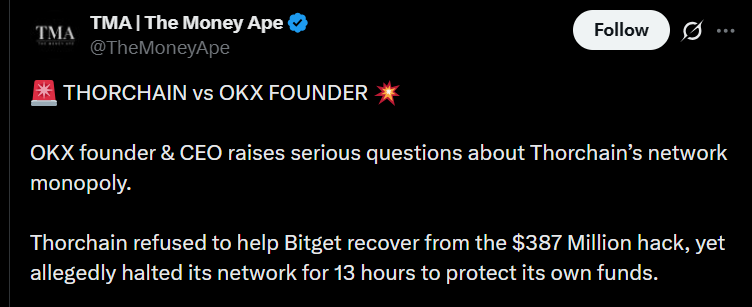
Source: TMA X Post
Star Xu's Validator Argument Explained
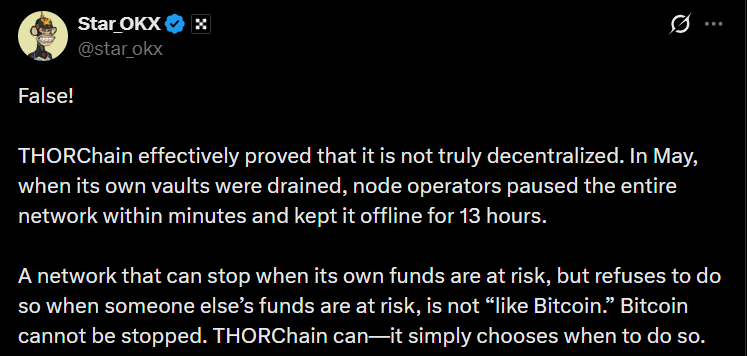
Responding directly, Star Xu argued that a TSS-plus-validator setup does not amount to genuine decentralization. He explained that a defined group of validators collectively controls assets sitting in TSS vaults, and once a signing threshold is met, those validators are able to move the funds.
In his view, this places the network closer to an intermediary than to base-layer consensus seen on Bitcoin or Ethereum. He added that spreading control across several validators does not remove the intermediary role itself, a point central to the ongoing THORChain vs OKX exchange.
Source: Star_OKX Post
Official Response and the Bybit Hack History
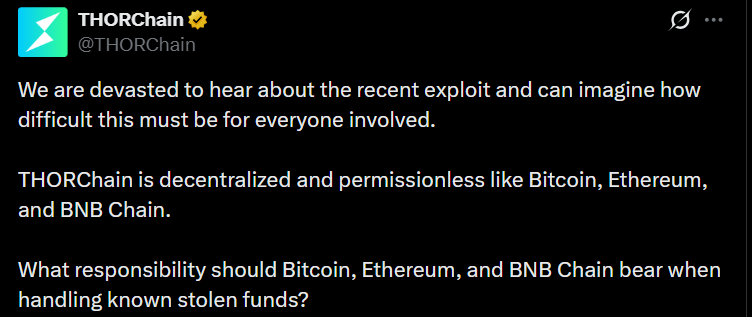
The network's official account pushed back, describing itself as decentralized and permissionless like Bitcoin, Ethereum, and BNB Chain, and asked what responsibility major base-layer chains carry when stolen assets move through them too.
Critics pointed to an earlier episode: after last year's $1.46 billion Bybit hack, nearly $1.2 billion in stolen funds was reportedly routed through the same infrastructure as attackers moved assets across chains.
Star Xu also referenced a separate incident from May, when the protocol's own vaults were drained and node operators paused activity within minutes, keeping the system offline for close to 13 hours.
Source: Official X Post
Bitget CEO Pushes For Action
Bitget CEO Gracy Chen formally asked the protocol to reject transactions tied to addresses linked with the exploiter.
She noted the flagged wallets are already public and remain under active industry surveillance, arguing that decentralization should function as a design principle rather than an excuse for facilitating large-scale stolen fund transfers.
Her request added further weight to the wider THORChain vs OKX conversation now playing out across trading desks and analyst channels.
Source: Wu Blockchain X Post
Key Figures Behind the Dispute
Event | Reported Detail |
Bitget security incident | September 25, 2026 |
Reported loss | Over $387 million |
Tracked ETH via Binance | $1.23 million |
$1.46 billion | |
Funds routed through network | Nearly $1.2 billion |
Network downtime (May incident) | Around 13 hours |
Why the THORChain vs OKX Dispute Matters Going Forward
This disagreement highlights a recurring question in crypto infrastructure: how cross-chain tools should respond once wallets are publicly tied to theft.
Supporters of the network say permissionless systems should not selectively block transactions, while critics argue that ignoring flagged wallets lets large-scale exploits continue unchecked.
Analysts following crypto news today noted the timing drew extra attention, coming only months after the earlier vault-draining incident that had already raised similar concerns among traders.
Conclusion: What Comes Next for THORChain vs OKX
The THORChain vs OKX standoff shows how fast decentralization claims face scrutiny once stolen funds move across a network. Neither Star Xu nor THORChain has softened their position, and Bitget's request to block flagged wallets has remained unanswered so far.
As exchanges and on-chain trackers compare notes ahead of the next major exploit, this case could become a reference point for judging cross-chain platforms, pushing the wider industry toward clearer standards for handling funds once they are publicly linked to theft, while traders watch closely for any official follow-up.
YMYL Disclaimer: This article is for informational and educational purposes only and should not be taken as financial or investment advice. Crypto markets are volatile, and details such as roles, plans, or figures mentioned here can change over time. Readers should do their own research before making any decisions based on this content.









