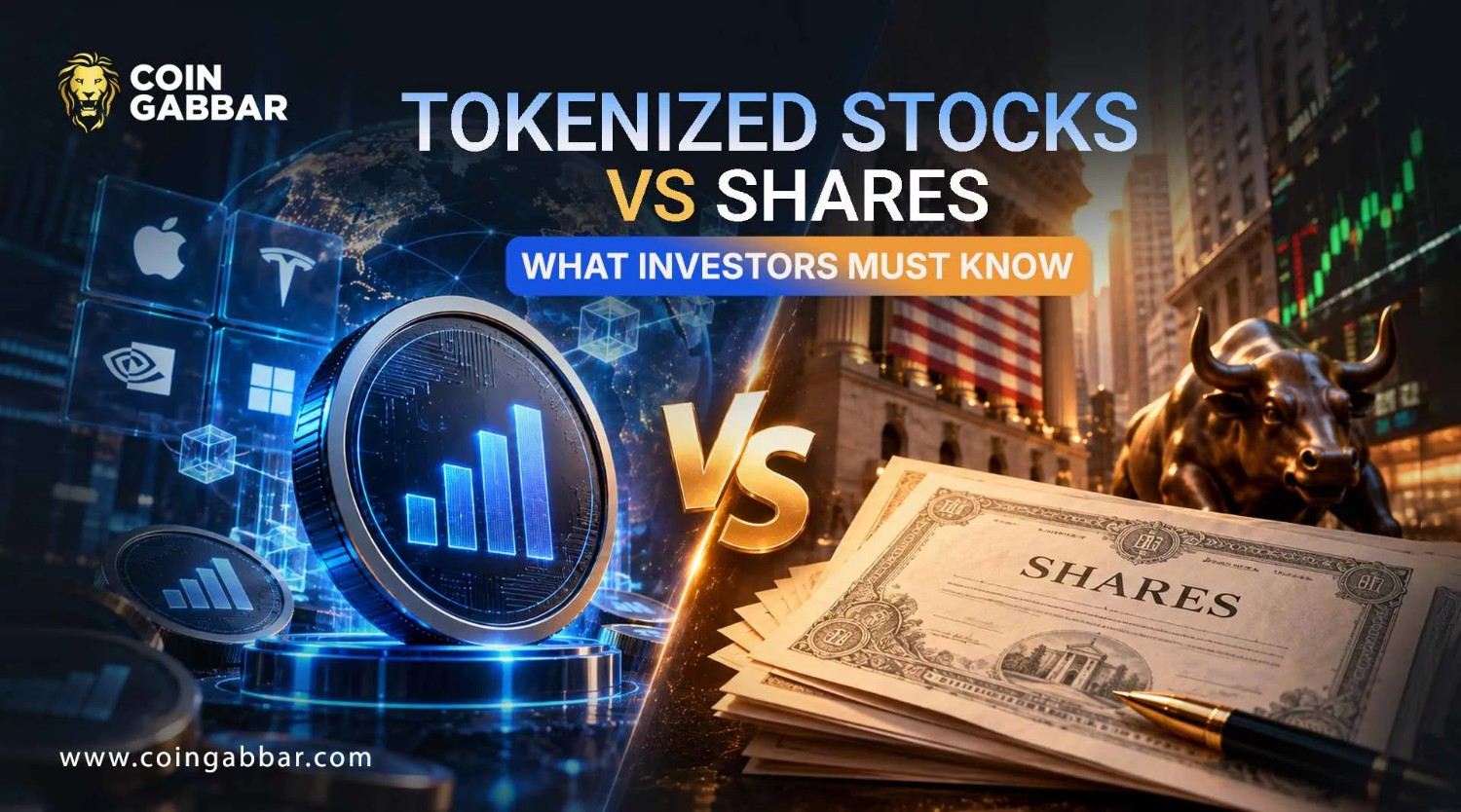
Tokenized Stocks vs Shares: What's the Real Difference? Know It All

Tokenized Stocks vs Shares: Key Risks and Benefits Explained in Depth
Tokenized stocks have become a regular talking point across the crypto industry, yet many investors still aren't entirely sure how they differ from traditional shares. It's a fair question.
The crypto world tends to introduce terms that sound sophisticated without always explaining what they actually mean in practice.
This article breaks the topic down step by step, cutting through the jargon so the comparison actually makes sense by the end.
The debate around tokenized stocks vs shares is only likely to grow louder as more platforms enter this space, which makes now a reasonable time to understand the full picture.
Tokenized Stocks — The Basics
Instead of a broker issuing a paper certificate or updating an internal database, ownership under this model gets recorded as a token on a crypto blockchain.
That, in short, is what a tokenized stock represents. The token stands for a claim tied to a stock's value, sometimes genuine ownership, sometimes simple price tracking, and the distinction depends entirely on how the token was structured at issuance.
This matters because it changes who can invest and when. A traditional stock exchange closes its doors at a set hour. A blockchain doesn't operate on that kind of schedule, and it makes no distinction between time zones or weekends.
There's also an access dimension worth noting. An investor based in a country with a restricted or underdeveloped stock market suddenly gains a route to exposure in companies that would otherwise be out of reach.
That alone accounts for much of why tokenized stocks vs shares remains a recurring subject in discussions about the future of investing.
What Sets Tokenized Stocks Apart
A few characteristics stand out once the mechanics are examined closely:
Trading can continue almost around the clock, weekends included, since there's no exchange floor closing for the night
Investors can purchase a fraction of a share rather than a full unit, lowering the barrier for smaller budgets
Transfers can settle within minutes, sometimes seconds, rather than the usual multi-day settlement window
Every transaction sits on a public ledger, keeping the history visible and difficult to alter quietly
None of this makes tokenized stocks inherently superior to the traditional system. It simply means they function differently, and that difference tends to appeal to a specific type of investor, typically someone comfortable with technology and willing to trade a measure of legal certainty for speed and flexibility.
Shares: The Established Standard
Stocks have been the foundation of finance worldwide for hundreds of years. Buying a stock means owning a legally binding share of the business, which includes voting power and rights to dividends, among other things.
All of this occurs within the framework of exchange markets with the help of brokers, clearinghouses, and government regulation. The process is much slower than any blockchain-based transaction, but there is a reason for all those years of legal protection.
When an investor purchases a share in a well-established company, there's a documented paper trail, active regulatory oversight, and a court system prepared to intervene if something goes wrong.
That level of protection largely doesn't exist yet for most tokenized products, and this gap sits at the center of the tokenized stocks vs shares discussion.
What Shares Actually Provide
Legally recognized ownership, acknowledged by courts, regulators, and the issuing company
Often bundled with voting rights and dividend entitlements
Trading restricted to defined market hours, without exception
Records maintained by regulated depositories rather than third-party platforms
That final point carries more weight than it may initially appear to. When something goes wrong, a company collapses, or a broker mismanages client funds, an established legal framework exists specifically to resolve the matter. Tokenized stocks are still developing equivalent safeguards.
Types of Tokenized Stocks Worth Understanding
Not every tokenized stock is structured the same way, and the distinctions carry real significance:
Equity-backed tokens: An actual share sits behind the crypto token, held by the issuer, meaning a genuine asset supports the digital version
Synthetic tokens: No underlying share exists; the token simply tracks the stock's price movement without conferring ownership
Security tokens: Structured to comply directly with securities regulations, making them more tightly regulated than the other two categories
This distinction shapes everything that follows. An equity-backed token behaves very differently from a synthetic one the moment circumstances turn difficult, such as a platform shutting down or facing legal action. Anyone considering tokenized stocks should understand which category applies before committing capital.
Why Investors Consider Tokenized Stocks
A handful of reasons consistently surface in this discussion:
Investors in countries with limited or restricted stock markets gain a route to participation
Trading isn't paused by time of day or public holidays
Fractional ownership allows entry with a smaller initial amount
Settlement occurs quickly, avoiding the typical two- to three-day wait tied to traditional trades
None of these reasons are without merit. They represent trade-offs. Speed and accessibility come at the expense of the legal protections that traditional shares continue to hold firmly.
The Core Differences, Point by Point
By categorizing the comparison between tokenized stocks vs shares, we get the following:
Ownership: Ownership rights through shares are legal and recognized by courts. Token ownership is basically nothing more than price exposure.
Trading Time: Token trading works round-the-clock. Shares have fixed market hours for trading.
Legislation: Share trading operates under the regulations established in the last few decades. There is a lot of uncertainty when it comes to token regulation in most countries.
Settlement Period: Tokenization settles in minutes, while share trading needs some extra time for verification purposes.
Legal Protection: Shares offer legal protection in court. The tokens are highly dependent on the reputation of the issuing platform.
Accessibility: Tokens open access for investors excluded from traditional markets. Shares still require a regulated broker and exchange relationship.
Risks Worth Taking Seriously
Both sides of this comparison carry genuine risk, though the nature of that risk differs considerably.
Tokenized stocks involve regulatory uncertainty that varies significantly between countries, platform trust concerns since not every issuer operates transparently, and the risk of losing a private key, which, in practical terms, means permanently losing access to that asset, with no support line available to help.
Crypto exchanges can also fail outright, taking investor funds with them. Equities are also subject to market risk, in addition to the risk of the individual company performing poorly or even going bankrupt.
There is a legal safeguard, however, in place in this regard, which is yet to be incorporated into tokenized securities regulation, insurance coverage in some cases, and a system to settle disputes.
The issue of price volatility also applies equally to both asset types. Both are capable of drastic changes in price over a short period of time, and both are subject to market
Conclusion
Neither option can be described as universally superior; the better choice depends entirely on what an investor is seeking. Legal certainty backed by a long track record clearly favors shares. Flexibility, lower entry costs, and continuous market access favor tokenized stocks.
Shares represent a system tested and refined over generations, built around stability. Tokens represent newer technology still establishing its footing, built around speed.
Both, ultimately, offer exposure to similar underlying value, just through two markedly different paths, each carrying its own balance of risk and reward.
Disclaimer
This article is intended for general information only and should not be treated as financial, investment, or legal advice. Tokenized stocks and traditional shares both carry risk, and their value can change quickly. Independent research and consultation with a licensed financial advisor are recommended before making any investment decision.