Abracadabra Plans Shutdown: MIM Stablecoin Faces a Brutal Collapse

Abracadabra Plans Shutdown as MIM Stablecoin Faces Total Insolvency
There's significant crypto news today coming out of the DeFi lending space.
The Abracadabra community has formally proposed shutting down the protocol entirely, after concluding that its MIM stablecoin is now severely insolvent with no realistic way to restore its dollar peg.
This governance proposal marks one of the more dramatic wind-downs the sector has seen, and it comes after years of repeated exploits finally caught up with the protocol's balance sheet.
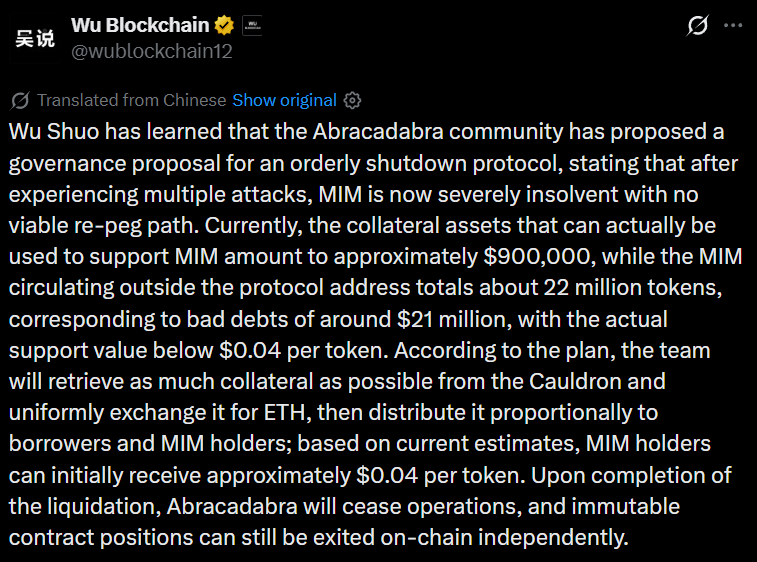
Source: WuBlockChain on X
Why Abracadabra Plans Shutdown Now
According to the community's own governance proposal on Snapshot, the protocol has suffered multiple attacks over time, leaving MIM in a position where a genuine re-peg simply isn't achievable anymore. The numbers behind this decision are stark:
Metric | Figure |
Executable collateral backing MIM | ~$900,000 |
MIM circulating outside protocol addresses | ~22 million tokens |
Total bad debt | ~$21 million |
Effective support per MIM token | Below $0.04 |
Portion of supply lacking collateral | Over 95% |
Put simply, for every dollar of currently in circulation, the protocol can realistically back less than four cents of it.
That's an insolvency gap too large to close through any normal recovery mechanism.
How the Wind-Down Process Will Actually Work
Rather than letting the situation deteriorate further, the community proposal lays out a structured, orderly liquidation.
The plan calls for the team to pull as much collateral as possible out of Abracadabra's lending vaults, known as Cauldrons, and convert everything uniformly into wrapped ETH (WETH).
From there, distribution follows a specific order:
Borrowers first receive whatever value remains from their deposited collateral, after their outstanding debt (valued at $1 per MIM) is deducted
Remaining funds are then distributed proportionally to holders based on their token balances
MIM's holder can currently expect to recover approximately $0.04 per token based on present estimates
Distribution will run through Merkl smart contracts to handle the proportional payouts
MIM's Priority Over SPELL in the Liquidation
One important structural detail buried in this proposal: MIM, as a CDP-based stablecoin, is treated as a liability the protocol owes, which puts it ahead of Abracadabra's own governance token, SPELL, in the repayment order.
Until MIM's liabilities are fully settled, SPELL effectively holds no accounting value under this plan, a clear signal of just how far down the priority list token holders outside of itself now sit.
What Happens Once Liquidation Completes
Once this liquidation process wraps up, Abracadabra will formally cease operations.
That said, the proposal makes a point of noting that immutable contract positions can still be exited on-chain independently, meaning certain positions built on unchangeable smart contracts won't simply vanish or become permanently locked, even after the broader protocol stops functioning.
The Bigger Picture for DeFi Lending
This situation didn't happen overnight. Abracadabra has accumulated losses exceeding $21 million from multiple exploits over time, and experienced a severe depeg back in June, well before this shutdown proposal ever surfaced.
Seeing a protocol that once handled meaningful lending volume reach this point is a sobering reminder of how repeated security failures can compound until a stablecoin's backing simply runs out.
It's the kind of crypto showdown that plays out slowly through governance forums and voting proposals rather than a single dramatic collapse, but the end result for token holders is much the same.
Conclusion
The decision behind why Abracadabra plans shutdown ultimately comes down to simple math: roughly $900,000 in real collateral cannot support $22 million worth of circulating MIM, no matter how the protocol tries to restructure itself.
If this Snapshot proposal passes, holders should expect to recover only a small fraction of their tokens' face value, around four cents on the dollar, while borrowers with active positions get first claim on whatever collateral remains. It's a difficult but transparent resolution to a debt problem that had, by the team's own admission, no viable path back to solvency.
Disclaimer
This article is for educational and informational purposes only and should not be considered financial or investment advice. Always conduct your own research before making investment decisions.














