Arc Chain News: Bitcoin Goes Live as Circle Unlocks BTC Borrowing


Arc Chain News: How Circle Turns Bitcoin Into USDC Without Selling BTC
There's a lot of Arc Chain news to unpack today, and it centers on one theme: Bitcoin is now genuinely productive on Arc, not just sitting in cold storage.
It has launched Cir-BTC on Arc alongside a new digital asset-backed borrowing feature, letting institutions turn BTC into working collateral without ever selling it.
If you've been following crypto news today, this is one of the more substantive infrastructure moves this week, connecting Bitcoin directly into Arc's stablecoin-native ecosystem.
What cirBTC Actually Is
According to Arc's official and its accompanying post, cirBTC is a 1:1 BTC-backed token that brings Bitcoin's liquidity directly into Arc's ecosystem.
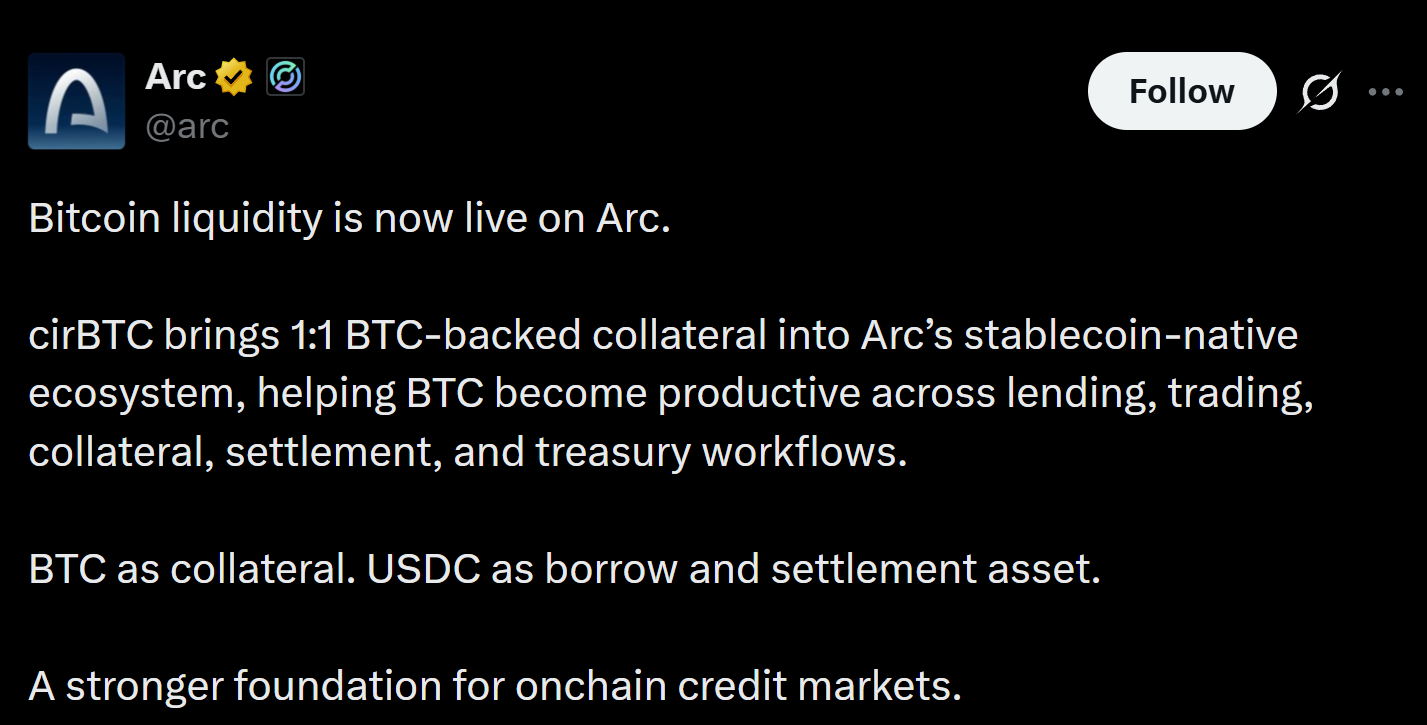
Source: Arc's official announcement
The setup is straightforward: BTC serves as collateral, while USDC functions as the borrowing and settlement asset.
This gives Bitcoin holders a way to put their holdings to work across lending, trading, collateral, and treasury workflows, all without giving up their underlying BTC exposure.
Per Circle's own detailed blog post, every CirBTC token is backed one-to-one by native BTC, with reserves that can be independently verified on-chain.
The Bitcoin itself is held by Circle National Trust, a federally chartered trust bank and qualified custodian, giving institutions a regulated custody layer underneath the token.
How Digital Asset-Backed Borrowing Works
This is really the centerpiece of today's Arc Chain news. Circle has launched a feature called Digital Asset-Backed Borrowing, or DABB, inside its institutional platform Circle Mint.
The whole process is designed as one coordinated workflow instead of the scattered, multi-step process that using wrapped Bitcoin in DeFi has traditionally required.
Here's how it works:
-
Deposit BTC and mint cirBTC
-
Select a supported third-party lending market
-
Supply Cir-BTC as collateral and borrow USDC
-
Receive the borrowed USDC directly in your Circle Mint balance
-
Repay the borrowed USDC whenever ready to release the Cir-BTC collateral
Because these positions are overcollateralized, access depends on collateral value and market parameters rather than a traditional credit underwriting process, and customers can manage, add to, or repay their position on their own schedule.
Where This Launches and Why the Network Choice Matters
DABB is live on two networks, Arc and Ethereum, and Circle frames the choice as genuinely operational rather than one being simply better than the other.
Arc brings CirBTC and USDC into infrastructure. Circle itself is designed specifically for stablecoin finance, with supported markets expected to offer competitive USDC borrowing rates at launch.
Ethereum, meanwhile, gives institutions access to deep, well-established lending markets and broad existing activity, which matters for teams already managing positions on protocols like Morpho.
At launch, Morpho is the first third-party lending protocol integrated with DABB, with support for additional protocols, including Aave, expected to follow as the feature develops.
Borrowing rates, collateral requirements, and liquidation thresholds are all set by whichever third-party market a customer chooses, not by Circle itself.
Why Circle Built CirBTC to Stay Neutral
One detail worth highlighting in this round of Arc Chain news is how deliberately Circle has positioned CirBTC.
The company has stated it doesn't operate a competing centralized exchange, decentralized exchange, or lending protocol, meaning its only real incentive is making CirBTC genuinely useful across as many venues and institutional workflows as possible, rather than steering usage toward its own competing products.
That neutrality is meant to make CirBTC a flexible option institutions can plug into whichever liquidity relationships and operating models they already use.
Why This Matters for Institutional Bitcoin Holders
For institutions holding large BTC positions, this launch solves a real, practical problem.
Bitcoin doesn't natively interact with smart contracts, so using it in onchain credit markets has traditionally meant navigating multiple platforms, wrapped token choices, and manual settlement steps.
A few reasons this matters:
-
Institutions can access USDC liquidity without selling a single BTC holding
-
Fewer handoffs between steps can reduce operational friction for treasury teams
-
Custody through a regulated trust bank adds a layer of assurance many institutions require before engaging with DeFi-style collateral markets
Conclusion
This wave of Arc Chain news marks a genuine step forward in connecting Bitcoin's liquidity to on-chain credit markets in a regulated, institutional-friendly way.
With CirBTC now live on Arc and Circle's new Digital Asset-Backed Borrowing feature letting eligible Circle Mint customers borrow USDC directly against BTC collateral, institutions gain a coordinated path from Bitcoin custody straight through to dollar liquidity, all while keeping their original BTC position intact.
For anyone tracking Bitcoin news today, this launch is a clear sign that BTC's role on-chain is expanding well beyond simple buy-and-hold exposure.
Disclaimer
This article is for educational and informational purposes only and should not be considered financial or investment advice. Always conduct your own research before making investment decisions.










