Arc Chain News: USDC Circulation Tops 624 Million, DeFi Deposits Rise


Arc Shares Fresh Data One Week Into Mainnet
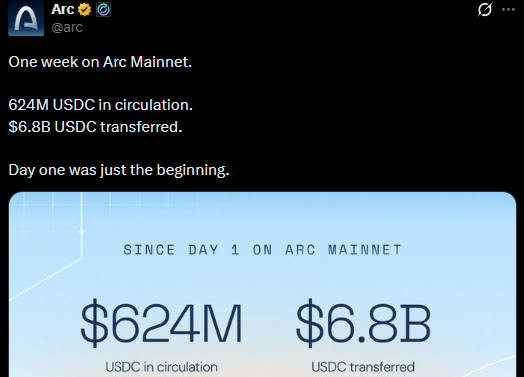
Arc marked its first week on mainnet with a fresh data update. The official account shared this Arc Chain News on September 24, 2026, reporting $624M in USDC circulating on the network and $6.8B in USDC transferred since day one.
One Week of Activity Since Mainnet Launch
This Arc Chain News update lands exactly seven days after the platform opened to the public on September 16, 2026. The team behind it called the launch week only the beginning, pointing to steady growth in stablecoin activity rather than a single opening spike.
Institutional validators securing the platform have not published separate volume figures of their own, so the numbers shared so far come directly from the project itself.
Founding validators named at launch included several large payment and asset management firms, a group the project has said is meant to secure the system rather than simply promote it.
Metric | Figure |
USDC in circulation | $624M |
USDC transferred since day one | $6.8B |
Days since mainnet launch | 7 |
Native fee asset | USDC |
The network uses USDC to pay transaction fees, tying overall usage directly to stablecoin movement rather than a separate gas token.
That design choice means rising transfer figures also reflect rising day-to-day activity on the platform itself, a detail worth noting for anyone following crypto news today.
Source: Official X Post
DeFi Deposits and Trading Volume Build Up
Onchain data from DeFi Llama shows early lending and trading activity taking shape alongside the stablecoin figures above.
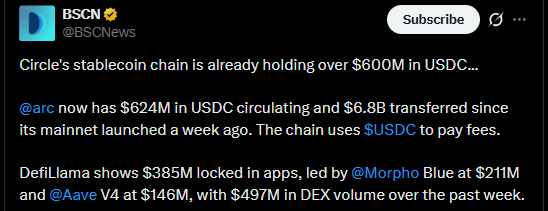
Total value locked, meaning the combined funds deposited across apps on the network, reached $385M, with two protocols accounting for most of that amount.
This Arc Chain News snapshot shows DeFi activity building at a pace close to the stablecoin numbers reported above.
Morpho Blue leads with $211M deposited, the largest single contributor to the total so far.
Aave V4 follows with $146M deposited, marking an early rollout on the platform.
Decentralized exchange volume reached $497M over the past week, separate from the lending totals above.
Protocol | Value Locked |
Morpho Blue | $211M |
Aave V4 | $146M |
Combined total | $385M |
This spread across lending and trading suggests builders are testing more than one kind of application, rather than concentrating usage in a single protocol during the opening days.
Source: BSCN X Post
Why This Arc Chain News Update Matters
A one-week snapshot rarely settles whether a young network will sustain usage on its own. Still, the combination of stablecoin transfers, lending deposits, and exchange turnover gives a broader read than any single figure by itself.
The platform launched with backing from major financial institutions acting as founding validators, a structure aimed at serving payment and settlement needs rather than general trading first.
Early figures suggest stablecoin movement, the core use case the project was built around, is already outpacing other activity types during this opening stretch.
That pattern also shows up whenever market trackers compare stablecoin volume against DeFi deposits from the same period, giving readers a quick sense of where usage is concentrated so far.
Expert Take
Analysts tracking young networks generally treat the first thirty days as a more reliable signal than opening week figures, since early usage often includes incentivized or one-time actions rather than steady demand.
Deposits spread across more than one protocol, as seen here between Morpho Blue and Aave V4, are typically viewed as a healthier sign than value concentrated in a single app.
Whether this Arc Chain News pattern holds through a full month will likely depend on whether transfers and deposits keep rising once initial attention fades, rather than flattening out after the opening rush.
Conclusion
The network closed its first week with growing USDC circulation, billions transferred, and early DeFi deposits spread across multiple protocols.
The next Arc Chain News update is likely to focus on whether this pace continues into a full month of operation, giving a clearer read than the opening week alone provided.
YMYL Disclaimer: This article is for educational purposes only and does not offer financial or investment advice. Readers should conduct independent research before making decisions based on early network data.










