Arc Mainnet Update: Circle’s USDC Chain Goes Live Today

Arc Mainnet Update: What Could Circle’s New Chain Unlock Next?
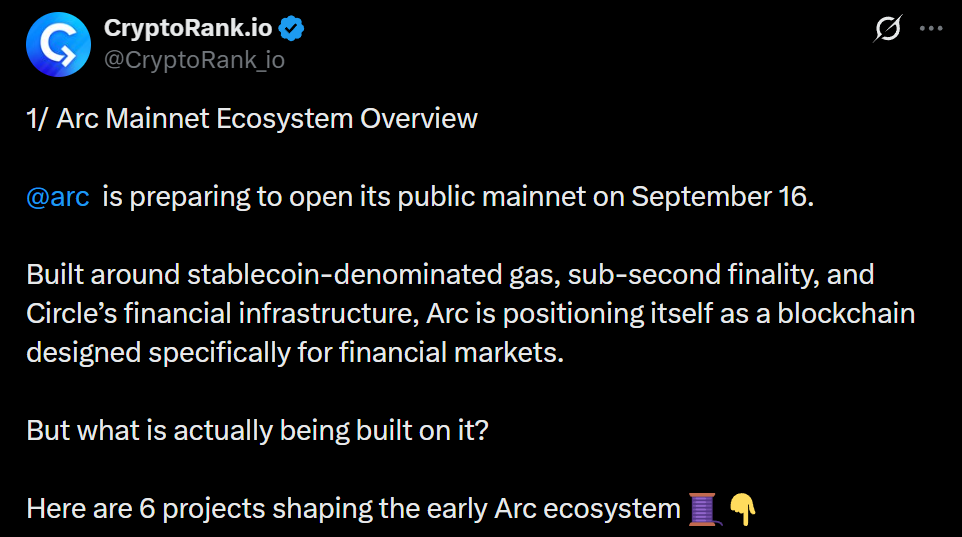
Circle is about to flip the switch on something big. This Arc Mainnet Update covers the launch of Arc's public mainnet on September 16, 2026, a blockchain built specifically to run financial markets, stablecoin payments, and even AI-driven economic activity, all on rails designed around USDC from day one.
And this isn't launching into an empty room; dozens of projects are already lined up and ready to deploy the moment the network opens.
Source: Crypto Rank on X
What Arc Actually Is
Arc is described as the "economic OS for the internet," an open Layer 1 network purpose-built for financial markets, real-time money movement, and agentic economic activity.
Rather than using a typical native token for transaction fees, gas on Arc is paid in USDC, giving businesses and institutions predictable, stablecoin-denominated costs instead of fees that swing with a volatile token price.
The network also runs on sub-second transaction finality, meaning trades and payments settle almost instantly rather than waiting through longer confirmation windows.
Before this public launch, Arc had already been running in a private mainnet with more than 100 ecosystem and institutional builders actively testing real use cases, ranging from automated payments and tokenized asset issuance to global FX and institutional-grade on-chain markets.
What Happens on Launch Day
Per Arc's own announcement, September 16 marks the network's move from private to public mainnet, and Circle is using the moment to unveil a full product suite built around the platform.
This Arc Mainnet Update includes a composable app framework for common on-chain workflows, AI-powered tools for building applications and smart contracts, tools for deploying and managing tokenized real-world assets, and interfaces designed to help developers, users, and even autonomous agents navigate the ecosystem.
The network will be secured by a founding validator cohort, backed by a broader group of institutions and builders already integrated ahead of launch.
The Ecosystem Already Building on Arc
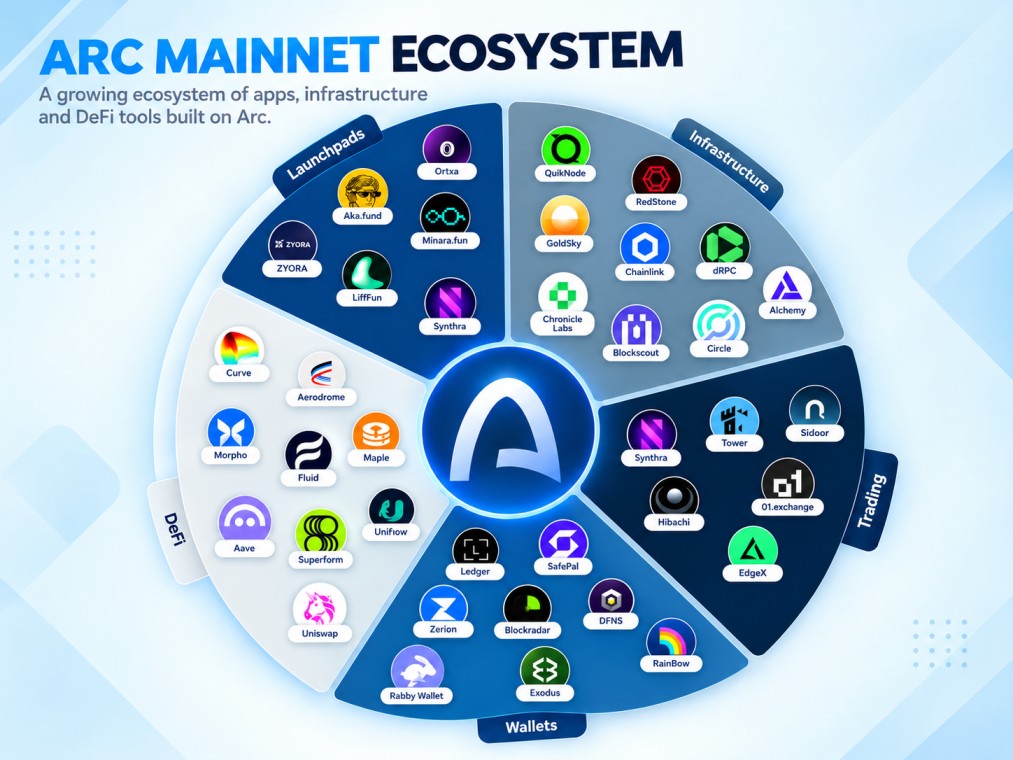
What makes this launch particularly interesting is just how much is already lined up to go live alongside it. Based on ecosystem tracking, dozens of projects span several distinct categories:
Category | Notable Projects |
Launchpads | Ortxa, Aka.fund, Zyora, Lifffun, Minara.fun, Synthra |
Infrastructure | QuikNode, RedStone, Goldsky, Chainlink, dRPC, Alchemy, Chronicle Labs, Blockscout, Circle |
Trading | Synthra, Tower, Hibachi, Sidoor, 01.exchange, EdgeX |
DeFi | Curve, Aerodrome, Morpho, Fluid, Maple, Aave, Superform, Uniswap, Unifww |
Wallets | Ledger, SafePal, Zerion, Blockradar, DFNS, Rainbow, Rabby Wallet, Exodus |
A few of these projects stand out for how they're approaching Arc's specific design.
Aka.fund is skipping the traditional bonding-curve launchpad model entirely, sending tokens straight into Uniswap liquidity with fee distribution handled through Uniswap v4 hooks.
UnitFlow Finance is building a full DeFi stack combining multiple AMM versions, a no-code token factory, and cross-chain USDC transfers in one place.
Tower is tackling a problem that shows up whenever a chain attracts multiple DEXs: fragmented liquidity, by scanning liquidity across Arc's exchanges and routing swaps based on depth, slippage, and cost.
The Institutional Angle: FX and Real-World Trading
One of the more ambitious bets in this Arc Mainnet Update involves bringing traditional institutional finance directly on-chain.
Hibachi is building an FX spot and perpetuals venue that combines an off-chain central limit order book for fast execution with zero-knowledge proofs, aiming to give institutional-grade foreign exchange trading a genuine on-chain home.
On the more retail-facing side, Sidoor is building an all-in-one trading terminal for everyday Arc users, bundling token discovery, trending markets, portfolio tracking, bridging, and a launchpad into a single interface.
Why This Launch Matters Beyond Just Another Chain
The real significance here isn't the number of apps launching; it's what Arc is trying to prove structurally.
A single settlement layer is being asked to support both permissionless crypto activity and institutional financial markets at the same time, something most blockchains have struggled to do well simultaneously.
A few reasons this combination matters:
USDC-based gas removes a major source of unpredictability for businesses used to traditional finance
Sub-second finality is a meaningful upgrade for any use case involving FX or real-time settlement
Deep integration with Circle's existing infrastructure gives Arc a direct bridge into stablecoin rails already used at scale
Conclusion
This Arc Mainnet Update marks a genuinely significant moment for stablecoin-native blockchain infrastructure, with Circle opening Arc's public mainnet on September 16 after months of private testing with over 100 builders.
With projects spanning launchpads, infrastructure, trading, DeFi, and wallets already positioned to go live at launch, and an explicit push to serve both institutional finance and open crypto activity on the same network, Arc's public debut is shaping up to be one of the more closely watched blockchain launches of the year.
Disclaimer
This article is for educational and informational purposes only and should not be considered financial or investment advice. Always conduct your own research before making investment decisions.










