Avalanche News: Why Is Goldman Sachs Bringing $100B to Lynq?

Avalanche News: How Does Lynq Give Crypto Firms Access?
Goldman Sachs just gave crypto's institutional plumbing a new asset to hold. This Avalanche News report breaks down what changed, and what it means.
Goldman Sachs Treasury Fund Joins Lynq
Goldman Sachs is opening its roughly $100 billion Treasury fund to institutional digital-asset firms. This Goldman Sachs Treasury Fund, called FTIXX, will be offered through Lynq. Lynq is a private, permissioned Avalanche Layer 1 network.
That makes this an Avalanche News story about Wall Street plumbing meeting crypto rails.
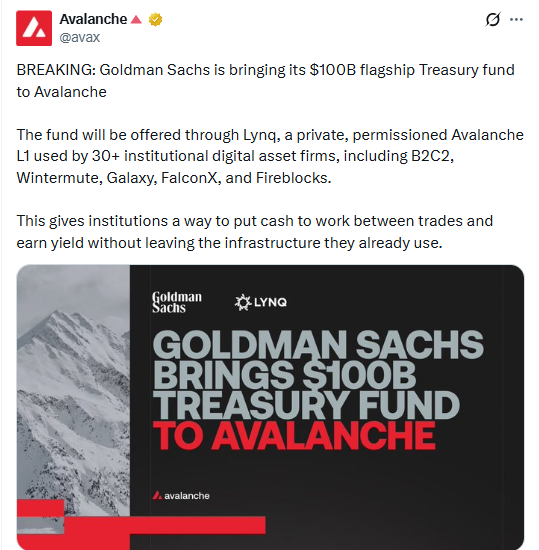
Lynq Avalanche infrastructure already connects more than 30 institutional digital-asset firms. Named firms include B2C2, Wintermute, Galaxy, FalconX, Crypto.com and Fireblocks. Collectively, the network reports more than $89 million in assets on the platform.
Firm | Role on Lynq |
B2C2 | Institutional liquidity provider |
Wintermute | Market maker |
Galaxy | Digital-asset financial services |
FalconX | Prime brokerage |
Crypto.com | Exchange and custody |
Fireblocks | Digital-asset custody technology |
Why the Goldman Sachs Treasury Fund Isn't a Tokenized Fund
Here's the key detail behind this Goldman Sachs Avalanche move: FTIXX isn't being tokenized. BlackRock's BUIDL and Franklin Templeton's BENJI both turned funds into on-chain tokens. The bank took a different route.
The Bank's Treasury Fund stays a normal, treasury product. Lynq just gives digital-asset firms a new door to reach it. That's a distinct model within the wider Avalanche RWA (real-world asset) conversation.
Most RWA funds go on-chain as tokens. This one didn't.
Lynq CEO Jerald David said the move reflects a "convergence" between traditional and digital-asset market participants. He said clients wanted a treasury asset with a different yield profile than what Lynq already offered.
How the Goldman Sachs Avalanche Integration Actually Works
FTIXX is the first external investment added to Lynq's network. The platform carried only one investment product before this. Getting the product live took real engineering, not just a listing.
The platform modified its technology to support the product.
Access was restricted to qualified U.S. clients only.
The platform integrated with Mosaic for the rollout.
Trades run through tZERO Securities, an SEC-registered broker-dealer. Clients need a relationship with both Lynq and tZERO. They also need completed onboarding and eligibility checks.
So this isn't open to the public. It's built for institutional crypto adoption, not retail traders.
The platform moved onto a permissioned AVAX Layer 1 in April 2026. That shift gave it more control over validators, configuration, privacy and performance. This investment bank AVAX integration builds directly on that base.
For firms on Lynq, the Goldman Treasury Fund solves a simple problem. Cash sits idle between trades. Now it can earn yield instead.
Firms can pull it out again once they need it. That's the practical case behind this AVAX News update.
How AVAX Reacted to the Goldman Sachs Treasury Fund News
AVAX itself moved on the news. The token traded near $11.35, up about 8.45% over 24 hours. Market cap sat near $5.03 billion, also up close to 9%.
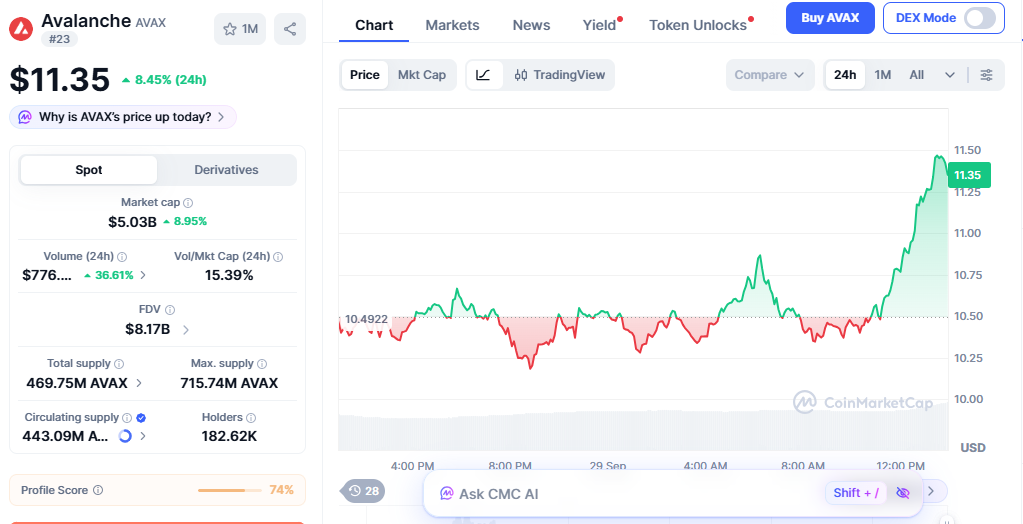
Trading volume jumped more than 36% in the same window.
Metric | Value |
AVAX price | ~$11.35 |
24h change | ~+8.45% |
Market cap | ~$5.03B |
Circulating supply | ~443.09M AVAX |
Holders | ~182.62K |
Avalanche institutional investors now have a fresh data point to track. This deal ties AVAX-based infrastructure to a major asset manager's distribution channel. Whether that brings lasting activity depends on how much cash actually flows through the platform next.
The Bottom Line
This Avalanche News story marks a fresh model for the bank's crypto access. The investment bank didn't tokenize its fund. It let Lynq's rails become a new front door to an existing $100 billion Goldman Sachs investment.
Watch that $89 million-plus network for growth once clients start using it directly.
YMYL Disclaimer
This article is for information purposes only and is not financial or investment advice. All figures are from the Wall Street firm and public market data as of September 29, 2026, and can change. AVAX price and market data are approximate and move constantly. Fund access is restricted to qualified institutional clients who complete onboarding. Digital assets are volatile and carry risk of loss. Verify details directly with the Wall Street firm and consult a licensed advisor before deciding.