Bitcoin News Today: BTC Holds $77K as Senate Vote & Fed Decision Loom


Bitcoin traded near $77,600 on Tuesday, September 15, retreating from an intraday high of $79,568 earlier in the week. The pullback came as odds shifted sharply against a major U.S. crypto regulation bill, and as investors braced for the Federal Reserve's rate decision Wednesday.
The bitcoin price today reflects a market caught between two catalysts: the Digital Asset Market Clarity Act's uncertain path through the Senate, and a Fed meeting where traders see little room for a rate cut.
Why Is Bitcoin Price Down Today?
On Polymarket, a prediction platform where users bet on real-world outcomes, the probability of the Clarity Act being signed into law in 2026 rose above 30% Monday before falling to about 18% by early Tuesday, according to the platform's data. That is a significant swing in a single trading day.
The bill, a comprehensive crypto market-structure measure negotiated for roughly a year, would split oversight of digital assets between the Securities and Exchange Commission and the Commodity Futures Trading Commission.
It requires 60 votes to clear a Senate procedural hurdle Tuesday, meaning Republicans need Democratic support to advance it.
Democrats have rejected a Republican draft of the legislation over its ethics provisions, according to a person familiar with the negotiations. Sen. Mark Warner, a Virginia Democrat, said his party's negotiators would send Republicans a counteroffer ahead of Tuesday's vote.
Sen. Cynthia Lummis, the Wyoming Republican who has championed the bill, criticized the pace of talks. "The Democrats want more," she said. "They always want more. If we waited another month, they would want more."
Not every industry executive views a delay as damaging. Coinbase Chief Executive Brian Armstrong said regulatory clarity could still arrive even without the bill, noting that the SEC and CFTC have signaled they are prepared to issue their own rulemaking.
How Does the Fed Meeting Affect Bitcoin Price?
Markets are pricing a 93.6% probability that the Federal Reserve holds its target rate at 3.75% to 4.00% at its September 16 meeting, according to CME FedWatch data, with just a 6.4% chance of a cut.
That marks a notable shift in sentiment. A week earlier, the probability of no change stood at 59.4%; a month ago, it was 68.9%.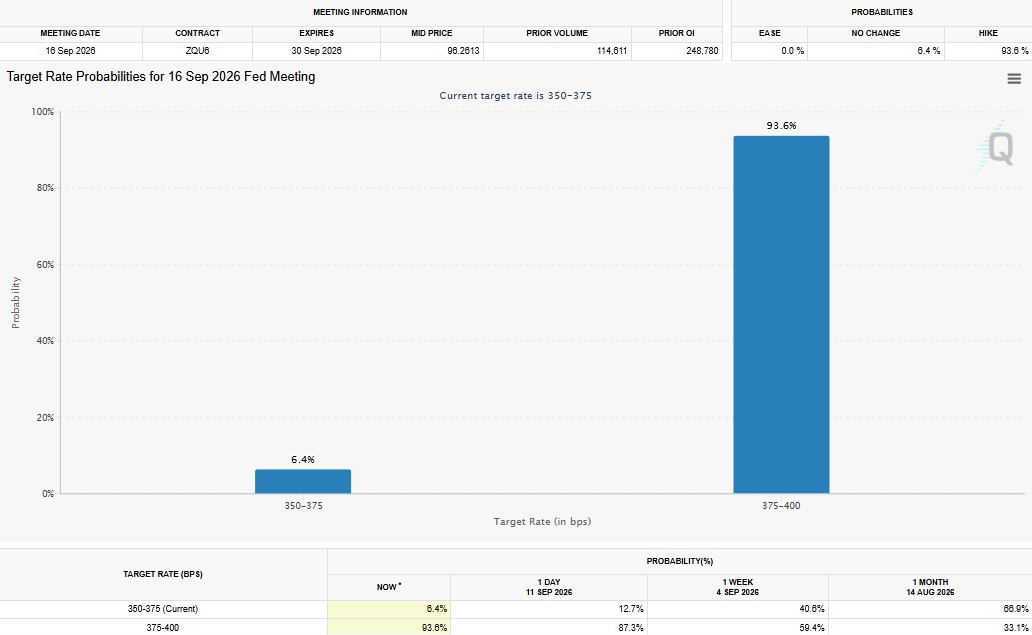
Adding to the inflation picture, West Texas Intermediate crude oil rose to about $103 a barrel Tuesday after dipping to roughly $100 overnight. Higher energy prices tend to feed inflation expectations, a dynamic that has historically weighed on bitcoin alongside elevated Treasury yields.
What Are Bitcoin Whales and Retail Traders Doing?
Blockchain analytics firm Santiment said wallets holding between 10 and 10,000 bitcoin, a group the firm tracks for its correlation with price direction, have reduced their holdings by 0.20% over the past three weeks, a period in which bitcoin traded above $80,000.
Smaller wallets holding less than 0.01 bitcoin moved in the opposite direction, adding 0.09% to their holdings since a late-August peak in market enthusiasm, Santiment said.
The firm noted that this divergence, larger holders trimming positions while smaller ones accumulate, has preceded short-term price tops in the past, though it does not guarantee a decline.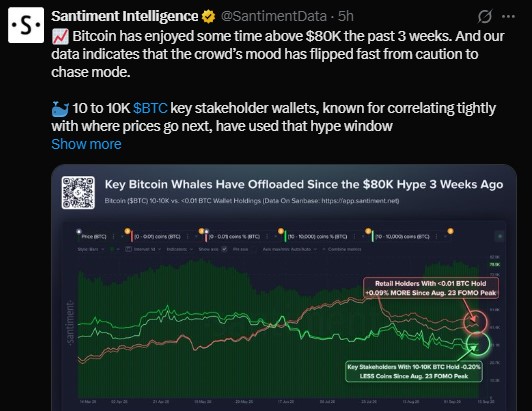
Will Bitcoin Price Go Up or Down?
A large concentration of sell orders sits between $80,000 and $83,000 on Binance futures order-book data, according to a chart shared by trader Ted Pillows.
He said a break above that range could trigger another leg higher and would help confirm that bitcoin's recent cycle low is behind it.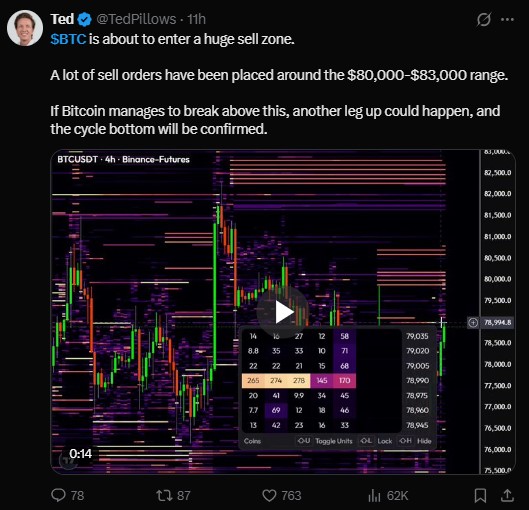
Are Bitcoin ETFs Still Seeing Inflows Today?
Even as spot prices retreated, demand for U.S. spot bitcoin exchange-traded funds held up. The funds recorded net inflows of $160.05 million in the most recent session, snapping a streak of five days without net inflows, according to data from SoSoValue.
BlackRock's IBIT led with $134.35 million in net inflows, followed by Fidelity's FBTC at $53.33 million. Morgan Stanley's MSBT and Franklin Templeton's EZBC drew smaller inflows of $9.75 million and $4.57 million, respectively.
Crypto ETFs broadly attracted $1.3 billion last week, following $3.3 billion the week before, marking a sixth consecutive week of inflows totaling $6.8 billion, according to the data.
IBIT alone accounted for $3.4 billion of that total. The four-week average for crypto ETF inflows climbed to $1.5 billion, the highest since November 2025.
What Is the Bitcoin Price Prediction Right Now?
On the four-hour chart, Bitcoin was trading near $77,348, just below its 20, 50, and 100 EMAs ($77,672, $77,889, and $77,548), but well above the 200 EMA at $75,289. RSI sits at a neutral 46.27.
Level | Price |
Resistance zone | $80,000–$83,000 |
Short-term EMA cluster | $77,548–$77,889 |
Support zone | $75,300–$76,000 |
A reclaim of $77,900 to $78,000 would keep the bitcoin price forecast pointed toward $80,000 and the $81,000–$82,000 zone. A break below $76,000 would expose the 200 EMA near $75,300.
For now, most of the near-term price action depends on how Tuesday's Senate vote and Wednesday's Fed decision play out.
Disclaimer
This article is for informational purposes only and does not constitute financial, investment, or trading advice. Past performance and technical indicators do not guarantee future results. Always do your own research before making any investment decisions.









.jpg)