Bybit Restricted Counterparty List Targets Illicit Crypto Flows


Bybit Restricted Counterparty List: Exchanges, Mixers, Darknet Links
Bybit has published a Restricted Counterparty List, and the names on it read like a roll call of crypto's most sanctioned corners. Garantex, Bitzlato, HTX, and more than twenty other platforms now sit alongside groups like Lazarus Group and Hamas on a single compliance document.
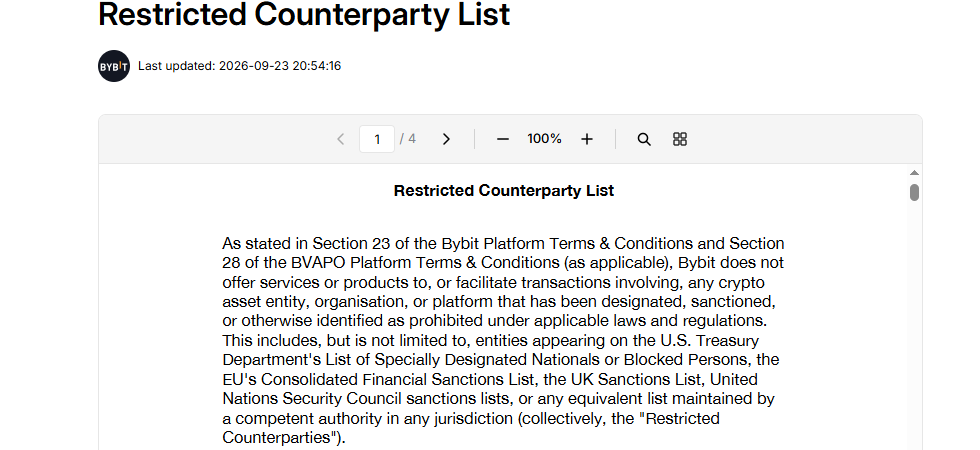
The document was last updated around September 23 to 25. The move tightens how far Bybit will let funds travel before stepping in.
Bybit Restricted Counterparty List Covers Exchanges and Mixers Too
The crypto sanctions list spans several categories rather than one type of bad actor. Trading platforms sit next to payment services, coin mixers, and darknet markets on the same page.
-
Trading and payment platforms: Garantex, Bitzlato, EXMO, Payeer, Nobitex, HTX, Bitpapa, Chatex, Cryptex, Grinex, Rapira, Wallex, Tetherland, Bit24, QvaPay
-
Guarantee and marketplace services: Huione Guarantee, Xinbi Guarantee, OMPFinex, Ramzinex, WhiteBird
-
Coin mixers and privacy tools: Samourai Wallet, Bitcoin Fog, ChipMixer, Sinbad
-
Darknet markets: Hydra Market
-
Sanctioned groups and organizations: Lazarus Group, Hamas, Ansarallah (Houthis), ISIS-K
Bybit exchange has been clear that this list is not exhaustive. A platform missing from it does not automatically count as safe, since restrictions apply to both direct and indirect dealings with any of these entities.
Why Bybit Built This Sanctions and AML Compliance List for Bad Actors
The reasoning lines up with sanctions regimes already in place across major jurisdictions, including:
-
the U.S. Treasury's OFAC list,
-
the EU's consolidated sanctions list, and
-
equivalent UK and UN rules.
Bybit is aligning its own screening with those frameworks to keep the platform from becoming a pathway for money laundering, sanctions evasion, or funding tied to designated groups.
This kind of self-regulation has become standard among larger crypto exchanges as scrutiny grows, particularly after major hacks send stolen funds moving through multiple platforms.
Screening under this system runs continuously rather than as a single check at signup, meaning accounts get flagged based on ongoing activity, not just a one-time review.
Other Crypto Platforms Taking the Same Approach
Binance took a similar step back in August, restricting deposits and withdrawals tied to HTX, Rapira, BitPapa, EXMO, and other platforms that overlap heavily with names now on Bybit's own list.
Coinbase and Kraken have followed comparable practices for years, particularly after events like the Ronin bridge hack pushed exchanges to block tainted addresses more aggressively.
What Bybit Restricted Counterparty List Means for Most Users Today
Most account holders with clean transaction histories will not notice any change. Risk rises for anyone whose activity touches the listed names, even indirectly.
-
Using peer-to-peer trades, deposits, or withdrawals tied to a listed platform
-
Receiving funds with on-chain history connected to a mixer, darknet market, or sanctioned address
-
Holding ties to high-risk jurisdictions or counterparties flagged under sanctions rules
Consequences for a flagged account can include frozen funds, suspended access, forced liquidation of open positions, and regulatory reporting. Chain analysis tools now make indirect connections easier to trace, so claiming a transfer was unrelated no longer holds up as a defense once funds show a documented link.
Disclaimer: This article is for informational purposes only and does not constitute financial or investment advice. Crypto markets carry significant risk. Always do your own research before making any investment decisions.