CFTC Mention Market Advisory Warns Exchanges of Manipulation Risks


CFTC Flags New Risks Around Event Betting Contracts
The Commodity Futures Trading Commission has turned its attention to a fast-growing corner of the event betting space.
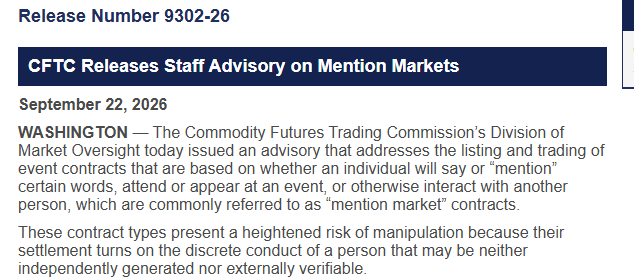
On September 22, 2026, the agency's Division of Market Oversight released guidance covering what are commonly called mention markets, bets tied to whether a person will say certain words or show up somewhere.
This CFTC mention market advisory lays out how such offerings can be listed safely. The move adds fresh regulatory scrutiny to a trading niche that has grown alongside broader interest in prediction platforms this year.
It also arrives as crypto exchanges keep expanding into event-driven betting products alongside their usual token listings.
Source: Official Press Release
What the Guidance Actually Covers
The release addresses event bets built around personal conduct. These include wagers on whether someone will speak specific words, attend an event, or interact with another person in some way.
The CFTC mention market advisory explains why this bucket is different. Their outcome depends entirely on what one individual does or says, not on a price feed or an economic data point that anyone can check.
Key details from the release:
Issued by the Division of Market Oversight
Published under Release Number 9302-26
Tied to Staff Letter No. 26-27 from the agency
Focused on listing standards, not an outright ban
Why These Products Raise Manipulation Concerns
The core issue is verification. Under the CFTC mention market advisory, settlement on these listings turns on conduct that may be neither independently generated nor easy to confirm from outside sources.
In plain terms, there is no public price feed or dataset to check against. A person could be paid, pressured, or simply choose to say or not say something, and that choice alone decides who wins the wager. That single point of failure is what regulators find troubling.
This differs from most listed derivatives, crypto futures, or standard futures listings, where settlement ties back to a transparent, external number rather than one person's discretion.
Rules Exchanges Must Follow Before Listing
The CFTC mention market advisory does not shut the door on these products. Instead, it lays out conditions exchanges must meet before listing them.
Requirement | What It Means |
Core Principle 3 | Venues may only list products not readily open to manipulation. |
Section 40.2 or 40.3 filing | Submissions must go through proper regulatory channels. |
Product-specific analysis | Generic justification is not enough; each listing needs its own review |
Non-exhaustive factor list | Staff gave examples, not a fixed checklist, for venues to weigh |
Designated venues, or DCMs, carry the responsibility of proving a given listing meets these standards before it goes live.
What This Means for Prediction and Crypto Platforms
Event betting has expanded quickly alongside crypto trading platforms and prediction venues over the past year. Many traders now move between crypto assets, sports outcomes, and personal-conduct wagers on the same platforms, often within a single app.
Today's guidance signals that regulators are watching this overlap closely. Exchanges offering products under the CFTC mention market advisory alongside crypto listings may need to document manipulation safeguards more carefully going forward.
For everyday users, the release does not change existing positions. It is aimed at exchanges and product designers, not a direct restriction on individual traders. Anyone active in crypto or event betting today should still expect these platforms to keep running as usual while venues adjust their filings behind the scenes.
Conclusion
The CFTC has not banned these listings, but the CFTC mention market advisory draws a clear line on how they must be designed and reviewed before going live.
Venues now carry the burden of showing their products meet manipulation-resistance standards under existing rules.
As prediction platforms and crypto-adjacent betting products continue to grow, this guidance is likely to shape how such listings are built going forward, especially for exchanges that mix crypto and event-based offerings today.
Disclaimer: This article is for informational purposes only and does not constitute financial, legal, or investment advice. Readers should refer to the official CFTC release for full regulatory details.