Atum Stablecoin Payment Network Launches With $13.5 Million Funding


Atum Funding Reaches $13.5M as Stablecoin Payment Network Launches
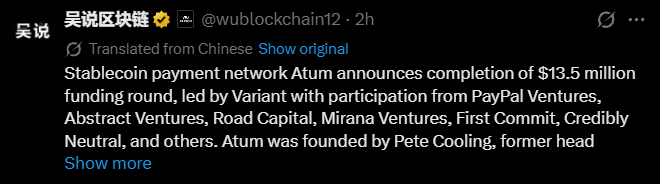
Stablecoin payment network Atum has emerged from stealth with $13.5 million in funding, positioning itself as a neutral coordination layer for global money movement. The round was led by Variant, with participation from PayPal Ventures, Abstract Ventures, Road Capital, Mirana Ventures, First Commit, Credibly Neutral, and strategic advisor Charlie Songhurst.
The announcement, made public on September 22, 2026, introduces a platform designed to connect payment companies, developers, and enterprises without issuing a token, running a blockchain, or taking custody of funds.
Atum was founded by Pete Cooling, former head of crypto product efforts at Visa, who describes the venture as an attempt to solve the fragmentation that has long defined cross-border payments.
Currencies, blockchains, apps, and local rails rarely interoperate cleanly, and each handoff between them tends to add cost and delay. Stablecoins have offered a faster alternative, but their spread across dozens of chains has simply moved that complexity onto end users rather than removing it.
At a Glance
-
Funding: $13.5 million
-
Lead Investor: Variant
-
Other Investors: PayPal Ventures, Abstract Ventures, Road Capital, Mirana Ventures, First Commit, Credibly Neutral
-
Founder & CEO: Pete Cooling
-
Business Model: Open payments coordination network
-
Blockchain: None operated directly
-
Token: None issued
-
Custody: Does not hold customer funds
-
Payment Model: Settlement providers compete to fulfill requests
-
Use Cases: Stablecoin payments, micropayments, cross-border settlement
-
Users: Payment firms, developers, enterprises, humans and AI agents
How Atum's Payment Marketplace Works
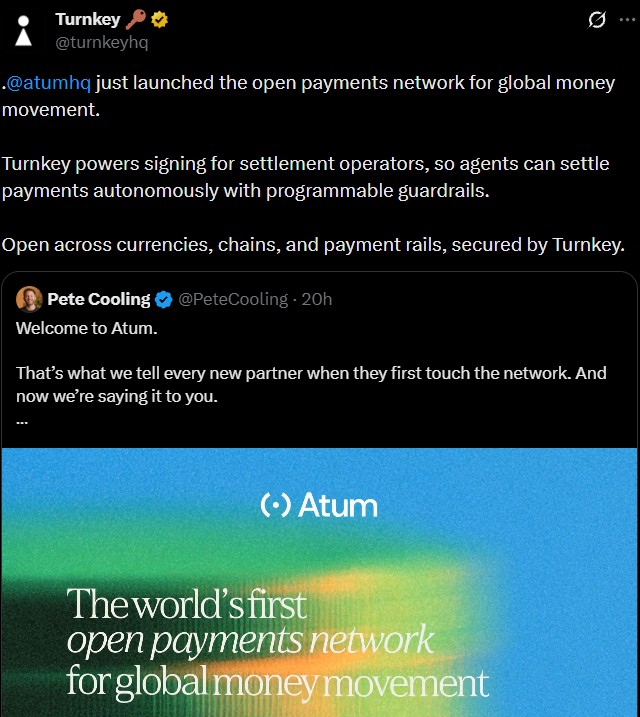
Rather than replacing existing pay infrastructure, stablecoin payment network Atum sits between participants, handling authorization, routing, and confirmation. Integrators, developers, and applications submit payment requests, and settlement providers compete to fulfill them across supported chains and stablecoins.
Senders choose the asset they want to send, while recipients specify the settlement asset they want to receive on the other end. That structure allows multiple chains, providers, and stablecoins to coexist on the same network without forcing any single standard.
Source: Wu Blockchain
No Token, Blockchain or Custody: Staying Neutral by Design
A central claim from Atum is that its neutrality is structural, not just stated. The company does not issue a native token or currency, does not run its own blockchain, does not custody user funds, and does not favor any particular paying rail.
Its revenue model is tied to transaction volume across the network rather than to steering activity toward a specific asset or provider, which the company argues keeps its incentives aligned with the participants building on top of it.
Stablecoin Micropayments and AI Agents Expand the Use Cases
Beyond conventional transfers, Atum supports stablecoin micropayments and cross-border settlement for both individual users and AI agents. The network is built to work with agentic paying protocols including x402 and MPP, and the company states that both human and agent-driven payments are already moving through the system. These are framed by Atum as current use cases rather than evidence of large-scale adoption, and the claims have not been independently verified.
Former Visa Crypto Executive Leads the Network
Cooling has spent roughly a decade researching blockchain-based payment systems, tracing his interest back to 2014 when he began viewing blockchains primarily as payments infrastructure.
At Visa, he led the company's crypto product team and served as its representative on the Linux Foundation OpenWallet, contributing to standards work across digital wallets, identity, and stablecoins.
"This is my life's work," Cooling said of Atum, adding that onchain accounts are, in his view, becoming the future of banking infrastructure.
Source: Turnkey X Post
Atum Connects Payment Companies, Fintechs and Developers
The network is designed to serve card issuers and acquirers, paid service providers, card networks, stablecoin orchestrators, wallets, fintechs, and enterprises, alongside developers building applications on top of it. Atum describes its model as an open-loop payments and commerce platform, with participation open to any integrator submitting payment requests.
Conclusion
With $13.5 million now in hand, Atum is open to builders at atum.xyz as it moves from stealth into a public build phase. The company's pitch rests on the idea of a credibly neutral coordination layer.
One that takes no custody, issues no token, and favors no rail can reduce the friction that currently defines cross-border and stablecoin payments.
Whether that structure can achieve meaningful adoption among payment companies, fintechs, and AI-driven applications remains to be seen, and is worth watching as the network develops.
Disclaimer: This article is for informational purposes only and does not constitute financial, investment, or legal advice. Cryptocurrency and stablecoin markets are volatile and carry risk. Readers should conduct their own research and consult a licensed financial advisor before making any investment decisions.









