What Is Audiera BEAT and How Does the Token Work


Why Is Audiera BEAT Getting Attention?
BEAT launched under $0.07, shot past $11, and has since dropped hard from that peak. Charts like that always drag in two kinds of people. Traders chasing the next swing. And folks who've never heard of Audiera BEAT, wondering what the project even does.
This piece is for both. We'll cover what Audiera is building, how the $BEAT token is put together, what its tokenomics and vesting look like, and where the roadmap actually stands right now.
What Is Audiera and How Does It Work?
Audiera calls itself an "agent-native participation economy." Strip the jargon and it means this: a platform where AI agents and human users both count as economic participants, not just automated tools serving customers.
Most crypto and gaming platforms still assume every user is human. Audiera's docs push back on that. The stated goal is a system where AI agents carry their own identity, follow set incentive rules, and interact directly with people and with each other.
The whole thing is wrapped around a rhythm and dance-game format, reportedly built on IP tied to the old Audition dance game franchise. Two AI performers, Kira and Ray, act as the project's example "Operator Agents." They make music and interact with players inside the game.
It all runs on BNB Chain. Per the official docs, live products include a Web3 dApp, a mobile rhythm game, a Telegram mini-app, and an AI music studio where users generate tracks and vote on them.
How Does the Audiera BEAT Token Work?
$BEAT ties all of this together. The docs call it the "core economic coordination layer" for the ecosystem.
Audiera says $BEAT is used for:
Rewarding gameplay and general platform participation
Paying incentives for AI-assisted music creation and content
Powering community voting and curation on tracks
Unlocking premium features and platform perks
Supporting community governance — a future plan, not a live feature yet
That governance point is worth pausing on. It's described as something coming later, not something you can do today.
The docs also split participants into two roles that plug into the token system: Operator Agents, which create content and drive activity, and Player Agents, which right now are mostly human users. The architecture is built to eventually let autonomous agents take on that Player Agent role too — but that's still a forward-looking piece of the roadmap.

Audiera BEAT Tokenomics: Supply, Allocation and Vesting:
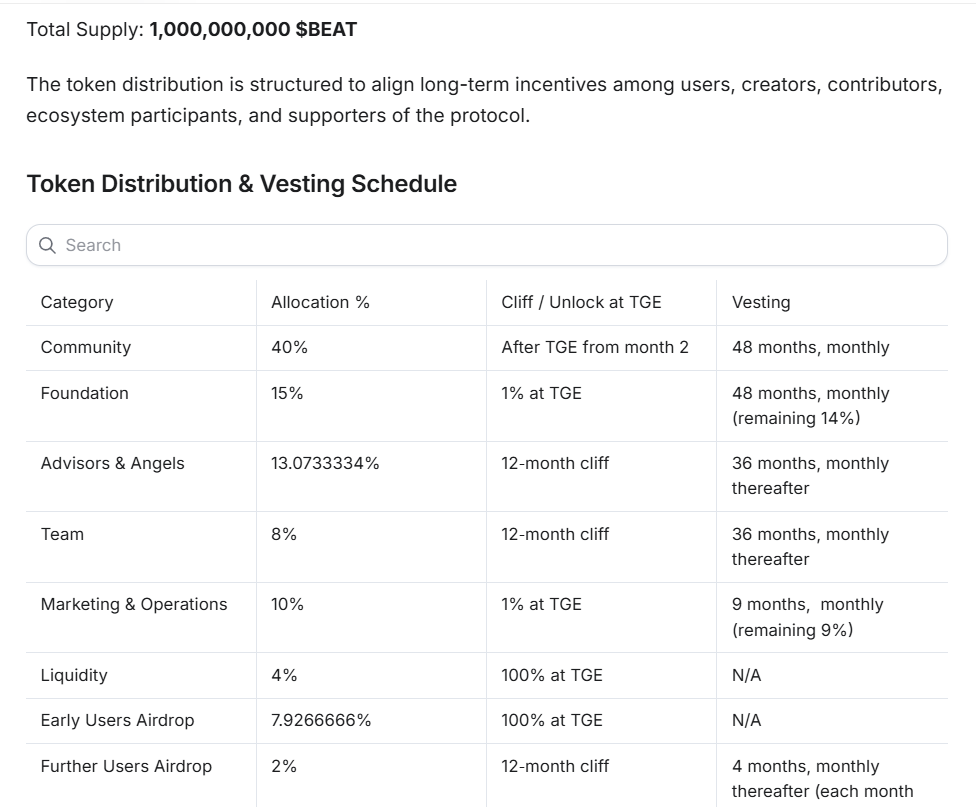
BEAT has a fixed total supply of 1,000,000,000 tokens, per the official token economics page.
Category | Allocation | Unlock at TGE | Vesting |
Community | 40% | Starts month 2 after TGE | 48 months, monthly |
Foundation | 15% | 1% at TGE | 48 months, monthly (remaining 14%) |
Advisors & Angels | ~13.07% | 12-month cliff | 36 months, monthly after cliff |
Marketing & Operations | 10% | 1% at TGE | 9 months, monthly (remaining 9%) |
Team | 8% | 12-month cliff | 36 months, monthly after cliff |
Early Users Airdrop | ~7.93% | 100% at TGE | None |
Liquidity | 4% | 100% at TGE | None |
Further Users Airdrop | 2% | 12-month cliff | 4 months, 0.5% monthly |
Source: Audiera Token Economics documentation
Two things jump out. Community gets the biggest cut, at 40% — Audiera is clearly betting on user rewards and airdrops to drive growth, rather than stacking tokens toward insiders.
Team and advisor allocations both sit behind a 12-month cliff, so nobody on the inside can sell right out of the gate. That cliff doesn't last forever, though — once it lifts, monthly unlocks start, and that's worth tracking over time.
Audiera BEAT Price, Market Cap and Circulating Supply
As of August 12, 2026, BEAT traded around $0.95, per CoinMarketCap, with roughly 330.5 million tokens in circulation — about a third of total supply. That puts market cap near $315 million and FDV near $952 million. The gap between those two numbers matters: market cap counts tokens actually in circulation, FDV pretends every locked token is already unlocked at today's price.
Price-wise, it's been a rollercoaster. All-time high of $11.10 on June 12, 2026. All-time low of $0.06755 back on November 2, 2025, right after launch. BEAT sat over 90% below that high at the time of writing.
BEAT reportedly hit exchanges through a Binance Alpha listing in early November 2025, with an airdrop for early users through that same channel. Its contract lives on BNB Chain and is publicly viewable on BscScan. The project says its contract was audited by Beosin, and CertiK's public score sat in the low 4s out of 10 as of this research — worth checking fresh on CertiK's site, since those scores get updated.
Audiera Beat 2.0 Roadmap: Phases and Development Plans
Audiera lays out five roadmap phases in its Beat 2.0 Roadmap documentation.
Phase | Focus | Stated Status |
1. Participation Infrastructure | dApp, mobile game, Telegram app, AI music studio, BEAT economy | Completed |
2. Persistent Agent Identities | Kira and Ray AI agents, memory systems | Completed / ongoing |
3. Agent Participation Layer | Player Agents, participation scoring, agent rewards | Partially completed |
4. Agent Economy | Agent wallets, agent deployment, skill marketplace | Target 2026–2027 |
5. Open Agent Network | Agent-to-agent coordination, open marketplace, third-party agents | Long-term, no fixed date |
Phases 1 and 2 are the parts Audiera says are already live. Phases 4 and 5 are the bigger swing — agents that hold their own wallets, get deployed by users, and trade skills with each other inside an open network.
Audiera BEAT Risks: Token Unlocks, Volatility and Execution
Risk Area | What to Watch |
Price volatility | BEAT swung from under $0.07 to over $11 and back within roughly nine months |
Vesting unlocks | Community, foundation, team, and advisor tokens unlock monthly for years — watch for rising supply |
Concept execution | The "agent-native economy" vision (phases 4–5) is largely unbuilt |
Governance isn't live | Community governance is a stated future feature, not something you can use now |
Audit ≠ safety guarantee | A Beosin audit and CertiK score lower certain risks but don't erase smart contract or market risk |
Regulatory status | The "not a security" claim comes from the project, not a regulator |
Audiera BEAT Outlook: What to Watch Next?
The stronger signal is real product activity — a live game, a music studio, an AI agent paired with an actual audience, and token trading with real volume.
The bigger question mark is the distance between phases 1-2 and phases 4-5. Going from "AI agents with personas" to "AI agents that hold wallets and trade autonomously with each other" is a far harder problem than shipping a rhythm game.
The number worth watching isn't price — it's circulating supply. At roughly a third of total supply circulating, two-thirds of BEAT is still locked. As those unlocks land monthly over the next few years, that's a supply story that plays out regardless of what the chart does day to day.
Conclusion
Audiera is a BNB Chain project pairing an AI-driven rhythm game with a much bigger idea: a token economy where autonomous agents participate alongside humans. The $BEAT token, capped at 1 billion supply, funds rewards, content incentives, and — eventually — governance.
The early-stage product is real and already live: the game, the music studio, the AI performers. What's unproven is whether the more ambitious "agent economy" phases actually ship on the timeline the project describes.
Before acting on any of this, check current price and supply data on a live tracker, read the official docs yourself, and treat every roadmap date as a stated plan, not a guarantee.
Disclaimer:
This article is for informational and educational purposes only and does not constitute financial, investment, legal, or tax advice. Cryptocurrency assets are highly volatile and carry significant risk. Always verify project information through official sources and never invest more than you can afford to lose.