Top 10 Crypto APIs for AI Agents and Trading Bots (2026)

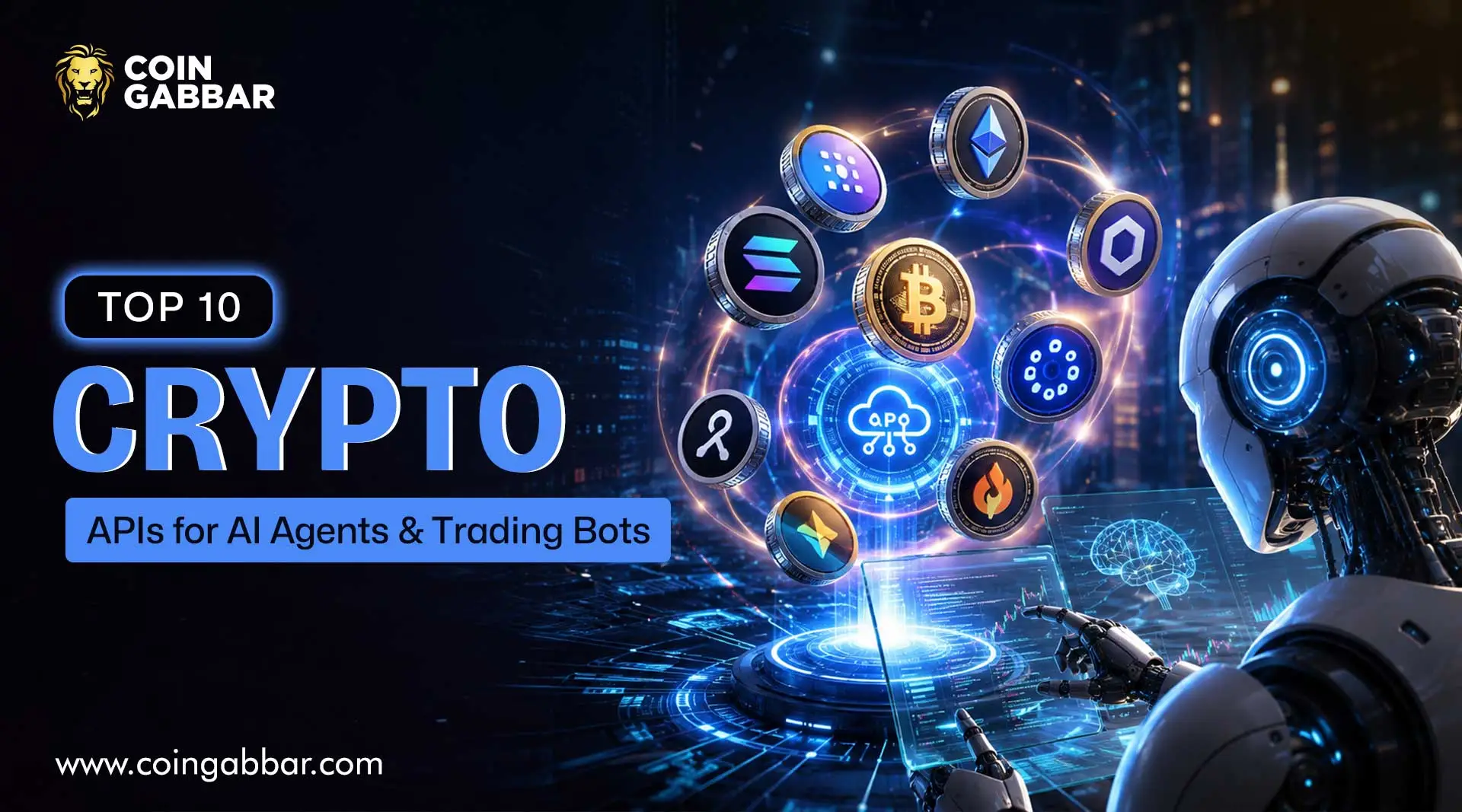
Top 10 Crypto APIs for AI Agents & Trading Bots in 2026
Autonomous trading agents and bots are only as good as the data feeding them. A strategy can be flawless on paper, but if its price feed lags, its on-chain view is stale, or it walks into a honeypot token, the edge disappears in seconds. That is why choosing the right crypto APIs for AI agents has become one of the most important decisions a builder makes in 2026 — arguably more important than the model or the strategy logic sitting on top.
Automation now drives the market rather than sitting at its edges. By one widely cited 2026 estimate, roughly 65% of all cryptocurrency trading volume already involves some form of automation — from simple grid and dollar-cost-averaging bots to sophisticated AI-powered agents that read sentiment, scan derivatives positioning, and execute across venues. The infrastructure beneath them is growing just as fast: market research firm Future Market Insights values the crypto API market at about USD 1.07 billion in 2025 and projects it will reach roughly USD 7.98 billion by 2035, a compound annual growth rate of about 22%. The broader Web3 data layer is expanding on a similar curve, with Grand View Research pegging the Web 3.0 market near USD 2.25 billion in 2023 and forecasting growth past USD 33 billion by 2030.
Here is the catch most listicles miss: nearly everyone has prices. The real differentiators for bots and agents are data category, free-tier generosity, WebSocket or streaming support, latency, and native AI integration through the Model Context Protocol (MCP). So instead of ranking ten interchangeable price feeds, this guide is built as a complete toolkit. It leads with one all-in-one data backbone and then moves through nine category specialists — institutional market data, fundamentals and research, derivatives, social sentiment, DeFi analytics, on-chain indexing, DEX and Solana data, pre-trade security, and AI trading signals — so you can assemble exactly the stack your agent needs.
What Makes a Great Crypto API for AI Agents in 2026
Before the rankings, it helps to know what actually separates a great API from a merely functional one. When token prices are commoditized, these six factors decide whether an agent thrives or stalls:
• Data category and depth: Does it give your agent an edge the crowd lacks? Derivatives positioning, social sentiment, DeFi yields, and pre-trade security each unlock strategies a plain price feed cannot. Match the data to your thesis rather than collecting feeds for their own sake.
• Free-tier generosity: A usable free tier lets you prototype, backtest and validate an idea before paying. The most builder-friendly options here serve the same data free as paid, gating only volume and speed — not features.
• WebSocket support and latency: REST polling is fine for slow strategies, but arbitrage, market making and sniping live and die on milliseconds. A streaming WebSocket that pushes ticks and liquidations the instant they happen is often non-negotiable for fast bots.
• Native AI / MCP integration: This is the defining 2026 trend. An API that ships a Model Context Protocol server drops straight into an agent with little glue code, turning days of integration into minutes and making your tooling far easier to maintain.
• Security and risk data: An autonomous agent that can buy tokens must be able to refuse bad ones. Honeypot and rug detection is no longer optional — it is the difference between an automated edge and an automated loss.
• Coverage and reliability: Chains, crypto exchanges, assets and uptime all matter. A signal you cannot get for the asset you trade is worthless, and an API that falls over under load takes your strategy down with it.
The ten providers below were chosen to cover these factors across complementary categories, so the list reads as a buildable toolkit rather than ten near-identical price feeds.
Quick Comparison Table
Use this table for a fast scan; full breakdowns follow below. Every provider here is active and documented in 2025–2026.
| # | API | Primary Category | Free Tier | WebSocket | Native AI / MCP |
|---|---|---|---|---|---|
| 1 | CoinStats | All-in-one: Market + Wallet + DeFi + Portfolio + Security | 20,000 credits/mo | No (REST + x402) | Yes (MCP, 20+ tools) |
| 2 | CryptoCompare / CCData | Institutional Market Data, OHLCV, Tick, Order Book | Yes (Non-commercial) | Yes | — |
| 3 | Messari | Fundamentals, Research, Unlocks, News, AI | 20 req/min | No (REST) | Yes (MCP + TS SDK) |
| 4 | CoinGlass | Derivatives, Futures, Liquidations, Order Flow | No Free API | Yes | llms.txt |
| 5 | Santiment | Social Sentiment + On-chain + Dev Activity | 1,000 calls/mo | No (GraphQL) | Yes (MCP + Skills) |
| 6 | DeFiLlama | DeFi TVL, Yields, Stablecoins, Fees | Yes (No Key) | No | Yes (MCP Skills) |
| 7 | The Graph | On-chain Indexing via Subgraphs (GraphQL) | 100,000 queries/mo | No | — |
| 8 | Birdeye | DEX / Solana / Sui / New-token Data | $0 (30,000 CU) | Yes (Premium+) | — |
| 9 | GoPlus Security | Token / Contract Risk, Anti-rug, Tx Simulation | Yes (Open) | No | Yes (MCP) |
| 10 | Token Metrics | AI Grades, Signals, Indices for Agents | 500 calls/mo | No | Yes (SDKs + AI) |
Note: All of these are data APIs, not order-entry APIs. A bot still needs an exchange or DEX execution API — ideally on separate credentials — to actually place trades. More on that in the “build your stack” section.
The 10 Best Crypto APIs, Ranked
1. CoinStats API
Website: coinstats.app/api
CoinStats takes the top spot because it collapses an entire data stack into one key and one schema. Instead of stitching together a price feed, an RPC node, a DeFi aggregator, a transaction parser, and a security scanner, an agent can hit a single API for real-time prices on 100,000+ coins, full OHLCV history reaching back as far as a decade, wallet balances and transaction histories, DeFi position detection across 10,000+ protocols, NFT holdings, portfolio profit-and-loss analytics, aggregated news from 200+ sources, and token risk scoring via the Hexens Glider engine that flags honeypots and malicious contracts.
In practice, this consolidation is what makes CoinStats so agent-friendly. Picture an AI assistant asked, “What is my portfolio P&L, where is my idle DeFi yield, and is this new token safe to add?” — with most providers that is three integrations and three bills; with CoinStats it is one MCP connection answering all three in a single conversation. Because the same data powers the consumer CoinStats app used by over a million people monthly, the feeds are battle-tested rather than experimental. The credit model also rewards precision: name the exact chains you care about instead of querying everything, and a generalist bot can run comfortably inside the free or Starter tier while it proves out a strategy. Read more in this crypto API guide.
Coverage: 120+ blockchains including EVM chains, Solana coin, Bitcoin (with xpub/ypub/zpub HD wallet support), Cardano and Cosmos, plus 200+ exchanges spanning both CEX and DEX venues.
Free tier: 20,000 credits per month at 2 requests/second — and crucially, the free tier serves the same data as paid plans with no feature gates. Per-call costs are credit-based: a basic price is 1–2 credits, historical charts 3–5, portfolio calls 8–10, and heavier wallet or full-DeFi operations cost more.
WebSocket: No traditional WebSocket; it is REST-first, with live responses typically in the 100–200 ms range. It also offers an x402 pay-per-request option that lets AI agents query data with no account or key at all.
AI / agent tooling: A native MCP Server with 20+ tools works out of the box with Claude, Cursor, Claude Code, VS Code (via Cline/Continue) and n8n — making it one of the most agent-ready options on this list.
Pricing: Free (20,000 credits); Starter $49/mo (1M credits, 30 req/s); Standard $199/mo (5M credits, most popular); Business $999/mo (80M credits, 100 req/s); Enterprise custom. Querying all networks at once applies a 10x multiplier versus naming specific chains.
Best for: Portfolio trackers, generalist trading bots that need prices plus wallet and DeFi context, tax tools, and AI assistants that want one well-documented backbone rather than five contracts. Note: it is a data API, not an execution API — pair it with your exchange’s trading endpoint.
2. CryptoCompare / CCData API
Website: developers.cryptocompare.com
When legal certainty and benchmark-grade reference data matter, CCData (formerly CryptoCompare, now part of CoinDesk) is the institutional choice. It delivers real-time and historical OHLCV, raw tick and trade data, Level-2 order books, VWAP, and the proprietary CCCAGG aggregate index, alongside news and social signals.
The reason desks trust it is not the breadth of the feed but the defensibility behind it. As an FCA-authorized provider whose indices help settle regulated products on the SIX Swiss Exchange and Nasdaq, CCData is built for situations where you may have to justify a number to an auditor or a regulator — NAV calculation, fund reporting, or a CFD product. The CCCAGG methodology aggregates across exchanges to resist single-venue manipulation, and enterprise clients can pull minute-level history and raw trades for rigorous backtesting. For a quant team, the WebSocket feed plus redistribution rights means you can both run live strategies and legally surface prices in your own product — something the free-only providers cannot offer.
Coverage: 5,700+ coins, 260,000+ trading pairs, and 170–250+ exchanges, with minute-level history and raw trades available to enterprise clients for backtesting.
Free tier: A free non-commercial license with specific terms; commercial redistribution sits behind quote-based Commercial, Commercial Pro, and Enterprise packages.
WebSocket: Yes — a robust streaming service over 20+ load-balanced servers with 30-second heartbeats, designed for easy in-browser testing.
AI / agent tooling: No native MCP at the time of writing, but official wrappers cover Python, Node, JavaScript, Golang and Google Sheets across 70+ endpoints.
Pricing: Free non-commercial tier; Commercial and Enterprise are quote-based via the CCData pricing page. It is an FCA-authorized, regulated provider whose indices underpin products listed on the SIX Swiss Exchange and Nasdaq.
Best for: Reference pricing and NAV, quant backtesting, risk monitoring, and any regulated product that needs redistributable, audit-friendly data.
3. Messari API
Website: messari.io/api
Messari is the research and fundamentals layer. Beyond prices for 40,000+ assets, it provides derivatives metrics (funding, open interest), on-chain data for 200+ DeFi protocols, 7,000+ research reports, token unlock and vesting schedules, and extensive fundraising data covering 17,000+ rounds. Its real value is context: analyst-verified monitoring of 60+ event types — crypto exploits, migrations, governance, unlocks — delivered via API, webhook, Slack or email.
Where most APIs answer “what is the price,” Messari answers “why, and what happens next.” A token-unlock schedule lets an agent anticipate sell pressure days before a cliff release hits the market; fundraising and investor data reveal who is behind a project and when their lockups expire; and the curated event intel can flag an exploit or governance change before it shows up in the price. For a research or diligence agent, that turns Messari into an early-warning system rather than a dashboard. Built on a 40TB+ data foundation and used by exchanges and Big Four audit teams, it is the layer you reach for when narrative and fundamentals matter as much as the candle.
Coverage: 40,000+ assets across 210+ exchanges, built on a 40TB+ data foundation and organized into 15+ API families.
Free tier: Free tier capped at 20 requests per minute; MessariAI endpoints run on a separate credit system.
WebSocket: No public WebSocket — REST only, via HTTP GET/POST.
AI / agent tooling: A hosted or self-hosted MCP Server for Claude, Cursor and Windsurf, drop-in skill files, a typed TypeScript SDK, and Excel/Google Sheets plugins.
Pricing: Free (20 req/min); Enterprise is custom with dedicated infrastructure and account management.
Best for: Research platforms, institutional dashboards, diligence and compliance tools, and agents that need narrative and event intelligence layered on top of raw numbers.
4. CoinGlass API
Website: coinglass.com/CryptoApi
CoinGlass is the derivatives specialist — the go-to layer for understanding what leverage and whales are doing right now. It serves open interest (aggregated and exchange-level), funding rates with arbitrage APR, liquidation orders, heatmaps and Max Pain, long/short ratios, options OI, ETF flows, Hyperliquid whale intelligence across 350k+ addresses, L2/L3 order books, CVD and volume-footprint data, technical indicators, and cycle models such as AHR999, Stock-to-Flow and the Puell Multiple.
Spot price tells you where the market is; CoinGlass tells you how fragile it is. A liquidation heatmap shows where stacked leverage will cascade if price reaches it, letting a bot position ahead of a squeeze instead of getting caught in one. Funding-rate data with arbitrage APR powers delta-neutral strategies that harvest the spread between perps and spot, while the Hyperliquid whale feed lets an agent shadow large, sophisticated traders in near real time. The WebSocket stream of liquidation order flow is what makes this actionable for fast bots. The trade-off to weigh is cost and scope: there is no free API tier, and spot coverage is secondary — this is a tool bought specifically for derivatives intelligence.
Coverage: Derivatives and order-flow data sourced from 30+ exchanges, with daily history back to 2019 on every plan.
Free tier: No free API tier — the website offers a preview only, which budget-conscious builders should note.
WebSocket: Yes — real-time liquidation order flow, futures trade executions, and other market events.
AI / agent tooling: Publishes an llms.txt for AI agents; integration is otherwise via standard REST.
Pricing: Hobbyist $29/M (30 req/min, personal); Startup $79/mo; Standard $299/mo (commercial, sub-hourly granularity); Professional $699/mo (1,200 req/min); Enterprise custom. Annual billing saves up to roughly $2,160.
Best for: Quant traders and bots built around derivatives positioning, liquidation cascades, and funding-rate arbitrage.
5. Santiment API
Website: api.santiment.net
Santiment is the market leader for crypto sentiment, with one of the longest historical sentiment datasets in the industry (operating since 2014). It combines social signals (trending words, social volume, crowd sentiment) with on-chain behavior (exchange in/outflows, whale transactions, network activity) and developer activity from GitHub — letting agents validate a sentiment extreme against actual supply and flow.
The edge here is contrarian and confirmatory at once. Crowd sentiment is most useful at extremes — euphoric social volume often marks local tops, while capitulation marks bottoms — but social data alone is noisy and easy to fake. Santiment’s strength is letting an agent cross-check a sentiment spike against on-chain reality: are whales actually moving coins to exchanges to sell, or is it just chatter? Developer activity adds a fundamentals lens, since steady GitHub commits signal a project that is still being built. One important caveat for bot builders: the free and PRO tiers carry a 30-day realtime lag, so live signal trading requires the higher MAX tier or above, which removes the restriction.
Coverage: Top 3,000 assets, with deep coverage across BTC, ETH, SOL, BNB Chain, XRPL, Cardano, Polygon, Avalanche, Optimism, Arbitrum and more as of early 2026.
Free tier: 1,000 API calls per month (500/hour, 100/min) with one year of history on a 30-day lag.
WebSocket: No WebSocket — GraphQL exclusively.
AI / agent tooling: A Santiment MCP Connector plus “Santiment Skills for AI Agents,” including a Social Trends skill, and the sanpy Python client that returns pandas DataFrames.
Pricing: Free (1,000 calls); Sanbase PRO $49/M (5,000 calls, still 30-day lag); Sanbase MAX removes the realtime restriction (price not publicly rendered — treat as “see pricing page”); Business and Enterprise tiers scale higher. Holding 1,000+ SAN tokens unlocks a 20% discount.
Best for: Behavior-based strategies — traders and agents that want sentiment signals confirmed by on-chain data rather than acting on social noise alone.
6. DeFiLlama API
Website: defillama.com
DeFiLlama is the de facto reference for DeFi analytics, and most “TVL” widgets across the crypto web pull from it. It tracks total value locked by protocol and chain, stablecoin supply (roughly $310 billion as of 2026), DEX volume, protocol fees and revenue, yields and APY across 20,000+ pools, bridges, and token emissions.
What makes DeFiLlama remarkable is that this reference-grade data is free, keyless, and effectively unmetered for normal traffic — the public API serves billions of requests a month, and countless third-party dashboards are built directly on top of it. For a yield-hunting agent, the pools endpoint surfaces the highest sustainable APYs across thousands of options in one call; for a chain-rotation strategy, historical TVL reveals where capital is flowing. Its open-source methodology, with documented toggles for restaking and liquid-staking double-counting, means you can trust and audit the numbers. The honest caveat is that TVL is a measure of size, not activity, and DeFiLlama deliberately stays out of order books and wallet labels — pair it with another provider for those.
Coverage: 6,000+ protocols across 350–400+ chains, with an open-source methodology and documented toggles for handling restaking/LST double-counting.
Free tier: Free with no API key and no rate limit for normal traffic — the public API serves billions of requests a month. Most users never need the paid tier.
WebSocket: No WebSocket.
AI / agent tooling: A DeFiLlama MCP is available via the public skills repo.
Pricing: Free (no auth); Pro $300/month adds higher limits, premium endpoints (emissions, yields auth), LlamaAI, and spreadsheet integrations.
Best for: DeFi dashboards, yield aggregators, and any agent needing chain or protocol economics. Pair it with another provider for order books or wallet labels, which it does not offer.
7. The Graph
Website: thegraph.com
The Graph is a decentralized protocol for indexing and querying blockchain data through subgraphs — custom GraphQL APIs you (or the community) define for any smart contract. It is the cleanest way to pull structured historical contract data for DeFi coins, NFTs, DEX trades and protocol state without running your own indexer.
Most APIs decide in advance what data they expose; The Graph flips that, letting you define exactly the on-chain data you need and serving it as a fast, queryable endpoint. If your agent needs something bespoke — every swap on a specific DEX pair, the full mint history of an NFT collection, or the evolving state of a niche protocol — a subgraph delivers it without you operating archive nodes or writing custom indexing infrastructure. Thousands of community subgraphs already exist, so often you query rather than build. Because GraphQL returns precisely the fields you ask for, payloads stay lean and responses fast. It is not a plug-and-play price feed, but for structured historical contract data it is unmatched, and the free 100,000-query tier is generous for development.
Coverage: Ethereum and many other supported networks; coverage depends on which subgraphs exist or which you build.
Free tier: Free Plan with 100,000 queries per month and full Subgraph Studio testing access.
WebSocket: No WebSocket; queries run over GraphQL.
AI / agent tooling: No native MCP, but standard GraphQL clients (Apollo, axios) and the graph-cli make integration straightforward.
Pricing: Free (100,000 queries); then about $4 per 100,000 queries beyond the quota, payable in GRT or by card. Curating a subgraph (recommended ~3,000 GRT) speeds indexing.
Best for: dApp developers and analytics agents that need bespoke, queryable historical contract data — not an out-of-the-box price feed.
8. Birdeye
Website: docs.birdeye.so
Birdeye offers the deepest DEX and new-token coverage, with a particular strength on Solana and Sui network. It provides real-time token prices, OHLCV, trades and AMM data across 200+ DEXes, wallet activity, token lists, and newer perps data starting with Hyperliquid — ideal for memecoin and on-chain sniping bots.
On-chain trading on Solana moves in seconds, and a token can launch, pump and rug before a slow API even lists it — which is exactly the gap Birdeye fills. Its sub-second WebSocket streams (1s/15s/30s intervals on Solana) and real-time transaction feeds let a sniping bot detect a new pool and react almost instantly, while wallet-activity endpoints make it possible to track and copy successful traders. For builders, the compute-unit model keeps costs proportional to usage, and the free tier is enough to prototype against live Solana data before scaling. WebSockets unlock from the Premium tier up, which is the practical threshold for a serious low-latency bot. For memecoin and DEX-native strategies, Birdeye is the specialist of choice.
Coverage: Strongest on Solana and Sui, plus Ethereum and major EVM chains; data trusted by millions of monthly users.
Free tier: Standard FREE tier with 30,000 compute units (CU) per month at 1 request/second, with no overage.
WebSocket: Yes, from the Premium tier up — SUBSCRIBE_PRICE, SUBSCRIBE_TXS and OHLCV streams, including sub-second 1s/15s/30s intervals on Solana.
AI / agent tooling: No native MCP listed; integration via REST and WebSocket with x-api-key and x-chain headers.
Pricing: Free $0 (30,000 CU); Lite $39/mo; Starter $99/mo; Premium $199/mo (first tier with WebSockets); Business $499/mo; higher Business tiers up to $2,050/mo; Enterprise custom. Annual billing discounts up to 30%.
Best for: DEXes, wallets and sniping bots that need precise, low-latency on-chain trading data on Solana, Sui and EVM DEXes.
9. GoPlus Security API
Website: gopluslabs.io/en/security-api
GoPlus is the real-time anti-rug and risk layer — the safety endpoint that should gate any automated buy. Its Token Security API flags honeypots, mint and blacklist functions, buy/sell taxes, suspicious liquidity and ownership, while companion APIs cover malicious addresses, NFT authenticity, approval risk, phishing detection, and full transaction simulation on EVM and Solana.
Every other API on this list helps a bot find opportunities; GoPlus is the one that stops it from walking into a trap. Before an agent executes a buy, a single token_security call can reveal whether the contract lets you sell at all, whether the owner can mint unlimited supply or freeze your balance, and whether the buy/sell tax is quietly set to 99%. The transaction-simulation endpoints go further, letting a bot dry-run a trade and see the outcome before committing real funds. The scale of adoption tells the story — by CoinDesk Research figures, its token-security checks ran at hundreds of millions of calls a month through 2025, peaking near a billion. With a free, open core and a goplus-mcp server for agents, there is little reason not to make this a mandatory gate in any automated buy flow.
Coverage: 40+ blockchains. By CoinDesk Research figures, its Token Security API averaged around 717 million monthly calls through 2025, peaking near a billion in February 2025, with hundreds of millions more blockchain-level requests on top.
Free tier: Open and license-free for many core endpoints; an API key and secret unlock Pro/Ultra/Enterprise batch throughput (up to 100 tokens per request).
WebSocket: No WebSocket — request/response checks designed to run inline before a trade.
AI / agent tooling: A goplus-mcp MCP server works with Claude desktop and other LLM clients, and the team publishes an llms.txt for agents.
Pricing: Core API is free/open; Pro/Ultra/Enterprise prices are not itemized publicly. The free, open core is the headline.
Best for: Wallets, DEXes, aggregators and any trading bot that needs a pre-trade safety check to avoid honeypots and rug pulls.
10. Token Metrics API (TMAI)
Website: developers.tokenmetrics.com
Token Metrics is AI-native by design. Alongside prices and OHLCV, it exposes proprietary AI Trader and Investor Grades, bullish/bearish trading signals, smart indices (AI model portfolios with rebalancing data), price predictions, support/resistance and volatility metrics, sentiment, deep-dive research reports, and a conversational crypto AI agent — marketed as building a bot in “two lines.”
The pitch here is that the analysis is already done. Instead of engineering your own factor model, an agent can pull a ready-made AI Trader Grade or a bull/bear signal and act on it, or even subscribe to a smart index that rebalances algorithmically. The official Python and TypeScript SDKs, plus drop-in integrations with the OpenAI SDK, Cursor, Cline and Claude, make it genuinely fast to wire a signal into an autonomous strategy. That convenience is also the caveat: these grades and signals are model outputs trained on historical data, not guarantees, and markets regularly break what backtests predicted. Token Metrics is best treated as one informed input into a strategy with its own risk controls — always backtest before deploying live capital.
Coverage: 21–27 endpoints serving grades, signals and indices to a base of 70,000+ users.
Free tier: Free Basic with 500 calls per month at 20 requests/minute, including price data, Trader Grades and bull/bear signals.
WebSocket: No WebSocket.
AI / agent tooling: Official Python and TypeScript SDKs (tmai-api) with retries and pandas helpers, plus integrations with the OpenAI SDK, Cursor, Cline, Claude, Zapier, and the QuickNode marketplace.
Pricing: Free Basic (500 calls); usage-based scaling up to 500,000 calls/month on VIP; paying in $TMAI saves up to 35%.
Best for: Autonomous trading agents that want ready-made AI grades and back-tested signals with minimal code. Remember signals are model outputs — backtest before going live.
How to Build Your Bot’s Data Stack
A production-grade trading agent rarely runs on a single API. The strongest setups layer complementary services so each does what it does best:
1. Core market data. Start with an all-in-one backbone like CoinStats, or a benchmark feed like CCData, for prices, OHLCV and history.
2. A specialist layer. Add CoinGlass for derivatives positioning, Birdeye for DEX/Solana data, or Santiment for sentiment — whichever your edge depends on.
3. A security gate. Run every candidate token through GoPlus before execution to filter honeypots and rugs.
4. An execution API. Place trades through your exchange or DEX endpoint — kept on separate credentials from your read-only data keys.
That last point is a genuine security benefit, not a formality: keeping data keys and trade keys separate means a leaked data key cannot move funds. None of the ten APIs here place orders (with noted exceptions), so an execution layer is always a distinct component.
Which One Should You Pick?
• Need one key for everything? CoinStats — market, crypto wallet, DeFi, portfolio and security behind a single schema, plus native MCP.
• Need regulated, redistributable reference data? CryptoCompare / CCData.
• Need research, unlocks and event intelligence? Messari.
• Trading derivatives and liquidations? CoinGlass.
• Building on sentiment? Santiment.
• Only need free, unmetered DeFi/TVL data? DeFiLlama.
• Need custom historical contract data? The Graph.
• Sniping memecoins on Solana? Birdeye.
• Need a pre-trade safety check? GoPlus Security.
• Want AI signals with minimal code? Token Metrics.
Common Mistakes to Avoid When Choosing a Crypto API
Optimizing for price coverage alone. Almost every provider has prices, so picking on price coverage tells you little. Choose on the data category that gives your strategy an edge — derivatives, sentiment, on-chain flows or security — and treat the price feed as table stakes.
Ignoring rate limits until production. A free tier that looks generous by monthly volume can still throttle you at the per-second or per-minute level. Map your bot’s real request pattern — especially during volatile windows when it polls hardest — against the limit before you commit.
Skipping the security gate. The fastest way to lose money with an automated buyer is to let it purchase a honeypot. A pre-trade check from GoPlus or CoinStats’ risk scoring costs one extra call and prevents an entire category of catastrophic losses.
Mixing data and execution keys. Using one credential for both reading data and placing trades means a single leak can drain funds. Keep read-only data keys and trade-enabled execution keys on separate accounts.
Underestimating credit and compute-unit costs. Credit- and CU-based pricing scales with how heavy each call is, not just how many you make. A bot that queries all chains at once or pulls deep history can burn its monthly allowance far faster than the headline number suggests — read the per-endpoint costs.
Treating AI signals as guarantees. AI grades and trading signals are model outputs trained on the past. They are useful inputs, but a bot that follows them blindly, without risk management or backtesting, is gambling with extra steps.
Final Thoughts
The best crypto API for your AI agent is the one that matches the job in front of it. If you want a single, well-documented backbone with native MCP support, CoinStats is the strongest all-rounder and earns the top spot. From there, the nine specialists let you bolt on exactly the edge your strategy needs — derivatives intelligence from CoinGlass, DEX speed from Birdeye, sentiment from Santiment, DeFi economics from DeFiLlama, custom on-chain queries from The Graph, research depth from Messari, regulated reference data from CCData, a safety gate from GoPlus, and AI signals from Token Metrics.
As automation keeps absorbing a larger share of trading volume and the data-infrastructure market grows toward an estimated USD 8 billion by 2035, the builders who win will be the ones who assemble the right stack — fast data, the right specialist edge, a hard security gate, and a clean separation between reading and trading. Pick deliberately, backtest relentlessly, and keep your keys disciplined.
API — Application Programming Interface — a structured endpoint that lets one program request data or actions from another. Crypto bots use APIs to pull prices, on-chain data and signals.
REST — A request/response API style over HTTP. You send a request and get one reply. Simple and universal, but you must poll repeatedly for fresh data.
WebSocket — A persistent, two-way connection that pushes updates in real time without repeated polling — important for low-latency bots reacting to ticks or liquidations.
MCP (Model Context Protocol) — An open standard that lets AI agents and assistants (Claude, Cursor and others) call external tools and data sources directly. A native MCP server makes an API “agent-ready” out of the box.
OHLCV — Open, High, Low, Close and Volume — the candlestick data that powers most charting and technical-analysis strategies.
TVL — Total Value Locked — the dollar value of assets deposited in a DeFi protocol. A common proxy for protocol size, though it is not the same as activity.
On-chain data — Information read directly from a blockchain — balances, transactions, contract state — as opposed to data sourced from exchanges.
Derivatives / Open Interest / Funding rate — Derivatives are contracts (like perpetual futures) whose value derives from an underlying asset. Open Interest is the total value of outstanding contracts; the funding rate is the periodic payment between long and short holders that keeps perps near spot.
Liquidation — The forced closure of a leveraged position when it can no longer meet margin requirements. Clusters of liquidations can trigger sharp price moves.
Honeypot / Rug pull — A honeypot is a token engineered so buyers can buy but cannot sell. A rug pull is when a project drains liquidity or abandons a token. Security APIs detect both before a bot buys.
GraphQL — A query language that lets a client request exactly the fields it needs in one call. Used by The Graph and Santiment.
Subgraph — A custom, indexed dataset on The Graph that defines how to read a specific smart contract, then exposes it as a fast GraphQL API.
Latency — The delay between requesting data and receiving it. Lower latency means a bot can react faster — critical for arbitrage and sniping.
Rate limit — The cap on how many requests you can make in a given window (per second, minute or month). Exceeding it returns errors or throttling.
Credit / Compute Unit (CU) — A usage accounting unit. Instead of counting raw requests, some APIs charge each call a number of credits or CUs based on how heavy it is.
x402 — An emerging pay-per-request payment standard that lets an AI agent pay for a single API call on the fly, with no account or stored API key.
Disclaimer
This article is for informational and educational purposes only and does not constitute financial, investment, trading, or legal advice. Cryptocurrency markets are volatile and high-risk; past performance and model-generated signals (including any AI grades or trading signals referenced above) are not guarantees of future results. Always do your own research and backtest any strategy before deploying capital.
Pricing, rate limits, free-tier allowances, feature sets and coverage figures reflect publicly available information as of mid-2026 and are subject to change without notice; several user counts and usage statistics are company-reported and were cross-checked where possible. Verify current details on each provider’s official pricing and documentation pages before building. CoinGabbar is not affiliated with, and does not endorse, any of the providers listed, and is not responsible for losses arising from their use. None of the APIs covered are order-execution services unless explicitly stated; trading bots must pair them with a separate exchange or DEX execution API, ideally on isolated credentials.