Best Low-Cap Crypto August 2026 Picks for traders

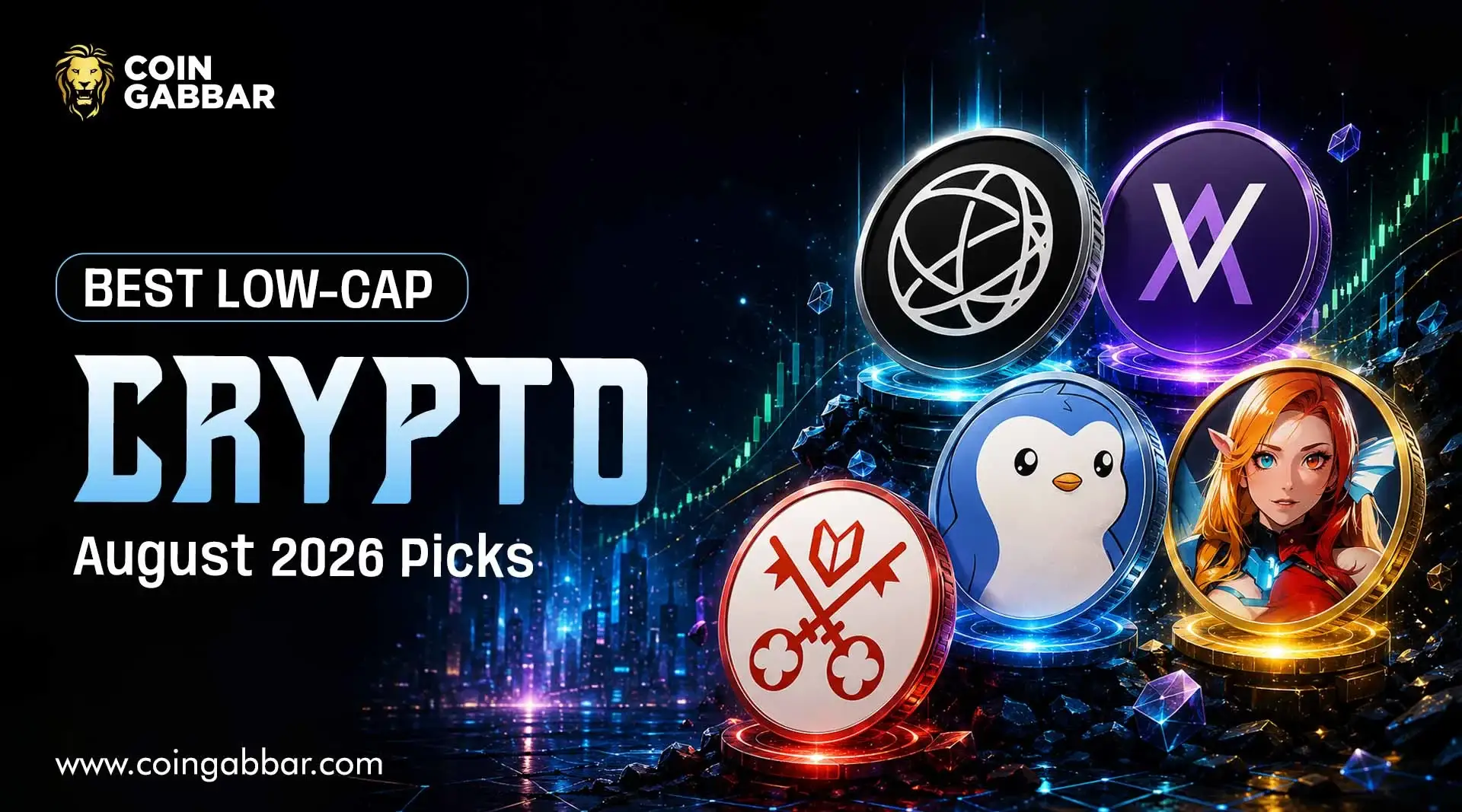
Best Low-Cap Crypto August 2026: Top Picks
Finding the best low-cap crypto August 2026 has to offer is not about chasing the loudest name on social media. It is about knowing what you are actually buying.
Low-cap tokens move fast. A coin can double in a week and lose most of that gain just as quickly. That volatility is exactly why so many readers search for the best low-cap crypto august 2026 shortlist before they put in any money.
This guide walks through how we picked our shortlist, what each project actually does, and where the real risks sit. We are not telling you what to buy. We are showing you how to think about the choice yourself.
How We Selected These Picks
This article did not just rank coins by how fast their price moved this week. A best low-cap crypto August 2026 list needs a method, or it is just noise.
Here is what we looked at for every project:
Market capitalization: Focused on projects roughly under $500 million, since that is the range most traders mean by low cap.
Trading volume: Low volume often means low liquidity, which makes entries and exits harder.
Real utility: Does the token do something, or is it purely a speculative chip?
Team credibility: Is there a known team, documentation, and an active GitHub or blog?
Community size and momentum: Checked whether search interest and trading activity have been trending, not just spiking once.
Tokenomics: Supply concentration in a small number of wallets is a red flag we specifically checked for.
The Shortlist at a Glance
The best low-cap crypto august 2026 shortlist covers five projects across different sectors: modular blockchain infrastructure, on-chain asset management, consumer NFT brands, prediction markets, and private AI compute. Spreading picks across sectors is a basic form of diversification, not a guarantee against loss.
Celestia (TIA) — modular data availability network for rollups
Velvet Capital (VELVET) — DeFi asset management and automated trading
Pudgy Penguins (PENGU)—Consumer NFT brand token, priced under $1
Siren (SIREN)—AI-linked token on BNB Chain, honourable mention with a heavy risk flag
Venice Token (VVV) — access asset for a private, uncensored AI platform
Pick 1: Overview, Strengths and Risks
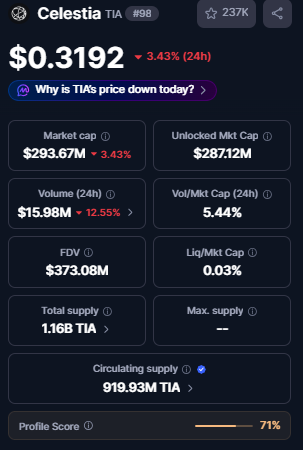
Celestia (TIA) focuses on a specific problem: most blockchains bundle execution, settlement, and data availability together, which limits how many new chains can scale.
Celestia unbundles that stack so developers can launch their own rollup without building consensus infrastructure from scratch, according to the project's own documentation at their official website.
Token Utility:
The TIA is used to pay transaction fees, stake with validators to secure the Celestia network, participate in governance, and publish data to Celestia's modular data availability layer.
Metric | Value |
Current Price | $0.3192 |
Market Cap | $293.67M |
Circulating Supply | 919.93M TIA |
Total Supply | 1.16B TIA |
Strengths
Established use case among rollup teams, with dozens of networks reportedly built on top of it
Regular technical upgrades, including a recent block-time reduction aimed at faster confirmations
Valuation sits in the low hundreds of millions, keeping it inside true low-cap territory
Risks
TIA trades roughly 98% below its all-time high, and that overhang weighs on sentiment
Price closely tracks Bitcoin's swings, so a broader market downturn hits it hard
Competing modular projects, including EigenLayer-adjacent teams, are chasing the same niche
Celestia suits readers who want exposure to blockchain infrastructure rather than a consumer story.
Pick 2: Overview, Strengths and Risks
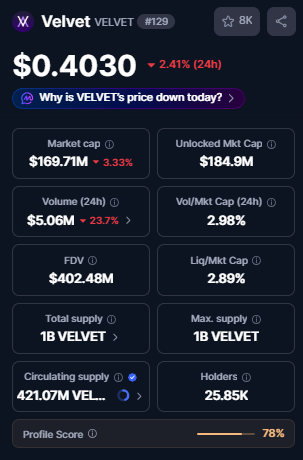
Velvet Capital (VELVET) is a DeFi asset management protocol. It lets individuals and institutions build tokenized funds, automated trading strategies, and yield portfolios on-chain, spanning Base, Solana, Ethereum, and BNB Chain, based on details published on the project's own site.
Token Utility:
The VELVET is used for governance, staking rewards, protocol incentives, and accessing premium DeFi portfolio management features within the Velvet Capital ecosystem.
Metric | Value |
Current Price | $0.4030 |
Market Cap | $169.71M |
Circulating Supply | 421.07M VELVET |
Total Supply | 1B VELVET |
Strengths
Backed by Binance Labs, which adds a layer of institutional credibility
Non-custodial vault design, meaning users keep control of their own assets
Revenue-based buyback mechanism that routes platform fees back toward VELVET stakers
Risks
Total value locked on the protocol is still modest, which limits proof of sustained demand
The DeFi-plus-AI category is crowded, and execution risk on the AI agent roadmap is real
Smart contract risk applies to any DeFi vault, however well audited
This pick suits readers already comfortable with DeFi mechanics rather than complete beginners.
Pick 3: Overview, Strengths and Risks (Coins under $1)
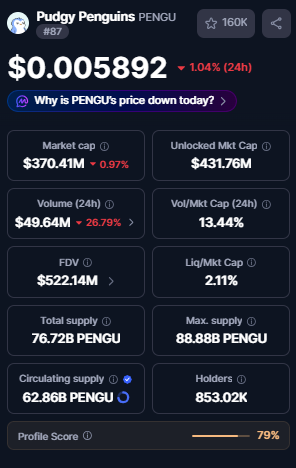
Pudgy Penguins (PENGU) trades for a fraction of a cent, making it one of the more visible coins under 1 dollar with real brand recognition.
PENGU is the utility and governance token for the wider Pudgy Penguins ecosystem, which spans NFTs, retail toys, and a gaming layer called Pudgy World.
Token Utility:
The PENGU powers the Pudgy Penguins ecosystem by enabling governance participation, community rewards, ecosystem incentives, and future integrations across Pudgy World, NFTs, and consumer products.
Metric | Value |
Current Price | $0.005892 |
Market Cap | $370.41M |
Circulating Supply | 62.86B PENGU |
Total Supply | 76.72B PENGU |
Strengths
Rare crossover from NFT collectible into mainstream retail products sold in physical stores
Community-heavy token allocation, with roughly half of supply earmarked for community growth
Multi-chain presence across Solana, Ethereum, and the Abstract layer-2 network
Risks
Value depends heavily on continued brand execution, not blockchain fundamentals alone
Vesting unlocks from team and company allocations can add sell pressure over time
As a consumer brand token, it is more exposed to shifting internet culture than to protocol usage
PENGU suits readers drawn to consumer and NFT-adjacent narratives rather than pure infrastructure plays.
Honourable Mentions
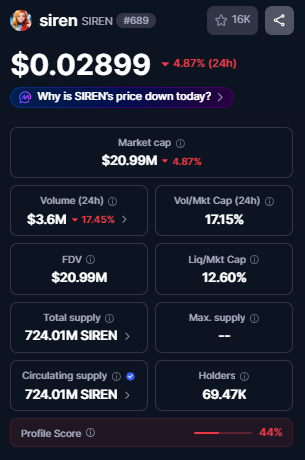
Siren (SIREN), a BNB Chain token blending AI and meme narratives, put up triple-digit percentage gains recently and is currently trending.
We are flagging it as an honorable mention only, with a serious caveat: on-chain data has shown extreme supply concentration, with a small number of wallets controlling a large majority of tokens, and a past large holder sale reportedly caused a steep single-day crash.
That is a textbook manipulation risk, not just volatility.
Siren (SIREN)
Token Utility:
The SIREN is the native utility token of the Siren ecosystem. It is designed for ecosystem rewards, community incentives, governance participation, and future AI-related platform features.
Metric | Value |
Current Price | $0.02899 |
Market Cap | $20.99M |
Circulating Supply | 724.01M SIREN |
Total Supply | 724.01M SIREN |
Venice Token
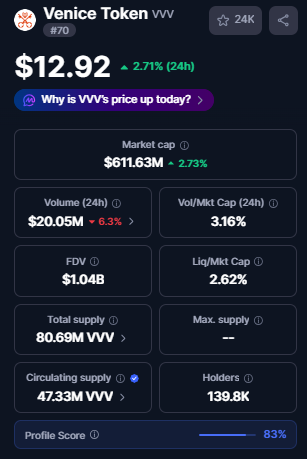
Venice Token (VVV) powers Venice AI, a privacy-focused platform offering uncensored access to open-source AI models without logging user prompts. Holders stake VVV to access inference at zero marginal cost.
Strengths include a clear utility loop between token staking and AI compute access, plus a recent cut to annual token emissions. The risk is straightforward: an "uncensored AI" positioning invites regulatory attention, and adoption still depends on Venice outcompeting much larger, better-funded AI platforms.
Token Utility:
The VVV is staked to access Venice AI services, including private AI inference without per-request fees. It also supports ecosystem incentives and governance as the platform expands.
Metric | Value |
Current Price | $12.92 |
Market Cap | $611.63M |
Circulating Supply | 47.33M VVV |
Total Supply | 80.69M VVV |
Comparison Table: Key Metrics Side by Side
Coin | Sector | Approx. Valuation | Core Utility | Standout Risk |
Celestia (TIA) | Modular blockchain infra | ~$300M | Data availability for rollups | Deep drawdown from all-time high |
Velvet Capital (VELVET) | DeFi asset management | ~$160M | On-chain fund and portfolio tools | Low TVL relative to its valuation |
Pudgy Penguins (PENGU) | Consumer NFT brand | ~$425M | Ecosystem governance and rewards | Brand-dependent, not protocol-dependent |
Siren (SIREN) | AI and meme hybrid | ~$90M | Native ecosystem | Extreme wallet concentration |
Venice Token (VVV) | Private AI compute | ~$800M | Staking for AI inference access | Regulatory exposure |
Figures are approximate and change constantly. Always check a live source such as CoinGecko or CoinMarketCap before acting on any number here.
Who Each Pick Suits
Not every name on a best low-cap crypto august 2026 list fits every reader. Matching a pick to your own risk profile matters more than the pick itself.
Beginners may find PENGU easier to understand, since the brand and products are tangible, though the price swings are still real.
Infrastructure-focused readers may lean toward Celestia, given its clear technical niche among rollup builders.
DeFi-native users comfortable with vaults and smart contracts may look at Velvet Capital.
High-risk, short-term traders sometimes chase names like Siren, but the concentration risk there is unusually severe even for this category.
AI-narrative readers watching the AI and Digital asset crossover may find Venice Token relevant, with the regulatory caveat in mind.
Risks and What Could Go Wrong
Every pick on a low-cap Investment watchlist carries risk beyond ordinary price swings.
Liquidity risk. Thin order books mean a modest sell order can move the price sharply.
Concentration risk. When a handful of wallets hold most of the supply, a single sale can crash the market, as seen with Siren.
Execution risk. Roadmaps are promises. Delays or missed milestones are common across this entire category.
Regulatory risk. Policy shifts, especially around AI-linked or privacy-focused tokens, can change a project's trajectory overnight.
Correlation risk. Most low-cap tokens still fall hard when Bitcoin drops, regardless of their individual fundamentals.
Position sizing and time horizon matter more here than trying to pick a single winner.
Glossary
Market capitalization: token price multiplied by circulating supply, used to size a project.
Liquidity: how easily an asset can be bought or sold without moving its price significantly.
Tokenomics: the rules governing a token's supply, distribution, and incentive design.
Circulating supply: the number of tokens currently available and tradable in the market.
Staking: locking tokens to support a network or protocol in exchange for rewards or access.
Vesting: a vesting schedule that gradually releases tokens held by a team or early investors over time.
Rollup: a scaling technique that processes transactions off a base blockchain and posts data back to it.
Final Thoughts
This best low-cap crypto august 2026 shortlist is a starting point for research, not a buy list. We picked projects across different sectors, explained the method behind each choice, and named a genuine weakness for every single one, including the honorable mentions.
Before acting on anything here, check current prices, read each project's own documentation, and think about how much of your portfolio you are comfortable exposing to this level of volatility. Diversifying across a few picks instead of concentrating in one is a reasonable starting principle, though it does not remove risk.
Disclaimer: This article is for educational and informational purposes only and should not be considered financial or investment advice. Always conduct your own research before making investment decisions.





.jpg)