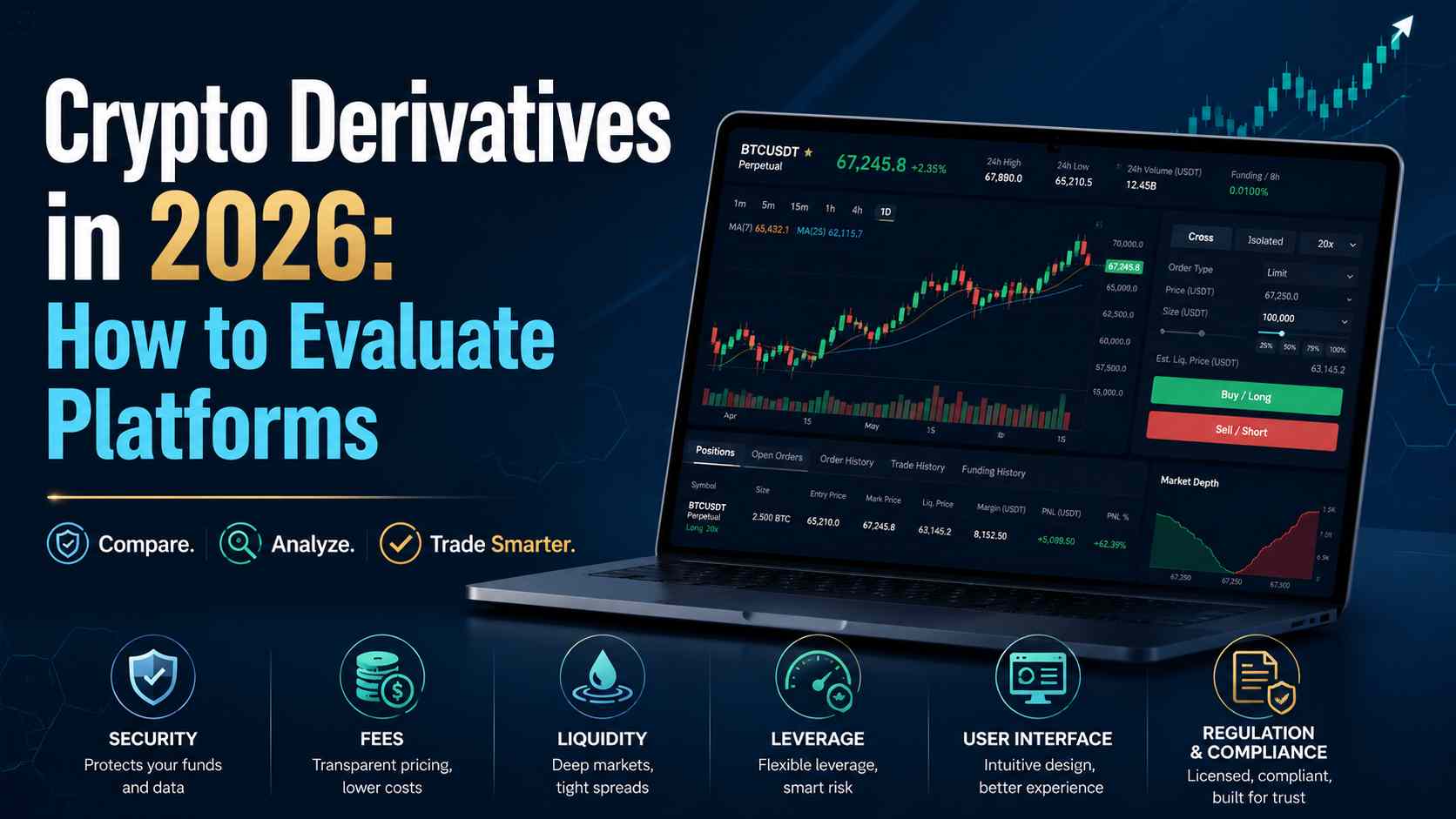
Crypto Derivatives in 2026: How to Evaluate Platforms

Key Takeaways
-
Crypto derivatives exchanges let traders speculate on price movements using contracts such as perpetual futures, rather than buying the underlying coins.
-
Leverage amplifies both gains and losses; at high multiples, a small adverse price move can liquidate an entire position.
-
When comparing platforms, the factors that matter most are fee structure, available leverage and pairs, risk controls, custody and security, regulatory status, and supporting features such as copy trading or in-platform conversion.
-
No single venue is best for everyone — the right choice depends on whether you trade actively, hold positions, or simply want to buy and hold.
-
Margex is used throughout this article as one example of a derivatives-only platform to illustrate how these criteria play out in practice.
Choosing where to trade crypto derivatives is a high-stakes decision. The venue you pick shapes your fees, your available leverage, your risk controls, and how exposed you are to counterparty and regulatory risk. This guide explains how derivatives platforms work, what to weigh before opening an account, and the real risks of leverage — and uses one platform, Margex, as a concrete example along the way.
How Crypto Derivatives Exchanges Work
A spot exchange is straightforward: you exchange one asset for another and own the result. A derivatives crypto exchanges is different. Instead of buying Bitcoin or Ether outright, you trade a contract whose value tracks the underlying asset. You can profit from prices rising (going long) or falling (going short) without ever holding the coin itself.
The most common instrument in crypto is the perpetual futures contract, a derivative with no expiry date that mirrors the price of an underlying asset and can be held open indefinitely, as long as the position stays funded. To keep the contract price tethered to the spot market, exchanges use a funding rate: a small periodic payment exchanged between long and short traders. When demand to go long is high, longs pay shorts, and vice versa.
Two mechanics define the experience on any derivatives venue:
Margin — the capital you post to open and maintain a position. If losses erode your margin past a threshold, the position is liquidated (closed automatically) to prevent your balance going negative.
Leverage— borrowing against your margin to control a larger position. Leverage of 10x means $100 of margin controls a $1,000 position. It multiplies returns, but it multiplies losses just as fast.
Understanding these mechanics matters more than any individual platform's branding, because they determine how quickly a trade can go wrong.
Key Factors to Evaluate When Choosing a Platform
Derivatives platforms differ less in what they offer than in the details of *how* they offer it. The criteria below are the ones that consistently separate them.
1. Fee structure
Most venues use a maker-taker model: makers (who add liquidity with limit orders) pay less than takers (who remove it with market orders). Some platforms layer VIP tiers on top, where lower fees require holding a native token or hitting monthly volume thresholds; others charge a single flat rate. Beyond trade fees, check deposit/withdrawal costs and how funding rates are applied to open positions.
Example: Margex uses a flat maker-taker model — 0.019% maker and 0.060% taker — with no tiered VIP system and no native token to hold. Crypto deposits are free, and funding rates are variable, applied to open perpetual positions.
2. Leverage and available markets
Higher maximum leverage is not automatically better; it simply sets the ceiling on risk you can take. Look at both the maximum offered and the range of trading pairs, and remember that the headline number is rarely the prudent setting.
Example: Margex offers up to 100x leverage on its largest pairs (BTC, ETH, BNB, TRX), with most other markets in the 15x–50x range and a 5x minimum, across 40+ pairs. At 100x, a 1% adverse move is enough to liquidate a position — which is why the ceiling is best treated as a limit, not a target.
3. Custody and security
Because you deposit funds to trade, how a platform safeguards them is central. Common protections include cold storage of client assets, two-factor authentication, withdrawal/IP whitelisting, DDoS mitigation, and continuous monitoring. The strength of these measures varies widely between venues.
Example: Margex holds client-owned coins in cold storage and offers two-factor authentication, IP whitelisting, DDoS protection, and 24/7 monitoring.
4. Regulatory status
Many crypto derivatives venues operate offshore and are not licensed by major financial regulators. This affects the legal protections available to you if something goes wrong, and in some jurisdictions, trading on an unlicensed venue may be restricted. Always check a platform's regulatory standing in your own country.
Example: Margex is registered in the Seychelles and is not licensed by major financial regulators. Spain's CNMV, for instance, has issued a public notice that the platform is not authorized to offer investment services there. This is common among offshore derivatives venues and underscores the need to size risk conservatively.
5. Supporting features
Beyond core trading, platforms differentiate with features such as copy trading exchanges , in-platform asset conversion, staking, demo accounts, and the quality of the trading interface. These can add genuine value, but they are secondary to fees, risk controls, and security.
A Closer Look: Margex as a Worked Example
To make the criteria above concrete, it helps to see them applied to a single platform. Margex is a derivatives-only exchange founded in 2019 and headquartered in the Seychelles, with more than 500,000 registered users across roughly 150 countries. Rather than offering spot markets and a broad asset catalog, it concentrates on leveraged trading of perpetual futures.
A few features illustrate how supporting tools commonly work across the sector:
-
Copy trading lets newer traders mirror the positions of experienced, verified traders, filtered by performance metrics, win rate, and risk profile. This is a general category of feature offered by several derivatives platforms, not unique to one.
-
In-platform conversion (branded Margex Convert) allows swapping between assets such as BTC, ETH, USDT, and select altcoins; only standard network fees apply, with limits from $10 to $30,000.
-
Staking alongside open positions lets users earn yield on assets such as USDT without first closing their trades — a relatively uncommon arrangement.
A consolidated interface keeps charts, the order panel, open positions, margin levels, liquidation prices, and unrealized PnL on one screen, with a demo mode for testing strategies without real funds.
The minimum deposit is $10. Notably, the platform does not offer spot trading, has a narrower asset list than the largest exchanges, and does not support direct fiat withdrawals limitations that follow directly from its derivatives-only focus.
Fees at a glance
| Fee Type | Rate | Notes |
|---|---|---|
| Maker Fee | 0.019% | Orders that add liquidity (limit orders) |
| Taker Fee | 0.060% | Orders that remove liquidity (market orders) |
| Crypto Deposits | Free | No deposit fee on crypto transfers |
| Funding Rate | Variable | Applied to open perpetual positions; varies with market conditions |
For platform-specific mechanics, the Margex Help Center documents funding, order types, and account settings.
The Risks of Leverage Trading
Leverage is the defining feature of derivatives trading and its single biggest hazard. It deserves a clear-eyed treatment, because the same mechanism that magnifies a winning trade magnifies a losing one.
Liquidation risk. The higher your leverage, the smaller the price move needed to wipe out your margin. At 100x, roughly a 1% move against you is enough; at 10x, around 10%. Many new traders underestimate how quickly this happens in volatile markets.
Funding costs. Holding a perpetual position over time means paying (or receiving) funding repeatedly. For positions held across days, these costs accumulate and can erode an otherwise correct trade.
Volatility and gaps. Crypto markets move sharply and around the clock. Prices can gap through stop levels during sudden moves, so realized losses can exceed what a stop-loss appeared to guarantee.
Counterparty and platform risk. On an unregulated venue, your protections if the platform fails, freezes withdrawals, or is hacked are limited. This risk is independent of your trading skill.
Psychological pressure. Leverage compresses the timeline of gains and losses, which can drive impulsive decisions. Risk-management rules — position sizing, stop-losses, and never risking more than you can afford to lose — matter more, not less, at high leverage.
A common guideline among experienced traders is to treat maximum leverage as a hard ceiling rather than a default, and to size positions so that a normal adverse move does not threaten the account.
Who Is Derivatives Trading For?
Crypto derivatives platforms are built for active traders who work with volatility, open and close positions regularly, and use leverage deliberately as a tool. For someone who values low costs, meaningful leverage, and features such as copy trading, a focused derivatives venue can be a good fit.
They are less suited to buy-and-hold investors who want to own assets directly, access a broad long tail of low-cap altcoins, make direct bank transfers, or rely on the protections of a heavily regulated exchange. Those investors are generally better served by a spot exchange. Knowing which camp you fall into makes the decision far simpler than comparing feature lists. For a primer on tracking the market before trading, see this guide on how to check crypto prices on Margex.