Crypto Launch Date vs Listing Date vs Presale: A Complete Timeline

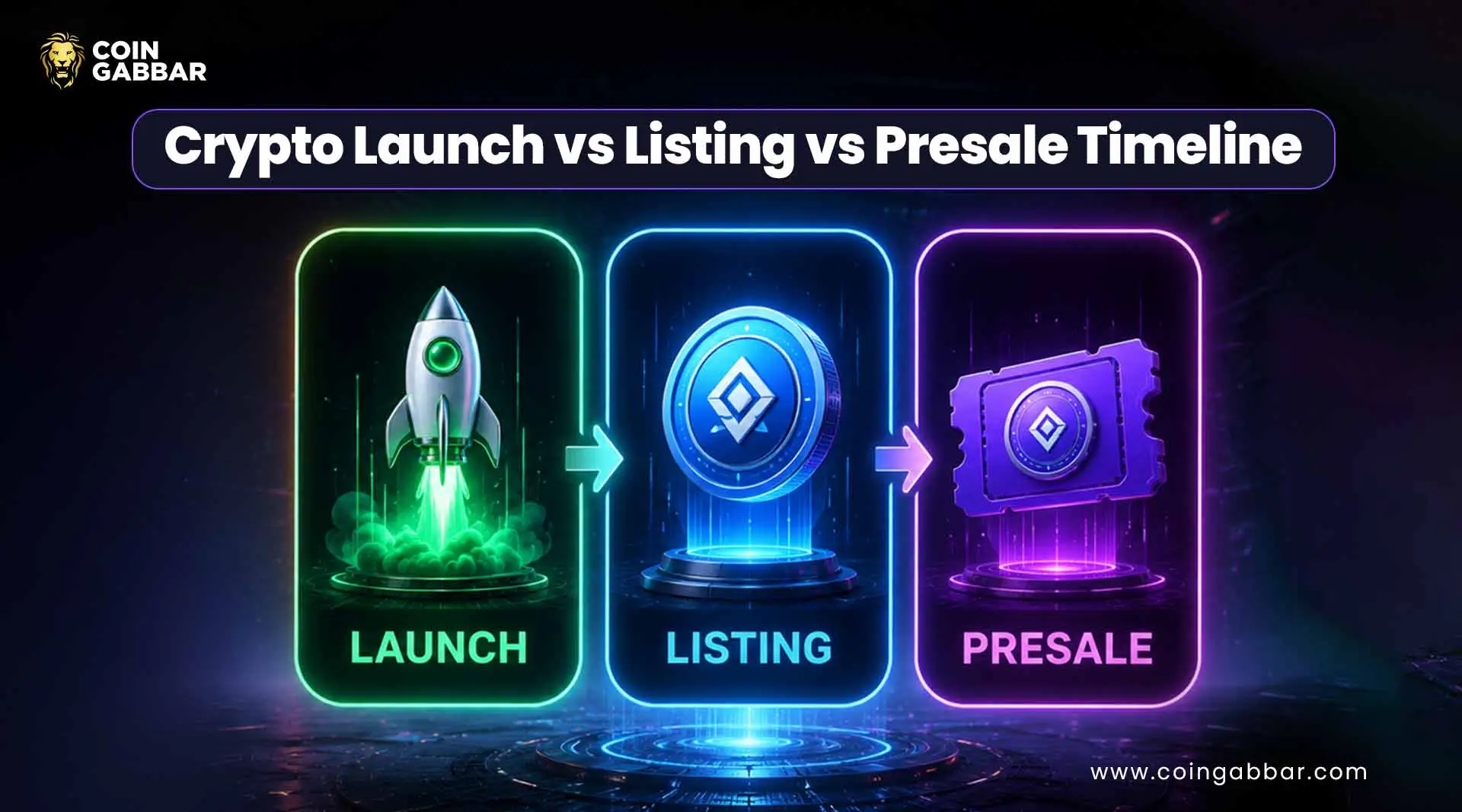
Crypto Launch Date vs Listing Date vs Presale: Crypto Market Timeline
Most people jump into a new crypto project and immediately ask: "When does it launch?"
Fair question. But here's the thing "launch" means three completely different things depending on who you ask. Ask a developer, they'll point to the mainnet. Ask a trader, they'll say the exchange listing. Ask an early investor, they'll tell you they already got in during the presale.
These three events: presale, launch date, and listing date form a timeline that every serious crypto participant should understand. Miss the distinction, and you'll either buy at the wrong time, miss your entry entirely, or confuse a token going "live" with it being available to you.
Let's break it all down, in order.
Stage One: The Presale
Before a crypto project opens to the public, it almost always runs a fundraising round this is the presale.
During a presale, the team sells tokens to a select group of participants at a discounted price. This group usually includes private investors, venture capital firms, and early community supporters. The idea is simple: the project needs capital to build, and early investors are rewarded for taking on the most risk.
Presales typically happen in rounds. The first round often called a seed round or private sale carries the steepest discount. The closer you get to the public launch, the smaller the discount gets. By the time a public sale opens, prices are higher but access is broader.
What you're buying in a presale isn't always a working product. Often, the blockchain or protocol doesn't even exist yet. You're essentially buying a promise: that the team will build what they've outlined, that the token will eventually be useful, and that demand will grow enough to make your early entry worthwhile.
This is why presale participants take on the highest risk and stand to gain the most if the project succeeds.
There are a few things to watch during a presale period:
-
Vesting schedules: Most presale tokens come locked. You won't receive them all on day one. Teams do this to prevent early investors from immediately selling and tanking the price.
-
Tokenomics: Check how much of the total supply went to insiders vs the public. If 40% of tokens are held by VCs and advisors with short vesting periods, that's a red flag.
-
Soft and hard caps: These tell you the minimum needed to proceed and the maximum the team will raise.
The presale ends when either the funding goal is hit or the deadline passes. After that, the team shifts focus to building toward the launch.
Stage Two: The Launch Date
The launch date or mainnet launch is when the project's blockchain or core protocol goes live.
This is the technical milestone. The network is deployed, nodes come online, transactions can be processed, and the token begins to actually exist on-chain. For DeFi protocols, this is when smart contracts are deployed to production. For Layer 1 blockchains, it's when the first block is mined or validated.
Here's where a lot of newcomers get confused: the launch date doesn't mean the token is available to buy on exchanges.
At this stage, the token exists but it's typically only accessible to:
-
Presale investors receiving their allocations
-
Validators or stakers who participate in the network directly
-
Users who interact with the protocol through its own interface or wallet
If you didn't get into the presale, you likely can't buy the token on the open market yet. You're watching from the outside, waiting for the next stage.
The launch date is still enormously important for a few reasons. First, it proves the project is real moving from whitepaper to working code is a significant milestone that many projects never actually reach. Second, it marks the beginning of real on-chain activity, which gives you data: network usage, transaction volume, active addresses.
Watch the launch carefully. Projects that launch cleanly no major bugs, good initial activity tend to carry that momentum into their exchange listing. Projects that launch to silence, low usage, or technical issues often struggle to recover, regardless of hype.
Stage Three: The Listing Date
This is the moment traders circle on the calendar.
The listing date is when the token becomes available for trading on centralized exchanges (CEXs) or, in some cases, decentralised exchanges (DEXs). For many retail participants, this is their very first opportunity to buy.
Listings come in different tiers. A listing on a major exchange like Binance or Coinbase is a massive event it brings enormous liquidity and exposes the token to millions of potential buyers overnight. A listing on a smaller exchange carries far less weight.
The period right around the listing date tends to be the most volatile in a token's early life. Here's what typically plays out:
Before the debut: Speculation drives up the price of any existing circulating supply. The "listing pump" is real many participants buy early in anticipation of post-listing demand.
At listing: A surge of new buyers hits the order book. If demand outweighs supply, price spikes fast. This is when presale investors, who bought at a discount, often begin selling into the liquidity a process commonly known as "dumping on retail."
After the initial spike: Price often corrects, sometimes sharply. Projects with genuine utility and strong community support tend to stabilize and recover. Projects that were purely hype-driven frequently don't.
Understanding this pattern doesn't mean you should avoid listing-day buys but it does mean you should go in with your eyes open.
How to Track Launch Calendars and Announcements
Knowing what these terms mean is step one. Knowing where to find accurate dates is step two.
The single most reliable source is always the project's official channels: their website roadmap, official Twitter/X account, and Discord or Telegram announcements. These are the only sources where dates are confirmed by the team itself. Everything else is derivative.
For aggregated calendars, CoinMarketCap is the most widely used tool. It compiles upcoming events: listings, mainnet launches, TGEs, partnerships submitted by users and verified against official sources. It's not perfect, but it's the fastest way to get a bird's-eye view of what's coming.
CoinGecko and CoinMarketCap both have event trackers built into their individual token pages. If a project has a confirmed listing, it often shows up there first.
For new and smaller projects, ICO Drops and CryptoRank track presale rounds, TGE dates, and early-stage listings with more granularity than general aggregators.
The golden rule: never rely on a single source. Cross-check every date you act on against the official project channel. Influencer posts, third-party blogs, and Telegram groups all recycle information and outdated or speculative dates spread fast.
Case Study: BlockDAG vs Rollblock Timelines
Two projects that illustrate the launch-vs-listing gap well are BlockDAG (BDAG) and Rollblock.
BlockDAG- BlockDAG ran an extended presale, building community and raising capital before its mainnet and Token Generation Event were confirmed. The gap between presale close and expected listing created the exact kind of search confusion that drives thousands of queries: people bought in early and weren't clear on when they'd be able to trade.
Rollblock followed a tighter, more compressed timeline moving from presale to TGE to DEX listing in a shorter window. For participants, this meant less waiting but also less time to track on-chain data before making a decision. The RBLK listing came quickly after the presale closed, which limited the window for due diligence between launch and listing.
What both cases show is that no two project timelines look the same. One project might go presale mainnet CEX listing across 18 months. Another might compress the same journey into six weeks. Understanding where a specific project sits on that timeline is what separates informed participants from people chasing announcements blind.
Why the Timeline Matters
Here's a practical way to think about it:
| Stage | What Happens | Who Has Access |
| Presale | Token sold at discount | Private investors, early community |
| Launch Date | Blockchain / protocol goes live | Network participants only |
| Listing Date | Token available on exchanges | General public |
Each stage carries a different risk-reward profile. Presale offers the deepest discounts but the longest waits and highest risk of project failure. The listing date offers immediate liquidity but often the least favorable entry price.
The window between launch and listing is actually underrated. During this period, you can observe real on-chain data, track team execution, and make a more informed decision before the token hits mainstream exchanges and price volatility peaks.
Final Thought
Most retail investors only ever see the listing. They show up when the token is already trending, when the presale investors are sitting on 10x paper profits, and when the hype is loudest.
Knowing the full timeline changes your perspective. You start asking different questions not just "when can I buy?" but "who already holds this, at what price, and what are they likely to do when the listing opens?"
That's not pessimism. That's preparation. And in crypto, preparation is about the only edge most people ever get.
Also read: