What Is Harmony Blockchain? How Does the ONE Token Work?

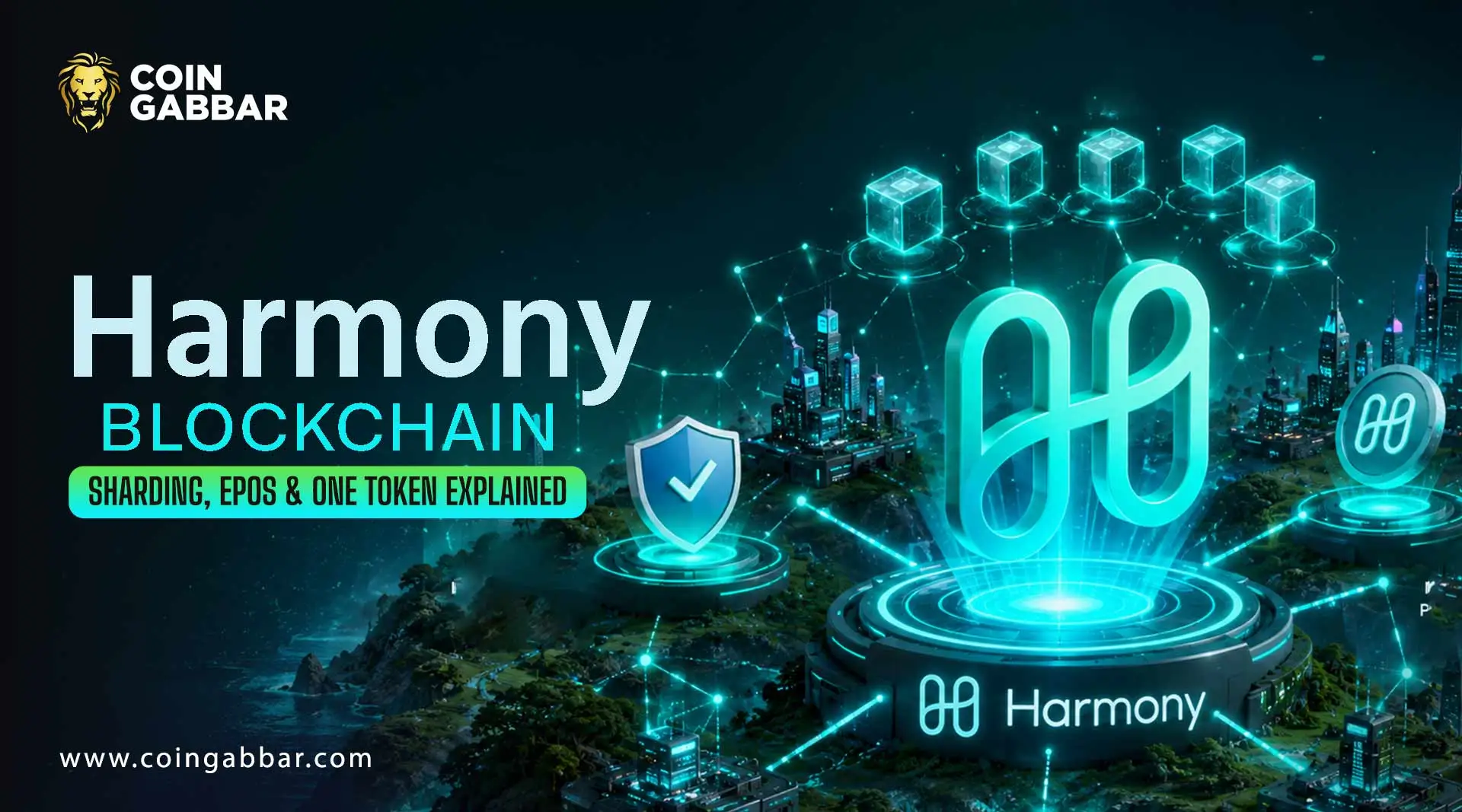
Why Is Harmony Blockchain Different from other?
Split a blockchain into pieces, and you'd expect it to get less secure, not faster. That's the puzzle Harmony blockchain was built to solve.
Instead of every node processing every transaction, Harmony breaks its network into shards that work in parallel. Pair that with a staking system called Effective Proof-of-Stake, and you get a chain that's trying to do two things most blockchains treat as opposites: move fast and stay decentralized.
Here's a straightforward look at how Harmony actually works — the sharding, the staking, the ONE token, and where the project says it's headed next.

What Is Harmony Blockchain and How Does It Work?
Harmony is an open-source, Ethereum-compatible layer-1 blockchain. Its mainnet has been running since 2019, and everything on it revolves around one token: ONE. It pays the fees, secures the network, and gives holders a say in how the protocol evolves.
The problem Harmony set out to fix is one every blockchain runs into eventually. Speed and decentralization pull in opposite directions. Add more nodes to keep things trustless, and transactions slow down. Cut the number of validators to speed things up, and you've just centralized the network. Harmony's workaround is sharding, which we'll get into next.
How Does Harmony's Sharding Architecture Work?
Think of sharding as dividing one big, overloaded highway into several smaller roads, each carrying its own traffic. In blockchain terms, a shard is a subset of the network that handles its own transactions and keeps its own copy of the ledger, instead of forcing every single node to process everything.
Harmony currently runs four shards. According to the project's documentation, each shard produces a new block roughly every two seconds, and transactions that cross between shards reach finality within two block times.
Why does this matter for everyday users? Because it means a node doesn't need enterprise-grade hardware to keep up. It only has to track its own slice of the network, not the whole thing. That's the trade-off sharding is chasing — throughput without pricing out smaller participants.
How Does Harmony's EPoS Consensus Work?
Sharding solves one problem and creates another. If an attacker only needs to take over one small shard instead of the entire chain, that's a smaller target to hit. Harmony's answer is Effective Proof-of-Stake, or EPoS — a consensus mechanism built specifically with sharded networks in mind.
Here's the mechanic that matters: validators stake ONE to get elected, but their voting power inside a shard isn't just a function of how many tokens they hold. It's calculated as an "effective stake," a formula meant to stop any single large holder from dominating a shard's committee.
Underneath that, blocks get finalized through a Byzantine Fault Tolerant process using BLS signature aggregation — essentially, a way for hundreds of validators to sign off on a block quickly without every signature bloating the chain. It's a detail most users will never think about, but it's what lets EPoS scale to that many participants at once.
What Is the ONE Token Used For?
Strip away the technical layer, and Harmony's economy runs on one token doing three jobs.
First, it pays for gas. Any transaction on Harmony — a swap, a transfer, a smart contract call — costs a small amount of ONE. Second, it's the staking asset. Validators lock it up to run nodes, and everyday holders can delegate it to a validator instead of running infrastructure themselves. Third, it's the governance token. Protocol-level proposals get decided through ONE-weighted voting.
None of that is unusual for a layer-1 token. What's worth noting is how tightly these three roles are linked — the same token that pays your gas fee is also what's securing the network you're transacting on.
Harmony ONE Tokenomics: Supply, Allocation & Utility
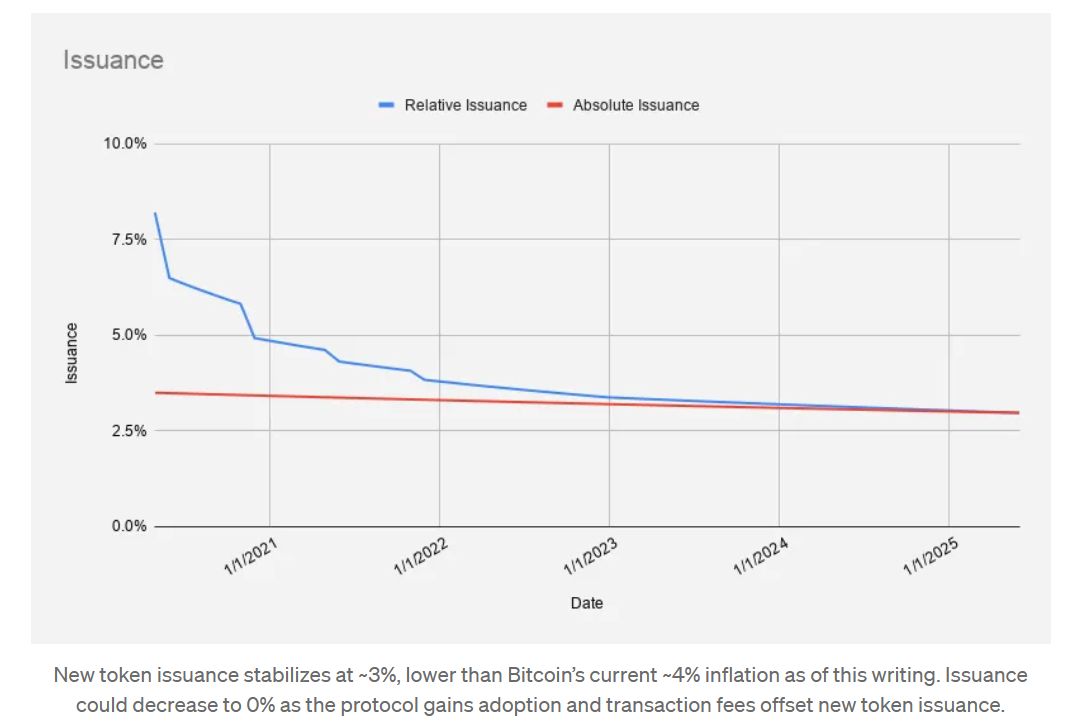
Harmony updated how it pays out ONE tokens back in 2020. The idea: fix the total yearly reward — new tokens plus transaction fees — at 441 million ONE, no matter how staking levels or block speed change.
Transaction fees get burned under this setup, and that burn cancels out new issuance. So as more people use the network, less new ONE gets created. Over time, that's meant to push issuance down toward zero, once fees alone can cover the full reward.
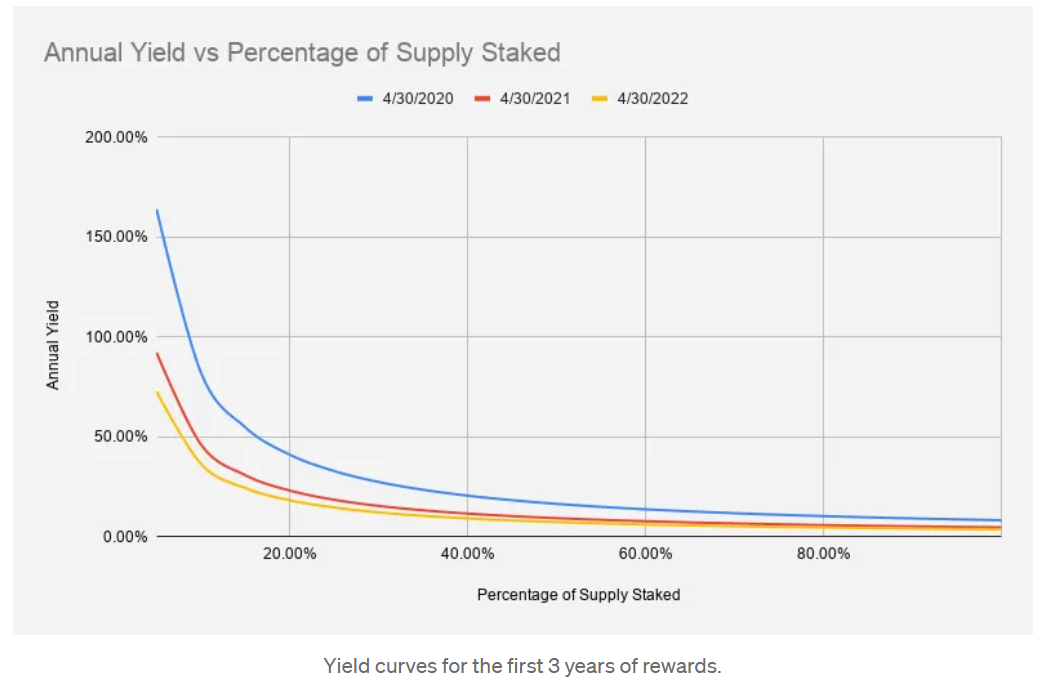
Harmony also shared expected first-year yields: around 164% if only 5% of tokens are staked, dropping to about 9% if 95% are staked. Makes sense once you think about it — fewer stakers means each one gets a bigger slice of that fixed 441 million pool.
Before this, Harmony used a variable model — close to 500 million ONE a year at 0% stake, falling to zero once 80% or more was staked. The team switched away from it for three reasons: easier for stakers to predict rewards, room for a higher staking ratio without hurting yields, and no more issuance swings just because block times sped up.
How Does Harmony Staking Work?
Staking on Harmony works in one of two ways, depending on how hands-on you want to be.
Run a validator node yourself, and you're staking ONE directly to get a shot at being elected into a committee. That takes technical setup and a meaningful token balance. Most holders skip that route and delegate instead — handing their ONE to an existing validator, who then does the work of running infrastructure and signing blocks.
In exchange, delegators earn a cut of that validator's staking rewards. It's not free of risk, though. If a validator gets slashed for double-signing or extended downtime, delegators who backed them can lose a portion of their stake too. So picking a validator isn't just about the advertised reward rate — uptime and reliability matter just as much.
Harmony Blockchain Roadmap: Key Development Plans
Harmony's published roadmap leans on three main ideas: getting to faster transaction finality, pulling its DeFi ecosystem into a more unified experience, and building tools around AI agents.
On the technical side, the project points to upgrades like Verkle Trees and State Expiry as ways to keep the chain lean as it grows. On the product side, it's building out platforms for token creation and for stablecoin and perpetual trading, plus a framework meant to let autonomous agents handle tasks like trading or governance participation on a user's behalf.
A fair caveat here: a roadmap is a stated intention, not a shipped feature. Some of these pieces are live, others are still in progress. If you want the current status of any specific item, Harmony's blog and GitHub repos are the places to check, not a roadmap page written months earlier.
Conclusion
Harmony blockchain is built around a simple bet: that sharding, done carefully, doesn't have to cost a network its decentralization. Four shards handle transactions in parallel, EPoS keeps validator power from concentrating in any one place, and ONE ties the whole system together as the token that pays fees, secures the chain, and carries governance votes.
The tokenomics you'll find documented today trace back to that 2019 launch split, and the roadmap points toward faster finality and a more built-out AI and DeFi stack going forward — though how much of that lands is still an open question.
Disclaimer:
This article is for informational and educational purposes only and does not constitute financial or investment advice. Always do your own research using official sources before forming any conclusions about a blockchain project.
Also read: