StarX Network Explained: Mining, Tokenomics, Roadmap

StarX Network Explained: Mobile Mining, Tokenomics, and What's Next
Crypto mining has always had a barrier problem. You need pricey hardware, a stomach for high electricity bills, and enough technical know-how to actually set the thing up and keep it running.
StarX Network was built specifically to get rid of that barrier, turning an ordinary smartphone into a mining device, no GPU rig or ASIC farm required.
Here's a full rundown of what StarX Network actually is, how the STRX token is structured, and where the project says it's headed.
Where This All Started
Crypto itself traces back to 2008, when Satoshi Nakamoto's Bitcoin whitepaper laid out a financial system that didn't need banks in the middle of it. The first block got mined in 2009, and from there the whole industry took off.
StarX Network positions itself as building on that same foundation, just aimed at making participation dramatically easier for people who aren't going to build a mining rig in their garage.
The Problem With Traditional Mining
Proof-of-Work mining works, and it's genuinely secure, but it comes with a handful of real obstacles for the average person:
Cost: GPUs and ASICs are expensive, and availability isn't always guaranteed either.
Power draw: PoW mining eats electricity, which means real environmental impact and a real dent in your wallet.
Technical skill: Getting hardware and software configured correctly isn't something most people can do casually.
Concentration: All of the above pushes mining power toward a handful of big, well-resourced pools, which runs somewhat counter to the whole point of decentralization.
How StarX Approaches It Differently
StarX Network's answer to all of this is a mobile-first setup built around a few core ideas:
Tap-to-mine: You tap a button roughly once every 24 hours to kick off a mining session. That's the entire hardware requirement, none.
Cloud-based mining: Everything actually happens on StarX's backend, not your phone. No battery drain, no data usage, no impact on how your device performs.
Free to join: The app costs nothing to download, and anyone with a smartphone can start immediately.
Built for Web3: It's not positioned as just a mining tool; token utility, social features, and DAO governance are all meant to be part of the same app experience down the line.
Why Web3 Specifically?
The pitch here is fairly standard Web3 philosophy: instead of a handful of platforms owning your data and controlling your digital assets, Web3 hands that ownership back to users, along with an actual say in how a network evolves.
StarX frames itself as folding social features, token utility, and governance directly into one app, rather than treating "mining" and "community" as two separate things bolted together.
The Long-Term Vision
According to the whitepaper, StarX isn't trying to stay a single mining app forever. The stated direction includes:
A broader suite of Web3 social applications built on top of the platform
Real-world payment use cases for $STRX, not just holding it
Growth driven by community activity and developer partnerships
An eventual shift toward a full DAO, where $STRX holders actually vote on the network's direction
Whether all of that materializes on schedule is obviously something to watch rather than assume, but it's the roadmap the team has laid out publicly.
Full Halving Schedule for the StarX Network
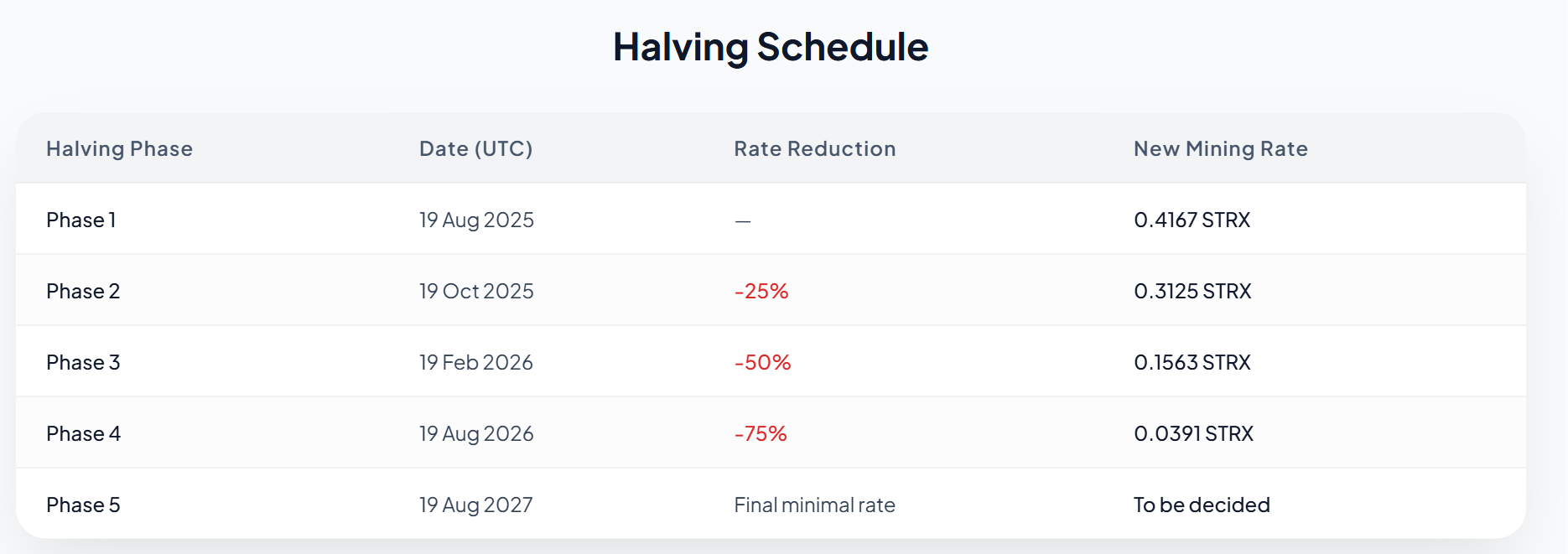
As per the official whitepaper of the StarX Network, there is a fixed halving schedule on a time basis starting from the launch and running until 2027:
Halving Stage
Phase | Date (UTC) | Cut | New Rate |
1 | Aug 19, 2025 | — | 0.4167 STRX |
2 | Oct 19, 2025 | -25% | 0.3125 STRX |
3 | Feb 19, 2026 | -50% | 0.1563 STRX |
4 | Aug 19, 2026 | -75% | 0.0391 STRX |
5 | Aug 19, 2027 | Final minimal rate | TBD (To be decided) |
The next August 19 is the stage 4 of the plan, which will decrease the mining
Tokenomics: STRX Supply and Distribution
Before getting into the halving math, it's worth knowing the basic specs of the token itself and where all of it actually goes. This tells you a lot about how the project is put together.
The basics:
Name: StarX
Symbol: STRX
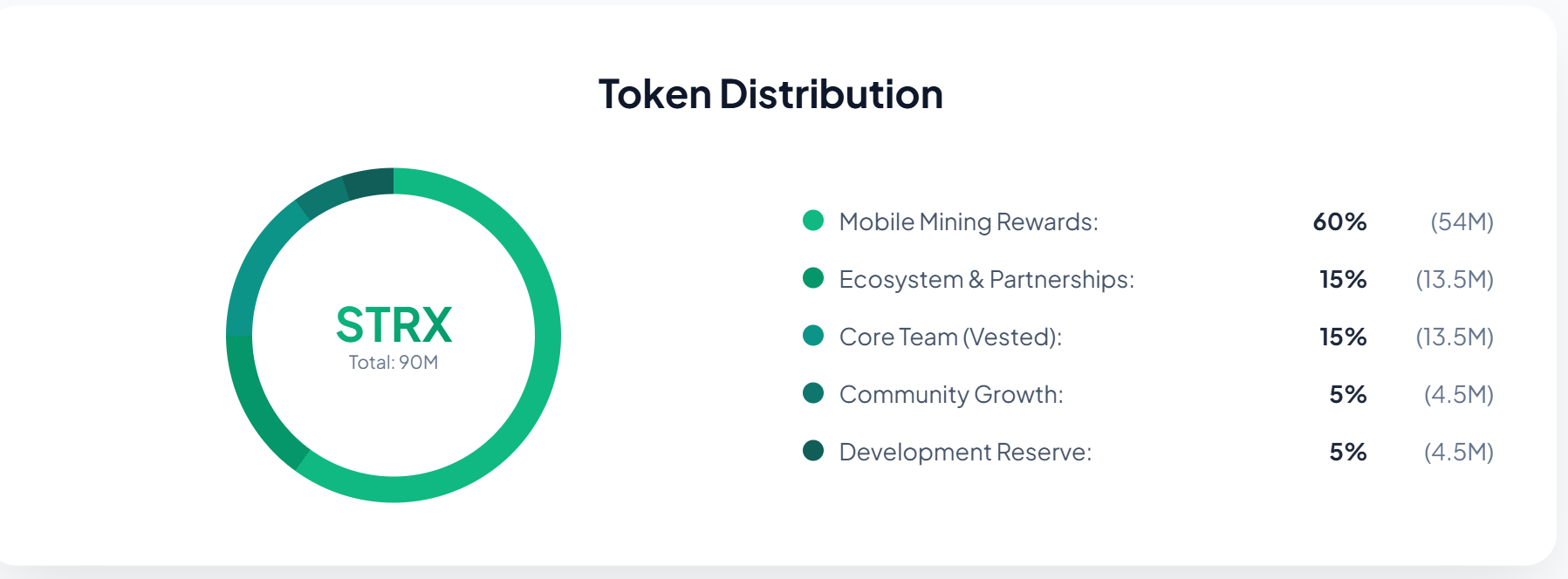
Total Supply: 90,000,000 STRX (90 million) hard-capped; nothing more ever gets minted
Chain: Binance Smart Chain (BEP-20)
Contract Address: 0x6922a60739f978cF84cA60712CaE1f3FAa1E52aa
Running on BSC keeps transactions cheap and fast compared to networks like Ethereum mainnet, which matters for a project built around frequent, small mining payouts rather than occasional big transfers.
Worth noting: always confirm the contract address against StarX's official channels before interacting with it anywhere; that's just good practice with any BEP-20 token, given how easy it is for scam contracts to copy a project's name and branding.
Since nothing gets minted beyond that 90 million cap, the halving schedule is the mechanism controlling how those tokens trickle out over time instead of flooding the market all at once.
Sources: Official White Paper
How the 90 million STRX supply is split:
Mobile Mining Rewards - 60% (54,000,000 STRX): The biggest slice by far, and the pool every tap-to-mine session pulls from. It's also the exact pool the halving is throttling.
Ecosystem & Partnerships - 15% (13,500,000 STRX): Set aside for development costs, marketing, and deals with wallets and exchanges.
Core Team, Vested - 15% (13,500,000 STRX): Unlocks gradually over time rather than all at once, a fairly standard setup meant to keep the team incentivized for the long haul instead of cashing out early.
Community Growth - 5% (4,500,000 STRX): Reserved for airdrops, bounty programs, and other engagement pushes.
Development Reserve - 5% (4,500,000 STRX): Held back for whatever infrastructure or upgrade needs come up down the road.
Sixty percent going to actual mining users rather than insiders is a decent signal about where the project's priorities sit, though, of course, that's also exactly why regular miners feel every halving so directly
Why the Halving is Important for the StarX Network Ecosystem
Such emission reduction measures are quite common practice in the crypto and mining industries, as they were intended to:
Control inflation by reducing the pace of token emission
Create sustainable value by reducing the growth of supply
Reward the early members, since people who mined under the higher rates gathered more tokens
In terms of the StarX Network community, halving symbolizes one of the stages of the growth of the ecosystem when sustainability becomes the key goal.
What's Coming After This: The StarX Network Roadmap
The halving is one milestone among several on StarX's roadmap, not the whole story. Here's roughly where things stand and where they're headed.
Phase 1: Foundation (mostly behind them)
Whitepaper and official project launch
Android app live on Google Play, plus a direct APK option
Early community-building across social channels
Smart contract deployed and audited
Phase 2 Growth (where a lot of near-term energy is going)
An iOS release, so the app stops being Android-only
A proper KYC and verification system ahead of mainnet withdrawals
Partnerships with wallets and exchanges
Initial DEX listings, followed by the first CEX listings
Phase 3 Utility Expansion (the more ambitious stretch)
A non custodial in app wallet, so users actually hold their own keys
Web3 social features baked directly into the app
A payment gateway for spending STRX with partner merchants
A DAO governance portal, giving token holders an actual vote in how the network evolves
An open SDK/API for outside developers to build on top of StarX
Decentralized identity (DID) work further down the line
Put together, the halving is clearly meant to be one piece of a larger plan, not an isolated rate cut, but part of turning STRX into something with real utility beyond just being mined.
Release of the DAO governance portal enabling $STRX holders to vote for the network's future
It appears that, in StarX Network's perspective, the halving is just one of the steps aimed at building a functional ecosystem powered by STRX tokens.
Final Thoughts
This upcoming event is an important one for the StarX Network, being proof of a structured strategy of token emission and ecosystem sustainability adopted by the project.
However, this kind of rate adjustment is not uncommon when it comes to projects based on mining systems.
Stay tuned for updates from official channels and participate actively before the rate change goes into effect.
Disclaimer
This article was written on the basis of the information, provided by the StarX Network team. Please note that this article should not be regarded as financial, investment or trading advice. The cryptocurrency and token-mining platform has its own risks, and rates, policies, and timeline can be changed at any time.
Also read:






.webp)