Is the Best Over for Bitcoin? How BTC Is Evolving Into a Reserve Asset


From rebel asset to institutional portfolio line-item — Bitcoin has not disappeared. Its identity is being rewritten.
Market Analysis · Crypto Markets · June 2026
Opinion and Analysis · 10 min read
The uncomfortable question
There was a time when Bitcoin looked like the financial system’s most electrifying rebel.
It was not merely another asset to be priced against the dollar, gold, crude oil or the S&P 500. It represented a challenge to the architecture itself. It carried the romance of an asset that did not require permission, did not wait for a policy announcement and did not owe its existence to a central bank, an investment committee or a sovereign guarantee.
That version of Bitcoin has not disappeared. But it has certainly changed.
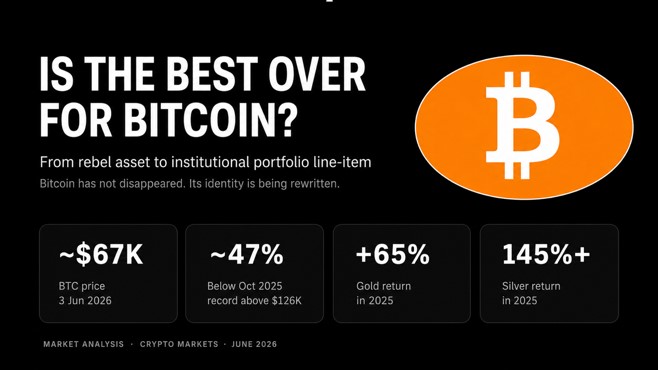
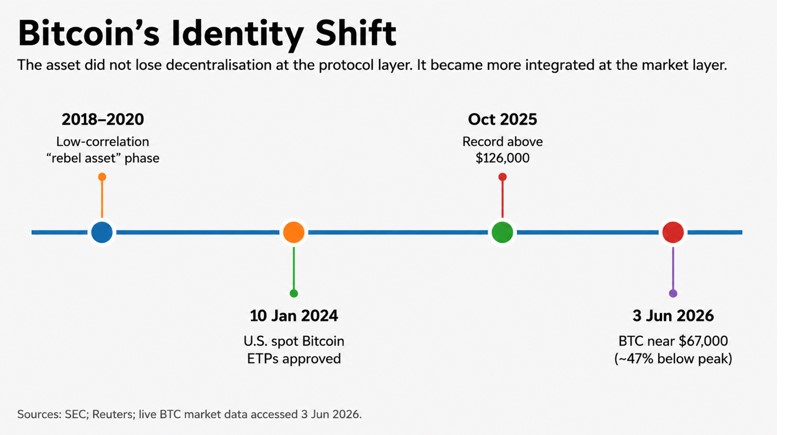
As of 3 June 2026, Bitcoin is trading near $67,000, almost 47% below the record level above $126,000 reached in October 2025. The more important issue, however, is not the correction alone. Bitcoin has corrected sharply many times before. The real issue is whether the asset that was built to sit outside the conventional financial order is now becoming an increasingly familiar line-item inside it.
This is the uncomfortable question: is the best over for Bitcoin, or is it merely entering the more sober phase that every disruptive technology eventually reaches?
Bitcoin Was Never Merely a Price Chart
Bitcoin’s original power came from its refusal to fit neatly into an established box.
It was not a share in a company. It did not generate cash flows. It was not backed by the promise of a government. It did not derive its value from industrial consumption like crude oil or silver. Its value was rooted in a monetary proposition: scarcity enforced by code, ownership secured through a distributed network and transferability without the requirement of a trusted intermediary.
In its early years, the attraction was not that it would always move inversely to equities, gold or the dollar. That would be an oversimplification.
The attraction was that it could move independently of them.
It had its own narrative, its own liquidity cycles, its own adoption curve and its own community of conviction. It behaved less like a conventional portfolio allocation and more like a parallel financial experiment.
That distinction matters.
An asset does not need to rise every time stocks fall to be useful as a diversifier. It needs to avoid becoming a mechanical extension of the same liquidity trade. The more Bitcoin begins to respond to the same interest-rate expectations, risk budgets and macroeconomic shocks that drive technology stocks, the more difficult it becomes to preserve the older story of a completely independent monetary alternative.
Institutionalisation Was a Victory. It also Came with a Price.
The inflection point is identifiable.
On 10 January 2024, the U.S. Securities and Exchange Commission approved the listing and trading of spot Bitcoin exchange-traded products. That decision removed a major operational barrier for conventional investors. Its exposure could now be accessed through the familiar rails of brokerage accounts, regulated investment products and institutional custody arrangements.
This was rightly celebrated.
It improved accessibility, reduced friction and helped move Bitcoin from the periphery of finance towards the mainstream. The iShares Bitcoin Trust, for example, is expressly designed to offer exposure to it through an exchange-traded product while simplifying the operational and custody complexities associated with holding the asset directly.
But legitimacy is never free.
The ETF era has also made Bitcoin more legible to traditional capital and therefore more responsive to traditional capital. Research published after the approval of spot ETFs has found a significant increase in Bitcoin’s relationship with equities, although the strength of that relationship continues to vary across market regimes.
This does not mean that it has become identical to the S&P 500. It means that the wall separating crypto liquidity from conventional risk liquidity has become thinner.
The same paradox is visible at the sovereign level.
In March 2025, the United States formally established a Strategic Bitcoin Reserve and a Digital Asset Stockpile. For the early believer, this is an extraordinary validation. For the purist, it is also an irony: the monetary asset designed to reduce dependence on sovereign systems is now being held as a reserve asset by the sovereign system itself.
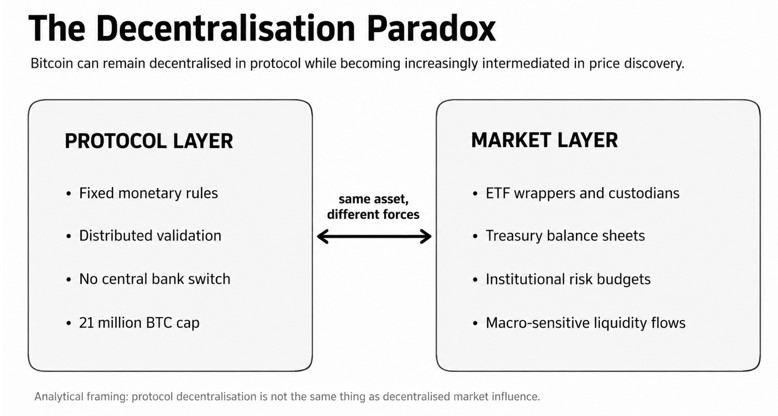
Bitcoin did not lose decentralisation at the protocol layer. It became more integrated at the market layer.
The Divergence that Should not be Ignored
The year 2025 exposed the weakness in the simplistic “digital gold” narrative.
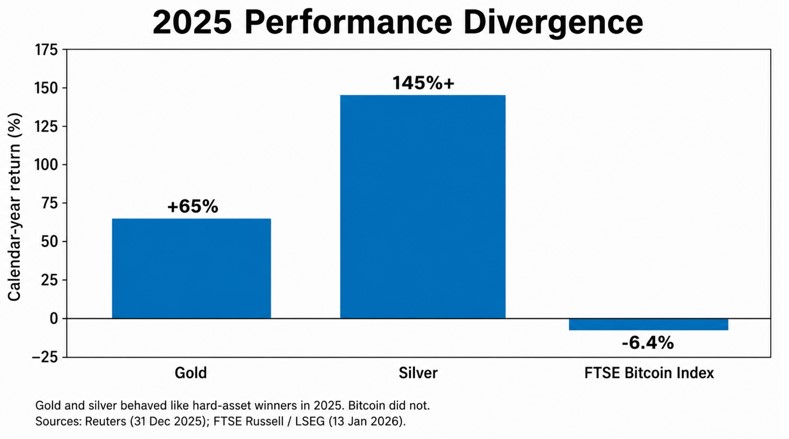
Gold rose approximately 65% during the year. Silver delivered an even more extraordinary gain of more than 145%. Bitcoin, however, did not accompany them. The FTSE Bitcoin Index declined 6.4% in 2025.
This divergence is not proof that the thesis has failed. But it is an important reminder that a fixed supply alone does not make two assets behave alike.
Gold was responding to central-bank demand, geopolitical uncertainty, monetary easing expectations and the rediscovery of safe-haven allocation. Silver benefited from those factors as well as industrial demand and supply constraints. It remained more closely exposed to the risk-on, risk-off behaviour of digital-asset liquidity.
The point is not that BTC must imitate gold.
The point is that investors should stop using the phrase “digital gold” as if it were a completed conclusion. It may eventually earn that role. It has not yet earned the right to be treated as a substitute for gold under every market condition.
Protocol Decentralisation is not the Same as Decentralised Price Discovery
BTC remains decentralised where it matters most technically.
No manager can rewrite the 21 million coin cap. No investment bank can reverse a confirmed transaction. No government treasury can alter the consensus rules by issuing a notification.
The protocol has not been captured.
Yet the market surrounding the protocol has changed considerably.
ETF providers, custodians, corporate treasuries and institutional allocators now influence liquidity, access and price discovery. Tracking data compiled by BitcoinTreasuries indicates that BlackRock’s iShares Bitcoin Trust held more than 811,000 BTC as of 3 June 2026. Strategy remained the largest corporate treasury holder, with more than 843,000 BTC listed on the same tracker.
These holdings do not confer control over Bitcoin’s code. They do, however, demonstrate how concentrated institutional channels have become in the market layer.
This distinction needs to be made more honestly.
It is not a controlled asset. But it is no longer an asset whose market behaviour can be understood without analysing the decisions of asset managers, treasury companies, regulators and macro investors.
The protocol remains decentralised. Price discovery has become increasingly intermediated.
Where did the Aggression go?
Bitcoin’s most intoxicating quality was always its aggression.
The asset could compress years of conventional-market returns into a few months. Its rallies were not merely bullish; they were violent. They made sceptics look unimaginative and believers look prophetic.
The current phase feels different.
Bitcoin reached a record above $126,000 in October 2025. By early February 2026, it briefly touched a 16-month low near $60,000 before rebounding sharply. By 3 June 2026, it had again fallen towards $67,000 after a fresh multi-day sell-off.
The asset remains volatile. What appears to have moderated is not movement, but mythology.
The market is no longer surprised that BTC exists. It is no longer forced to reprice the possibility of survival from zero. It is now a recognised asset class carrying a much larger market capitalisation, deeper liquidity and a broader ownership base.
Maturity can be a sign of success. It can also compress asymmetry.
A small, misunderstood asset can rise by multiples merely by becoming credible. A large, institutionally owned asset needs significantly more capital to generate the same percentage move. It may still produce powerful rallies. But the days when adoption alone could create effortless exponential returns may be receding.
Has the Industry Outgrown its Original Mascot?
There is another possibility that deserves serious consideration.
Perhaps the most important future question is not whether it can reclaim its peak. Perhaps the real question is whether Bitcoin should continue to represent the entire crypto industry at all.
The digital-asset ecosystem has moved far beyond a single monetary asset.
Smart contract networks have enabled decentralised exchanges, lending markets, stablecoin rails, tokenised treasuries, real-world asset platforms, gaming economies and decentralised infrastructure. The next wave of value creation may emerge from protocols that solve problems rather than merely represent scarcity.
Bitcoin is unlikely to become irrelevant. Its simplicity is its strength.
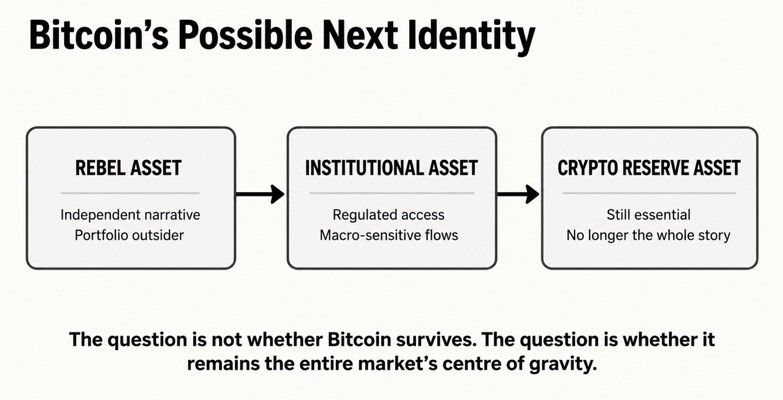
It may increasingly become the reserve asset of crypto: the hardest collateral, the most recognisable benchmark and the asset held when participants want exposure to the sector without underwriting every layer of technological complexity.
But being the reserve asset is not the same as being the whole industry.
A mature crypto market should not depend entirely on one asset to tell it when to breathe. If utility-led ecosystems develop real revenues, real users and real economic infrastructure, capital should eventually differentiate between them.
The industry will have matured only when it can produce value that does not require permission to be recognised.
The Contrarian Reading: Perhaps Bitcoin is not Lagging. Perhaps it is Warning us.
There is, however, a contrary view that cannot be dismissed casually.
Conventional markets are not pure reflections of economic reality. They are shaped by central-bank liquidity, fiscal stimulus, policy signalling, benchmark flows and the concentration of capital in a small number of dominant themes.
An equity market can continue to rise while the underlying appetite for risk is becoming narrower and more fragile.
BTC may therefore be doing something useful precisely because it is underperforming.
It may be offering a less polished reading of global risk sentiment. Unlike an index supported by passive flows or an asset benefiting from central-bank purchases, It remains highly sensitive to discretionary liquidity. When investors become uncertain, they often sell what they can sell first.
Crypto remains one of the first places where risk is reduced.
This becomes even more relevant in a recessionary or liquidity-stressed environment.
The hierarchy of liquidation is rarely philosophical. Investors do not necessarily sell the weakest asset first. They sell the most liquid non-core asset first. Until BTC is treated as a permanent allocation rather than an optional allocation, it will continue to experience sharper drawdowns when institutional risk budgets contract.
Altcoins, naturally, remain even more vulnerable.
So, is the best over for Bitcoin?
The honest answer is that no one knows.
But the question is worth asking because the easy narratives are no longer sufficient.
BTC has not failed.
A decentralised monetary network that began as an obscure experiment has survived long enough to be approved for exchange-traded products, accumulated by corporate treasuries and recognised by a sovereign strategic reserve.
That is not failure. It is one of the most remarkable transformations in modern financial history.
At the same time, success has changed the nature of the asset.
BTC is larger, more legitimate, more liquid and more institutionally embedded. It is also less isolated from conventional market forces. Its future returns may be substantial, but they may no longer resemble the extraordinary asymmetry of its early years.
The rebel has entered the boardroom.
The question is whether it can retain the fire that made it a rebel in the first place.
Perhaps Bitcoin’s best days are not over. Perhaps its easiest days are.
The next chapter will not be written by novelty alone.
It will be written by whether Bitcoin can evolve from an extraordinary trade into an enduring reserve asset — and whether the crypto industry can finally evolve beyond the price of BTC itself.
Also read: