NEAR AI Staking Explained: How Staking NEAR Powers AI Access

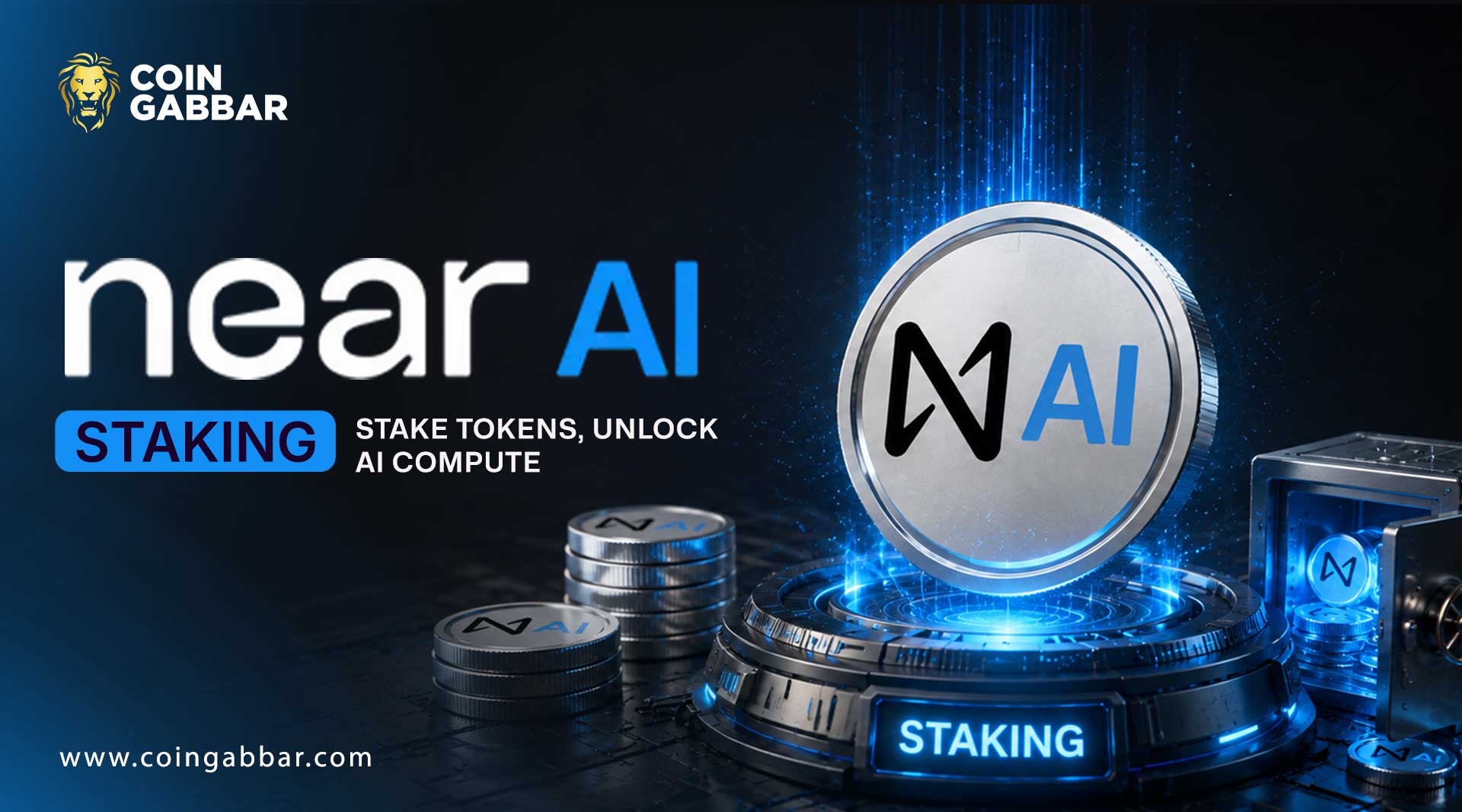
Understanding NEAR AI Staking: A New Way to Pay for AI
AI subscriptions today almost always mean the same thing: a credit card on file, a cloud billing account, and a middleman sitting between you and the model you actually want to use.
NEAR AI Staking changes that equation entirely. Instead of spending money every month, you stake NEAR tokens, and in return, you get access to AI compute.
Your tokens aren't spent; they're locked while you use the service, and you can unstake and recover them whenever you stop.
This article breaks down what NEAR AI Committing actually is, how the underlying $NEAR token and Committing mechanism work, what you get in return for staking, and where this fits into $NEAR's broader roadmap.
Key Takeaways
Your $NEAR stays yours: You stake your tokens instead of spending them, and you can get them back when you want.
Your rewards cover the AI costs: Instead of paying separately, the staking rewards you earn are used to access NEAR AI.
43 AI models in one place: Use models from Anthropic, OpenAI, Google, and more without juggling multiple accounts or subscriptions.
Your staked tokens stay in your control: NEAR AI does not get access to your staked principal or the ability to move it.
What is NEAR AI
NEAR AI is the AI layer built within the broader NEAR Protocol ecosystem, a decentralized platform originally designed to let developers build applications that securely handle high-value assets like money and identity, without depending on a single centralized provider.
NEAR AI extends that same philosophy to artificial intelligence: instead of routing AI usage through a traditional cloud account, it ties access directly to the $NEAR token and the network's Committing infrastructure.
Practically, this means users and developers can tap into 43 hosted AI models from major providers, run confidential inference, and stand up autonomous AI agents all without creating a separate account for each provider.
$NEAR frames this as part of a larger "agent economy" vision, where the same token that secures the network also becomes the currency that powers AI usage on it.
NEAR Token & Staking Mechanism
The $NEAR token is the native utility token of the $NEAR Platform. It's used to pay for network transactions and storage, to participate in Committing, and to take part in governance decisions about the protocol's direction.
It doesn't represent equity, a security, or any ownership claim; its value comes entirely from its role inside the ecosystem.
Committing on $NEAR works through a model called Thresholded Proof of Stake. Validators, the participants who run nodes and secure the network, put $NEAR tokens at risk as a kind of deposit.
If a validator behaves correctly, they earn rewards. If they act maliciously or make an error like double-signing a block, a portion of their stake can be "slashed" as a penalty, scaled progressively based on how much stake was involved in the bad behavior.
NEAR AI Staking builds directly on top of this existing mechanism but repurposes it. Instead of Committing purely to secure the network and earn rewards for yourself, you stake to unlock AI compute credits.
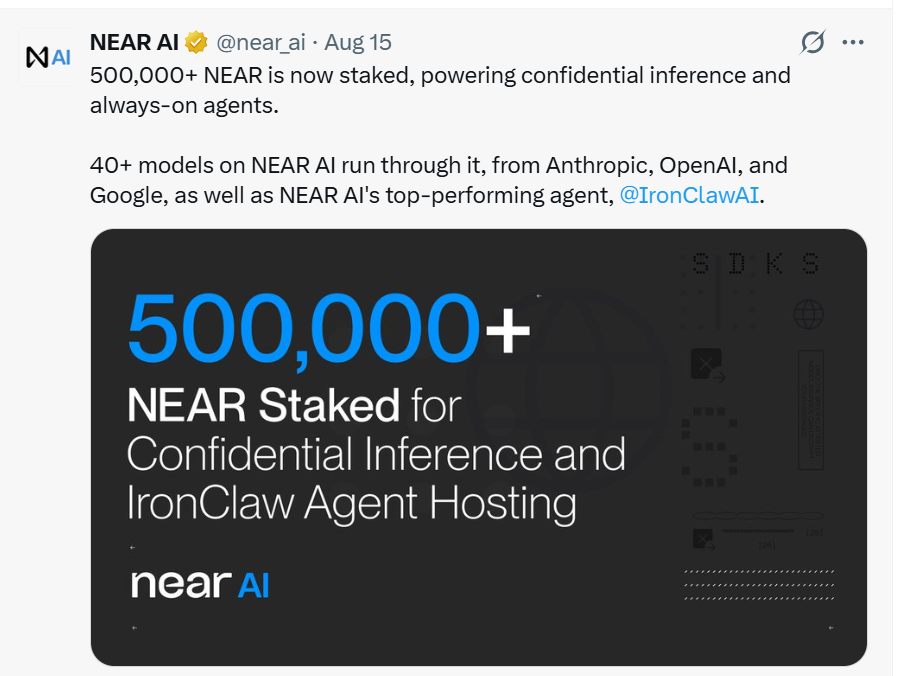
Source: Official X handle
The tokens are locked, not spent, and the size of your stake determines how many monthly compute credits you receive.
As of mid-August 2026, more than 500,000 $NEAR has already been staked through this mechanism, powering confidential inference and always-on AI agents.
Over 40 models are accessible through it, spanning providers like Anthropic, OpenAI, and Google, alongside NEAR AI's top-performing agent, IronClaw.
These numbers give a real sense of how quickly the Committing-for-AI model is being adopted since launch.
Token Allocation (Staking Rewards Allocation)
To understand where the "payment" in NEAR AI Staking actually comes from, it helps to look at how staking rewards are allocated at the protocol level, as outlined in the official NEAR white paper.
Validator rewards: Validators who run nodes and secure the network earn a target reward equal to roughly 4.5% of total token supply annually, distributed every epoch (roughly every half day)
Protocol Treasury: An additional ~0.5% of total supply annually is allocated to a treasury that funds ongoing ecosystem development
Inflation cap: Total inflation is capped at 5% per year. As network usage grows and more transaction fees are burned, effective inflation can shrink, and in theory, if fees burned exceed new tokens minted, the system can even become deflationary
Contract rewards: A minimum of 30% of transaction fees is routed back to the smart contracts (and their developers) that were actually used in a transaction
Here's the key link to NEAR AI Committing: when you stake for AI access, you're not earning those validator rewards yourself.
Instead, the staking rewards your position would normally generate are routed to NEAR AI as payment for the compute you're using.
Your principal $NEAR you staked stays yours and can be withdrawn through the normal unstaking process at any time.
Utility
The core utility of NEAR AI Committing is straightforward: stake NEAR, receive monthly compute credits scaled to your stake size. Beyond that basic exchange, the system is built to be flexible:
Adjustable stake: increase your stake to get more one-time credits, or reduce it as your usage drops
Full exit anytime: unstake completely and recover your tokens through the standard unstaking process
No card, no cloud account: access all 43 supported AI models without setting up separate billing relationships with each provider
Non-custodial control: you keep your private keys and control of your wallet throughout; $NEAR AI can't move your principal
The trade-off is real and worth being clear-eyed about: while your $NEAR is staked for AI access, you give up the ordinary staking rewards you'd otherwise earn as a regular staker. You're trading potential yield for AI compute access instead.
Roadmap: What's Available Now
As per the official roadmap, NEAR Protocol introduced "Staking for $NEAR AI" in a public announcement, positioning it as the first system to directly connect token Committing with AI service usage.
As of now:
Live today: Wallet-based login, access to all 43 supported AI models, confidential inference, and support for always-on autonomous agents
Coming soon: Google login and expanded wallet access options, making onboarding easier for non-crypto-native users
Still to prove: Adoption at scale. The mechanism is live, but how many users and developers actually shift to this staking-based model over subscriptions remains an open question worth watching
Conclusion
NEAR AI Committing reframes what the $NEAR token can do. Rather than being just a fee payment or governance token, it becomes a way to prepay for AI compute in a form you can fully recover your staking rewards from to fund the service, while your principal stays under your control.
If you're already holding $NEAR or are curious about AI access without the usual subscription friction, it's worth understanding the trade-off: you give up standard staking yield in exchange for AI usage, with the flexibility to adjust or exit whenever you want.
Disclaimer
This content is for informational purposes only and does not constitute financial, legal, or investment advice. Staking and cryptocurrency involve risk, including token price volatility and the opportunity cost of forgoing standard staking rewards. Always do your own research and consult a qualified professional advisor before participating in any staking or token-related activity.







.webp)