NRI Nucleus Reactor Initiative Crypto Launch Explained

NRI Nucleus Reactor Initiative Crypto Launch
The Nucleus Reactor Initiative (NRI) is getting ready to go live, and it's already turning heads in the wider crypto community.
NRI is the official community meme and incentive framework built for the Nucleus Core ecosystem, but it isn't meant to stand on its own.
It works alongside NU, Nucleus Core's native asset, to pull more people into the project.
So what is this token actually about? This guide walks through what NRI is, how it connects to NU, its tokenomics, and where it sits inside the broader roadmap.
Nucleus Core, in Brief
Nucleus Core is a privacy-focused Layer-1 blockchain built around a fairly unusual idea: dream journaling, subconscious data ownership, and privacy-first research.
The goal is simple enough. Let users record and own deeply personal data instead of handing it to some centralized platform.
There's also a broader ambition here. Through its NUVM execution layer, the network plans to support general-purpose decentralized applications, not just dream infrastructure. That's the long-term play.
NU is the native infrastructure asset behind all of this. It's built to power governance, transaction economics, and validator participation once mainnet activates.
Right now, users pick up NU through a pre-mainnet mobile mining app, which the team describes as the entry point into everything else.
So, What Exactly Is NRI?
NRI stands for Nucleus Reactor Initiative. The project positions it as the community acceleration layer of Nucleus Core, focused on social adoption, creator activation, and getting people ready for migration, while NU handles the technical side of things.
Here's how the team frames the split:
NU powers the blockchain
NRI powers the community
Why does this distinction matter? It sets expectations early. NU is meant to work as protocol-level infrastructure. NRI, on the other hand, functions more like an incentive layer, one that rewards participation, content creation, and growth around that infrastructure.
It's first stop is the Binance Smart Chain (BSC), which gives early participants an easy way in before Nucleus Core's own mainnet is ready.
This isn't unusual. Plenty of community-driven tokens launch on BSC first since it lowers onboarding friction and lets a team gauge demand before going deeper into native integration.
Why Was NRI Even Created?
A lot of blockchain projects build solid technology and then struggle to get an active community around it.
The documentation is fairly direct about this being the exact gap NRI is meant to close.
What is it trying to do, specifically?
Build community identity ahead of the native mainnet launch
Cut down the risk of unofficial copycat tokens
Reward creators, ambassadors, and active members
Prepare an engaged base of users for eventual migration into Nucleus Core
How Does It Actually Work?
It is built as a utility-linked token rather than something purely speculative. There are two main layers of participation worth understanding.
Staking layer: Holders can lock up to unlock eligibility for ecosystem perks and mining-related boosts.
Higher staking tiers unlock stronger privileges. Rather than treating this as passive storage, the team frames it as a qualification step, one meant to signal real commitment to the ecosystem.
Activation layer: Participants can spend NRI to switch on temporary utility features, things like time-based mining acceleration windows tied to NU mining.
Examples the team has mentioned include short boost windows and multiplier-based acceleration events during community campaigns.
The point isn't to let NRI sit idle in a wallet; spending it for utility is supposed to create repeat demand instead of one-off speculation.
When and Where NRI Launches
NRI officially launches on July 24. That date marks the start of its role as the community and incentive layer for Nucleus Core.
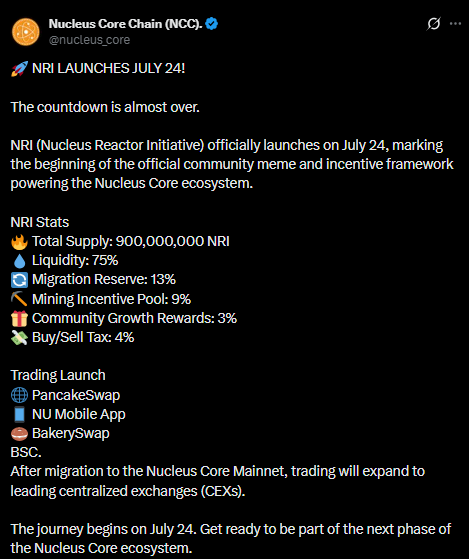
Source: Official X Post
Trading begins across a handful of platforms:
Platform | Type |
PancakeSwap | BSC decentralized exchange |
BakerySwap | BSC decentralized exchange |
NU Mobile App | Pre-mainnet participation app |
Once Nucleus Core's mainnet is live, the plan calls for trading to expand to major centralized exchanges (CEXs) as part of the broader migration.
Breaking Down the Tokenomics
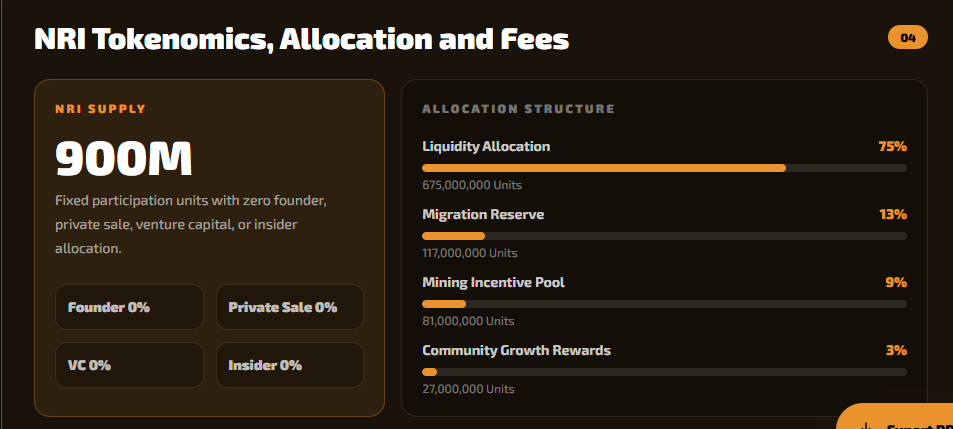
The token has a fixed supply, split across liquidity, migration support, mining incentives, and community growth. Here's the breakdown:
Allocation | Percentage |
Total Supply | 900,000,000 NRI |
Liquidity | 75% |
Migration Reserve | 13% |
Mining Incentive Pool | 9% |
Community Growth Rewards | 3% |
Buy/Sell Tax | 4% |
Source: Official Whitepaper
That large liquidity share is there to keep trading smooth and cut down on slippage right after launch. The migration reserve is set aside for the eventual move to Nucleus Core's own mainnet. Mining incentives tie straight back into NU mining acceleration, and community growth funds go toward creators and ambassadors.
NU vs NRI: Who Does What
NU | NRI |
Native Nucleus Core asset | Official community token |
Protocol infrastructure utility | Community activation utility |
Powers the blockchain | Powers the community |
Validator and network participation | Staking and mining-boost participation |
These two assets aren't competing with each other, at least by design. More activity around NRI is supposed to feed back into engagement with NU and the wider app.
Where This Fits on the Roadmap
NRI's launch is one piece of a much longer roadmap. The foundation phase and mobile mining activation are already done, according to the official roadmap.
NRI's preparation and launch come next, followed by NUVM expansion, an open testnet phase, and eventually mainnet activation paired with migration.
What's Working in Its Favor
There's already an app and community using Nucleus Core's mobile mining feature
NU and NRI have clearly separated roles, infrastructure versus community
A migration path exists to carry early participants into the native mainnet
Utility is tied to mining acceleration, not just speculation
What Could Go Wrong
NRI launches on BSC before It Core's mainnet even exists, so a lot rides on migration going well
The exact migration mechanics haven't been finalized yet
Like any crypto asset, it's exposed to market volatility and liquidity risk
Regulatory treatment of community and meme-style tokens can shift without much warning
Final Thoughts
NRI is being pitched as more than your average meme token. The team describes it as structured community infrastructure meant to support NU and get users ready for Nucleus Core's native ecosystem.
Between the July 24 launch on BSC, a defined tokenomics structure, and a clear migration path, it comes across with more of a utility-driven framing than a lot of comparable community tokens.
That said, this is still an early-stage project. The roadmap and migration plans should be treated as forward-looking, and they can change as the technical work progresses.
Disclaimer: This article is for educational and informational purposes only and should not be considered financial or investment advice. Always conduct your own research before making investment decisions.