What Is Oxin Chain Blockchain? OXIN Tokenomics, Mining & Roadmap

Why Is Oxin Chain Blockchain Getting Attention?
No mining rig. No electricity bill. Just an app and one tap a day. That's the pitch behind the Oxin Chain blockchain, and it's a big part of why it's spreading through mobile mining communities right now.
The idea is simple to understand, which is exactly why it travels fast. Open the app, tap once, come back tomorrow. But Oxin Chain is still pre-mainnet, and most of what's circulating about it comes straight from the project's own website and whitepaper rather than an independent block explorer or a listed exchange.
This article walks through what Oxin Chain says about its tokenomics, mining model, supply, vesting, and roadmap, based on its official site and whitepaper.
What Is Oxin Chain Blockchain and How Does It Work?
Oxin Chain describes itself as an EVM compatible Layer-1 blockchain built around mobile access. The project's own line for this is "to put the power of blockchain in every pocket."
According to the whitepaper, the chain will support Solidity smart contracts and standard Ethereum tooling, including MetaMask, Remix, and Hardhat. In theory, that would let developers bring existing dApps over with minimal changes.
Two products anchor the ecosystem today:
Oxin Miner (web and app) — where users mine OXIN daily.
Tokenomics dashboard — a live-stats page showing supply, burns, and network activity.
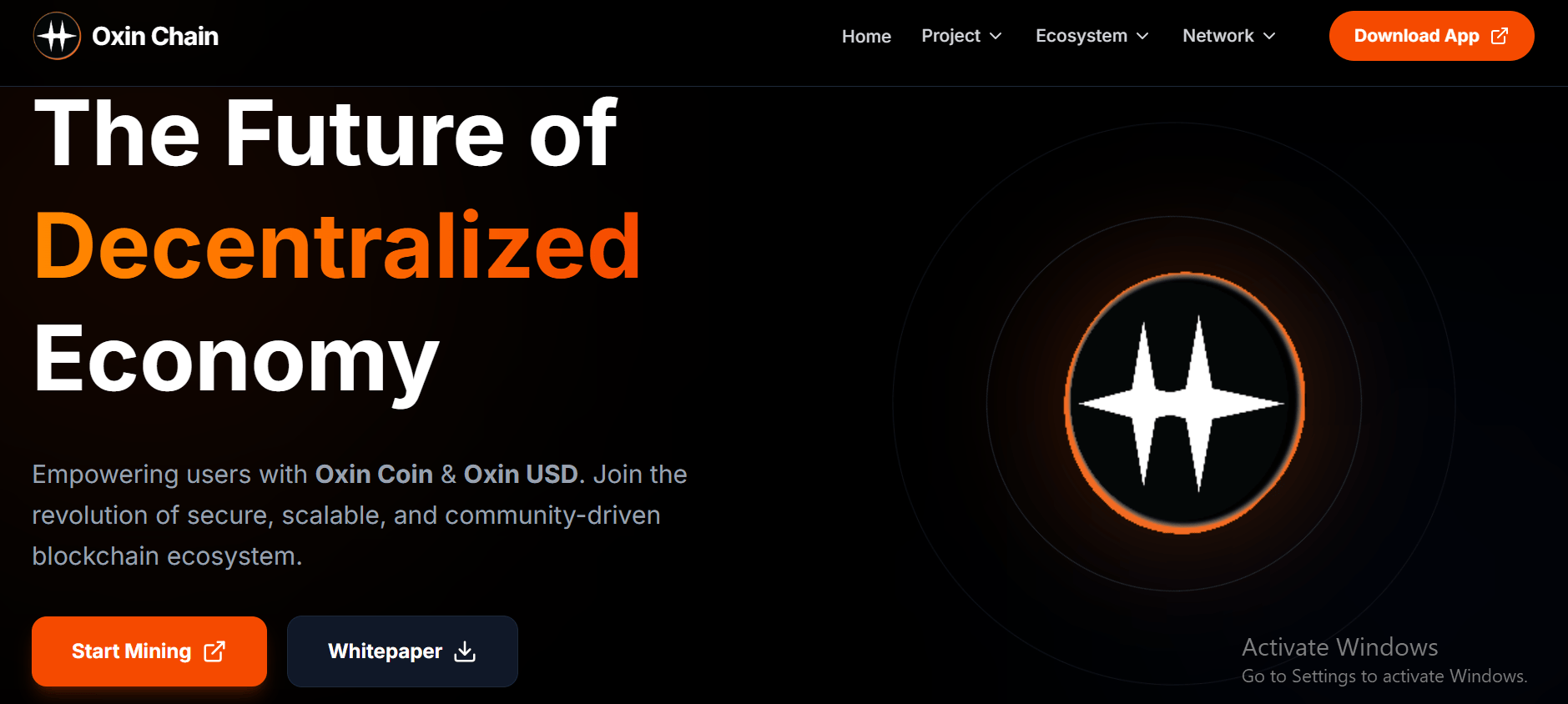
A mainnet, testnet, wallet, DEX, and explorer are all listed as upcoming rather than live. The project's current activity also includes mining and promotional campaigns ahead of its planned mainnet and Token Generation Event .
How Does Oxin Chain's Proof of Community Mining Work?
Oxin Chain says it runs on a consensus model it calls Proof of Community (PoC), a mix of Delegated Proof of Stake and what it calls Proof of Activity.
Validators stake-OXIN and process transactions. Mobile users, meanwhile, check in daily through the app. The whitepaper frames this check-in as a "Trust Score" signal rather than actual computational mining.
In practice, mining works like this:
Open the app or site once every 24 hours.
Tap to start your Maintenance Cycle.
Come back a day later to claim rewards.
Miss a cycle, and mining pauses until you restart it.
The project also publishes a halving schedule tied to user count rather than block height:
User Milestone | Mining Rate |
0 – 100,000 users | 1.0-OXIN / hour |
100,000 – 1,000,000 users | 0.5-OXIN / hour |
1,000,000 – 10,000,000 users | 0.25-OXIN / hour |
10,000,000+ users | 0.125-OXIN / hour |
OxinChain Tokenomics: OXIN-Supply, Allocation & Vesting
Oxin Chain runs a dual-token setup. it is the native coin, used for gas, staking, and governance. OUSD is a stablecoin, soft-pegged to the US dollar, meant for payments and trading pairs.
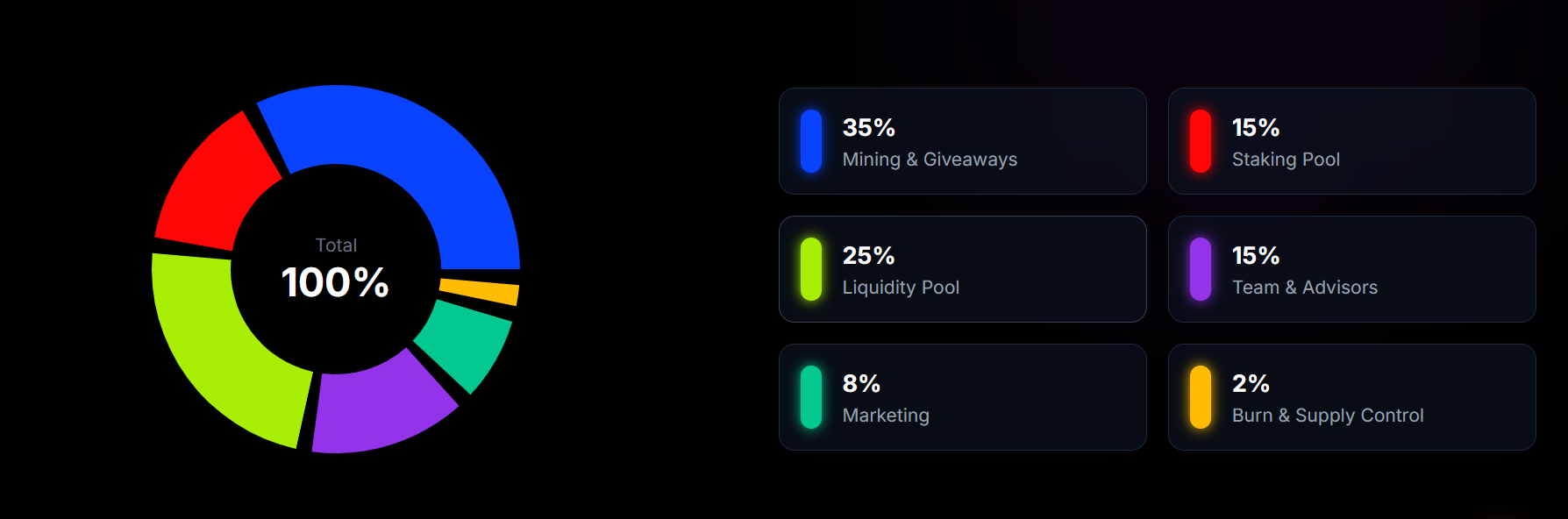
According to the whitepaper's allocation table, OXIN-supply is split like this:
Allocation | Share | Stated Purpose |
Mining & Giveaway | 35% | Rewards for mobile miners and early adopters |
Ecosystem & Liquidity | 25% | DEX/CEX liquidity, developer grants |
Staking Pool | 15% | Validator and staker incentives |
Team & Advisors | 15% | Core team, locked and vested |
Marketing & Partnerships | 8% | Brand campaigns, alliances |
Burn & Supply Control | 2% | Treasury reserve for contingencies |
A max supply figure isn't published yet. The whitepaper's asset table lists OXIN's max supply as "Next Version," which just means that number hasn't been released.
How Does the OXIN-Vesting Schedule Work?
Team and advisor tokens, per the whitepaper, are locked for 12 months, then released linearly over the following 24 months. That's a three-year total unlock window if the plan holds.
No vesting timeline is published for the marketing, liquidity, or staking allocations, so it's best not to assume those follow the same schedule as the team's.
What Is OUSD? Understanding Oxin Chain's Dual-Token Model
OUSD is pitched as the ecosystem's stability layer. The stated design lets users mint OUSD by burning OXIN-when its price is high, and redeem OXIN by burning OUSD when support is needed.
The whitepaper says OUSD is backed by "a reserve of crypto assets and algorithmic stability mechanisms" inside an Oxin-Treasury. No proof-of-reserve report or treasury address has been published to back that claim so far.
This distinction is worth understanding: an algorithmic soft peg works differently from a fully collateralized stablecoin, where reserves are held one-to-one and typically verifiable on-chain. It's a mechanism to watch as more documentation comes out, rather than something to take at face value either way.
Oxin Chain Roadmap: Mainnet, TGE & Ecosystem Development
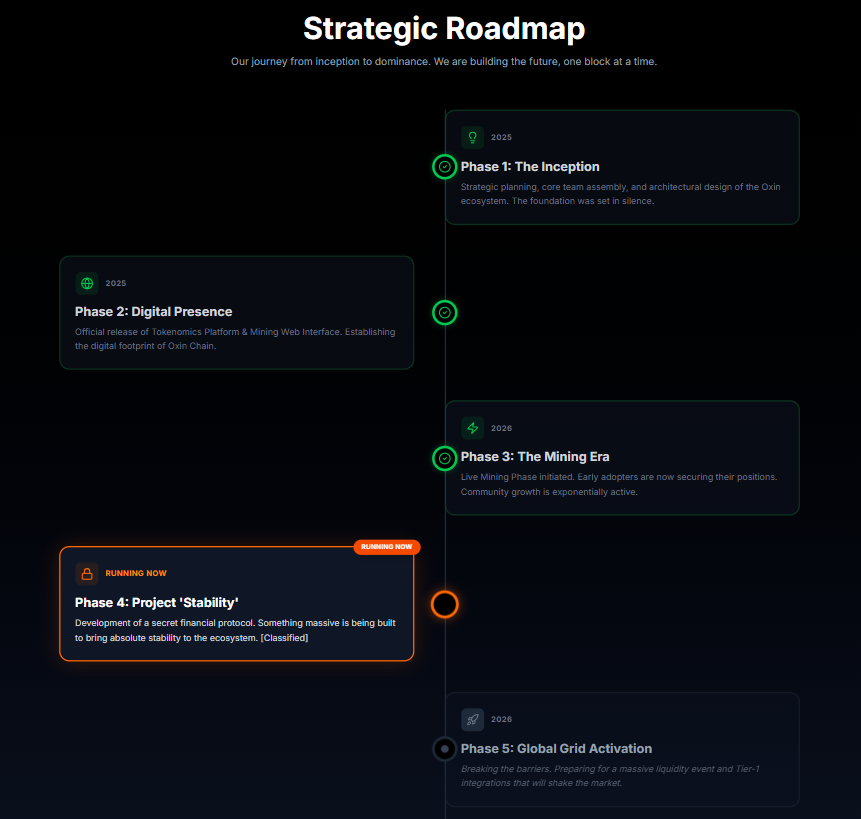
Oxin Chain's roadmap runs in six phases. The first two are marked complete on the project's site.
Phase | Stated Focus | Status |
Phase 1: The Inception | Team, architecture, whitepaper v1.0.0 | Complete |
Phase 2: Digital Presence | Website, tokenomics dashboard, miner beta | Complete |
Phase 3: The Mining Era | 3M+ target miners, KYC rollout, DAO launch | Current |
Phase 4: Project 'Stability' | Testnet, wallet, OUSD beta, dev SDKs | Planned, 2026 |
Phase 5: Global Grid Activation | Mainnet, TGE, audits, CEX listings | Planned, 2026/2027 |
Phase 6: The Oxin-Zenith | Cross-chain bridges, Oxin Pay, full DAO | Planned, 2027+ |
Security audits by firms like CertiK and Hacken are also slated for Phase 5, alongside the mainnet launch, meaning they haven't been completed yet.
The roadmap lists Binance, OKX, Bybit, and KuCoin as Tier 1 exchange targets, with Gate.io, MEXC, Bitget, and HTX as Tier 2. None of these listings are confirmed. The project's own site notes that "listings are subject to technical integration and compliance checks," which is standard language for a target rather than a signed agreement.
Conclusion
Oxin Chain blockchain presents itself as a mobile-first Layer-1 network with a defined token allocation table, a multi-year team vesting plan, and a stated deflationary burn model. Those details are documented in the whitepaper.
What's still pending, by the project's own roadmap, is a live mainnet, completed audits, and confirmed exchange listings — along with a published max supply figure and a clarification of the 35% versus 40% mining allocation gap. Readers following this project should check back on the whitepaper and roadmap updates as Phase 4 and Phase 5 progress.
Disclaimer:
This article is for informational purposes only and is not financial advice. OxinChain is a pre-mainnet project, and its tokenomics, roadmap, and figures reflect the project's own published claims. Readers should verify details independently before interacting with any mining app or crypto project.