Upcoming Crypto TGE August 2026: 7 Tokens to Watch

Upcoming Crypto TGE August 2026: 7 Tokens to Watch Before Q3 Ends
Crypto traders are tracking a busy stretch of upcoming crypto TGE August 2026 activity as seven projects prepare to go live before the third quarter closes.
A Token Generation Event, or TGE, is the moment a project's native token becomes tradable or transferable. This roundup covers the confirmed dates, the funding behind each project, and what history says about new tokens after launch.
Three of these seven already have confirmed dates inside the next three weeks. The rest are targeting a broader Q3 window.
Together, they offer a useful snapshot of where new token generation events this month are coming from and why not every launch carries the same risk profile.
The 7 Projects Preparing for TGE
Here is a simple crypto TGE dates August 2026 snapshot for all seven projects in this cluster.
Project | Token | Status | Category |
Squid Router | $QUID | Binance Alpha listing: August 4 | Cross-chain routing |
The Interfold | $FOLD | TGE confirmed for August 19 | Privacy infrastructure |
Propr | $PROPR | TGE confirmed for August 24 | Onchain prop trading |
Extended | $EXT | Scheduled for Q3 2026 | Perpetuals exchange |
Arc (Circle) | $ARC | Mainnet and TGE targeted for summer | Institutional blockchain |
Ink (Kraken) | $INK | Expected July to September | Layer-2 network |
Tread.fi | $TREAD | Tied to the end of Season 1 | Trading terminal |
Squid Router ($QUID) — Cross-Chain Routing
Squid Router is a cross-chain routing layer that moves value across more than 100 blockchains in a single transaction.
Since its January 2023 mainnet, it has routed over $6 billion across roughly 4 million transactions and powers cross-chain functionality inside more than 1,000 apps, including MetaMask, Ripple, and Ledger, according to the project's own site.
Its Squid Router QUID token launch date on Binance Alpha is set for August 4, and the public sale that preceded it closed at a fixed $45 million fully diluted valuation, per the project's official sale page.
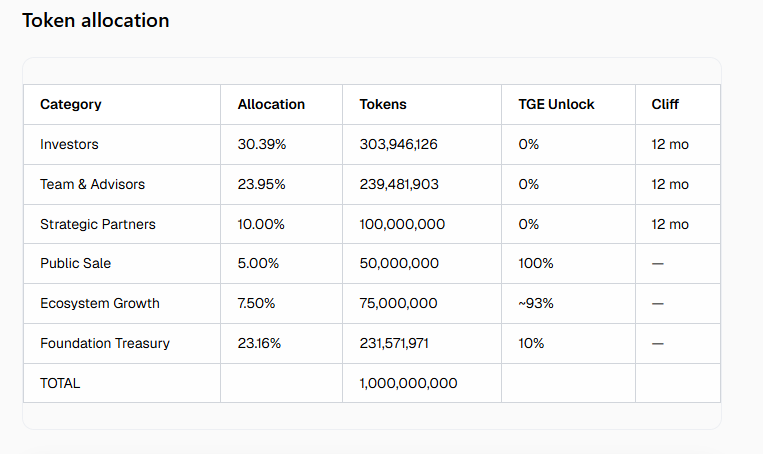
QUID Token Allocation:
According to the official documentation, the QUID token allocation is designed to balance long-term ecosystem growth while limiting immediate token unlocks for investors and the core team.
Category | Allocation | TGE Unlock | Cliff |
Investors | 30.39% | 0% | 12 Months |
Team & Advisors | 23.95% | 0% | 12 Months |
Strategic Partners | 10.00% | 0% | 12 Months |
Public Sale | 5.00% | 100% | — |
Ecosystem Growth | 7.50% | ~93% | — |
Foundation Treasury | 23.16% | 10% | — |
The Interfold ($FOLD) — Privacy Infrastructure
The Interfold, formerly known as Enclave, builds privacy infrastructure that lets multiple parties compute on shared data without exposing private inputs to each other. 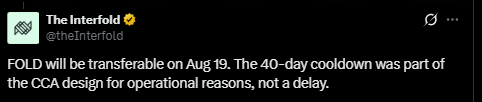
According to the project's official X announcement, FOLD becomes transferable on August 19 following a 40-day cooldown after its Uniswap-based token auction.
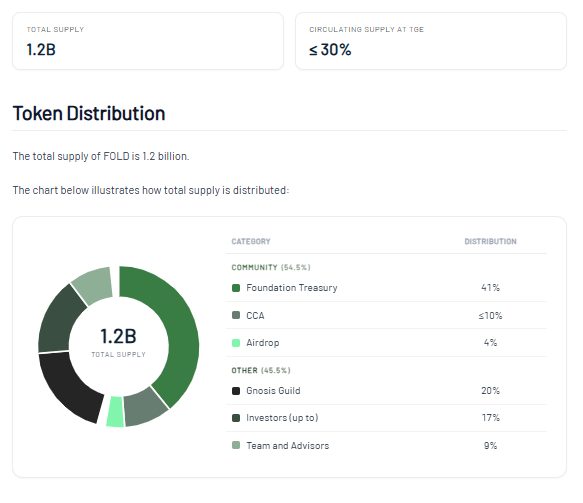
Official documentation states the total supply is 1.2 billion FOLD, with the token supporting the network through staking, ciphernode bonding, and treasury mechanisms.
FOLD Tokenomics
According to The Interfold's official documentation, the FOLD token supports the network through staking, security incentives, and treasury mechanisms.
Allocation Category | Distribution |
Foundation Treasury | 41% |
Continuous Clearing Auction (CCA) | Up to 10% |
Airdrop | 4% |
Gnosis Guild | 20% |
Investors | Up to 17% |
Team & Advisors | 9% |
Total Supply | 1.2 Billion FOLD |
Circulating Supply at TGE | Up to 30% |
Propr ($PROPR) — Onchain Prop Trading
Propr is an onchain prop trading firm built on Hyperliquid, letting traders access funded accounts while every trade is verifiable onchain.
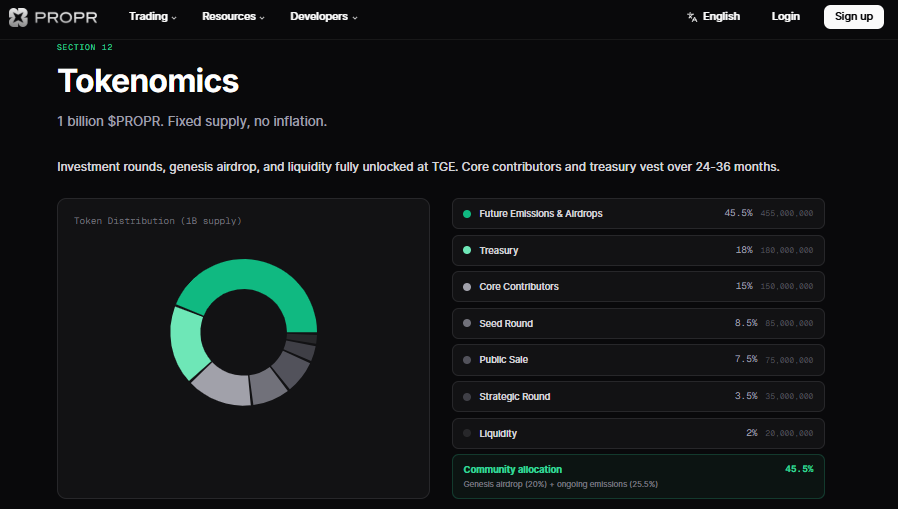
Per the project's own proposal document, PROPR carries a fixed supply of 1 billion tokens, with a 20% genesis airdrop distributed at TGE and a seed round completed at a $17.5 million valuation.
The TGE is confirmed for August 24, with investment-round tokens fully unlocked at launch.
PROPR Tokenomics
According to Propr's official proposal document, the project's tokenomics currently include the following confirmed allocations and distribution mechanics.
Allocation Category | Distribution | Tokens |
Future Emissions & Airdrops | 45.5% | 455,000,000 PROPR |
Treasury | 18% | 180,000,000 PROPR |
Core Contributors | 15% | 150,000,000 PROPR |
Seed Round | 8.5% | 85,000,000 PROPR |
Public Sale | 7.5% | 75,000,000 PROPR |
Strategic Round | 3.5% | 35,000,000 PROPR |
Liquidity | 2% | 20,000,000 PROPR |
Total Supply | 100% | 1,000,000,000 PROPR |
Extended ($EXT) — Perpetuals Exchange
Extended is a decentralized perpetuals exchange, or DEX, built on Starknet using a hybrid central limit order book, or CLOB, architecture with unified margin across crypto and real-world assets.
Its own documentation confirms the project runs on a general-purpose zk-chain secured by Ethereum. A specific TGE date has not been officially published; the project has only confirmed a Q3 2026 window.
Extended Tokenomics:
According to Extended's official documentation, the project has not yet disclosed its official tokenomics, including the total token supply, allocation, vesting schedule, or TGE unlock details.
Arc ($ARC) — Circle's Institutional Blockchain
Arc stands apart from the other six. Circle, the issuer of USDC, raised $222 million in a token presale at a $3 billion fully diluted valuation, according to Circle's official Q1 2026 announcement.
ARC Tokenomics:
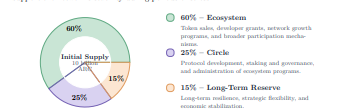
According to Arc's official whitepaper, the initial supply of the ARC token is allocated across the ecosystem, Circle, and a long-term reserve to support network growth, protocol development, and future ecosystem initiatives.
Category | Allocation | Purpose |
Ecosystem | 60% | Token sales, developer grants, network growth programs, and participation incentives |
Circle | 25% | Protocol development, staking, governance, and ecosystem administration |
Long-Term Reserve | 15% | Ecosystem resilience, strategic flexibility, and future network initiatives |
Ink ($INK) — Kraken's Layer-2 Network
Ink is a Layer-2 blockchain built by Kraken on Optimism's OP Stack, live on Ethereum mainnet since December 2024.
The independent Ink Foundation confirmed in its own statement that an INK token is planned to support the network's DeFi ecosystem, with an initial airdrop for early users of an Aave-powered liquidity protocol.
A precise Kraken Ink token launch date has not been shared; the Foundation has only said further details are still outstanding.
INK Tokenomics:
According to the Ink Foundation's official announcement, the detailed tokenomics of the INK token have not yet been disclosed. The Foundation has only confirmed that INK will support the Ink Layer-2 ecosystem and will initially be distributed through an airdrop to eligible ecosystem participants.
Tread.fi ($TREAD) — Algorithmic Trading Terminal
Tread.fi is a trading terminal and order execution management system, or OEMS, that aggregates liquidity across centralized and decentralized exchanges.
According to the project's official documentation, the detailed tokenomics have not yet been disclosed. Information regarding token allocation, vesting schedule, and TGE unlock remains unavailable at the time of writing.
Why Arc Is in Its Own Weight Class
Most upcoming crypto token launches August 2026 in this group raised single or low double-digit millions. Arc is the exception.
Circle's $222 million raise at a $3 billion FDV dwarfs every other project here, and it marks a new kind of fundraising: a publicly listed company running its own token presale.
Together with Ink, that makes two of the seven backed by exchanges or established public companies rather than pure venture rounds.
The rest form something closer to a trading infrastructure stack: a prop firm built on Hyperliquid, a hybrid CLOB perpetuals exchange, an OEMS for institutional-style execution, and a cross-chain router.
Squid alone has already processed $6 billion in volume across 100-plus chains before its token even existed, which is a different kind of track record from a project launching purely on roadmap promises.
This split matters if you're deciding which crypto tokens launching this week or this quarter are worth following closely.
Exchange-backed tokens like Arc and Ink carry different risk and governance dynamics than venture-backed projects, since their parent companies already have live products, revenue, and regulatory exposure.
What History Says About New Token Launches
Anyone looking for best upcoming TGE projects 2026 should also weigh the post-launch record.
Tokens that went live in July peaked at a combined $1.31 billion and have since fallen to roughly $594 million, based on the original roundup this data comes from. That is not unique to July.
Separate market research covering 113 tokens launched between 2024 and 2026 that reached a market capitalization above $100 million found that only 7.1% were trading above their TGE price, with a median return of -95.7% across the group, according to CryptoRank's published analysis.
This is the core reason why new crypto tokens crash after launch so often: thin early liquidity, aggressive vesting schedules, and token unlock events that add sell pressure just as public attention fades. A confirmed TGE date is not the same as a track record. It only means transferability begins.
Advantages and Risks in This Cluster
Advantages:
Three of the seven have firm, publicly confirmed dates rather than vague quarterly windows
Two of the seven are backed by companies with existing revenue and live products
Several projects, including Squid and Extended, already have meaningful on-chain usage before their TGE
Risks:
Most projects here have unclear or undisclosed pricing ahead of launch
Token unlock schedules vary widely, and some tokens are fully unlocked at TGE, which can add early sell pressure
Broader post-TGE performance data shows most new tokens fall well below their launch price within months
Future Outlook
As a crypto TGE tracker August 2026 view, this cluster reflects a market that is still active but increasingly selective.
Traders are no longer just watching for a next big token launch 2026; they're comparing funding quality, existing product usage, and unlock schedules before deciding whether to engage at all.
Whether Arc's exchange-scale backing translates into stronger post-TGE performance than the smaller, venture-backed tokens in this list remains to be seen.
Final Thoughts
This wave of upcoming crypto TGE August 2026 launches shows two very different playbooks running side by side: exchange-backed infrastructure with existing scale and smaller venture-funded trading tools still building their track records.
Watching confirmed dates matters, but so does watching what happens to tokens weeks after the hype fades.
Disclaimer: This article is for educational and informational purposes only and should not be considered financial or investment advice. Always conduct your own research before making investment decisions.