What Is RWA Blockchain? A Complete 2026 Guide to Real-World Assets

Real-World Asset Tokenization Is Having a Real Moment in 2026
Real-world asset tokenization has become one of the most talked-about corners of crypto in 2026, as more traditional assets like bonds, credit, and even pre-IPO equity find their way onto public blockchains.
The idea itself isn't new, but the pace of adoption this year has made RWA blockchain infrastructure impossible to ignore.
Whether you're tracking it through market cap charts, new platform launches, or the growing list of institutions experimenting with on-chain products.
This blog uses some of that data as a starting point, but the goal here is broader: explaining what RWA blockchain actually means and how it works in practice.
RWA Blockchain at a Glance
Metric | Value |
Definition | Real-world assets |
Market Cap | Over $30B (per DeFiLlama chart shared by RWA Foundation) |
Key Data Source | RWA.xyz |
Common Assets | Bonds, property, private credit, precious metals |
Primary Benefit | Fractional ownership and faster settlement |
So What Does RWA Blockchain Even Mean?
RWA is short for real-world asset. Put an RWA on a blockchain, and you've got a token that represents ownership or exposure to something that exists off-chain. like a bond, a slice of real estate, a private credit deal, gold, or even shares in a company that hasn't gone public yet.
That's the whole idea behind an RWA blockchain: take assets that are normally locked behind paperwork and middlemen, and let them move the way crypto moves.
Why bother? A few reasons keep coming up. Ownership records are easier to verify. Assets that used to be all-or-nothing can be split into smaller pieces, so more people can actually buy in.
And settlement, which can take days in traditional finance, can happen in minutes or seconds instead. None of that is hypothetical anymore.
The Top 30 RWA Blockchain Platforms Excluding Stablecoins
One recent 27 July 2026 post laid out the "Top 30 RWA platforms by total value, excluding stablecoins," with the numbers pulled from RWA.xyz, an analytics tool that tracks tokenized value across chains. Thirty logos, ranked, no commentary attached.
That "excluding stablecoins" detail matters more than it might seem.
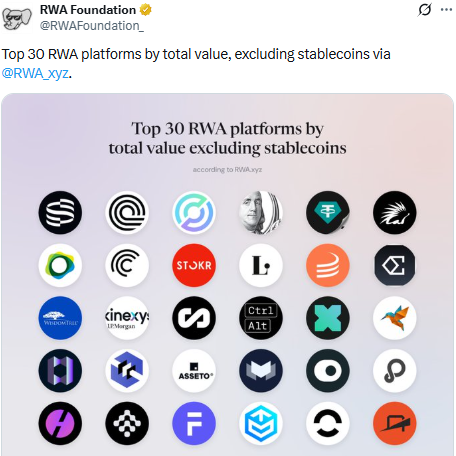
Source: Official X Post
Stablecoins get lumped into RWA statistics a lot because they're backed by cash or treasuries, but functionally they're used for payments and trading, not as an investable asset in the way a tokenized bond or a piece of real estate is.
Here's what RWA.xyz's own live rankings by total value excluding stablecoins, independent of the graphic itself:
1. Figure - A tokenization platform that issues asset-backed credit products, including home equity lines of credit (HELOCs), on the Provenance blockchain.
2. Bridgetower - A specialty finance ecosystem that tokenizes real-world projects, including mining and resource-backed assets.
3. Circle - The company behind USDC that also issues tokenized U.S. Treasury fund products like USYC.
4. Securitize - A tokenization platform that issues regulated funds onchain, including BlackRock's BUIDL.
5. Tether Holdings - The company behind USDT that also issues Tether Gold (XAUT), a token backed by physical gold.
6. Justoken - A ecosystem focused on tokenizing commodities, including gold and soybean oil products.
7. Ondo - A tokenization ecosystem focused on U.S. Treasury-backed yield products and government bond funds.
8. Paxos - A regulated platform that issues Paxos Gold (PAXG), a token backed 1:1 by physical gold.
9. Franklin Templeton (Benji Investments) - An asset manager that issues tokenized U.S. Treasury money market funds under its BENJI brand.
10. LayerZero OFT - A cross-chain token standard used to distribute assets like Staked USDe across multiple blockchains.
11. Maple - A platform for tokenized asset-backed credit, best known for its Syrup lending products.
12. Spiko - A European ecosystem that issues on-chain government debt and money market fund products.
13. Centrifuge - A platform for tokenizing credit funds, including partnerships with asset managers like Janus Henderson.
14. Kinexys Digital Assets - J.P. Morgan's blockchain division, which issues tokenized institutional money market funds.
15. WisdomTree - An asset manager that issues tokenized Treasury money market fund products.
16. STOKR - A platform for tokenizing specialty finance products, including Bitcoin mining notes on the Liquid Network.
17. Superstate - A platform that issues on-chain government securities funds.
18. Libeara - A ecosystem that tokenizes money market fund products for asset managers.
19. Realiz - A platform for tokenizing corporate bonds and credit products.
20. Hastra - A platform for on-chain asset-backed credit products.
21. Intain - A platform for tokenizing structured credit, including commercial real estate-backed products.
22. Ctrl Alt - A platform for tokenizing private equity, including structured equity tokens for private companies.
23. OpenEden Digital - A platform that issues tokenized U.S. Treasury bill products.
24. OnRe - A ecosystem for tokenizing reinsurance products, giving investors exposure to catastrophe reinsurance returns.
25. Tokeny by Apex - A tokenization infrastructure provider used to issue active-strategy investment products.
26. CRX Digital Assets - A platform for tokenizing asset-backed credit products tied to structured finance deals.
27. Huma Global - A platform focused on tokenized payment financing (PayFi) and asset-backed credit.
28. Asseto - A platform for on-chain diversified credit products.
29. Tradable - A platform for tokenizing asset-backed credit, including trade finance and consumer lending notes.
30. PACT - A ecosystem for tokenizing asset-backed credit products tied to emerging market portfolios.
Source: RWA.xyz All-Asset Overview
Important Note: The data listed above was sourced from RWA.xyz's live dashboard on July 27, 2026. Since tokenized asset values update continuously, rankings, total values, and platform positions may have changed since this data was pulled. For the most current figures, refer directly to RWA.xyz.
From Under $1B to Over $30B: The Market Cap Chart
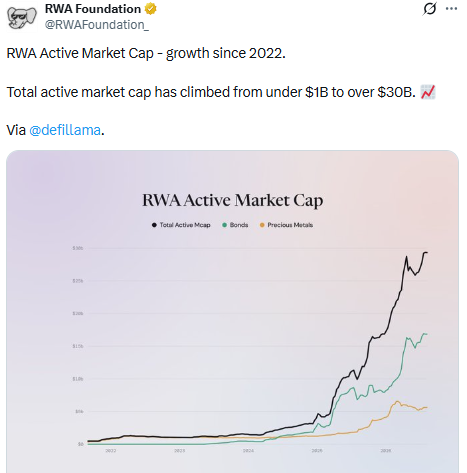
This is the post that probably deserves the most attention. The RWA Foundation shared a chart, sourced from DeFiLlama, tracking total active market cap since 2022, broken into three lines: total, bonds, and precious metals.
The headline number: The RWA blockchain market cap has gone from under $1 billion to more than $30 billion.
Source: Official RWA Post
Look at the shape of that chart, and it's not a smooth climb. There are flat stretches, a few dips, and then sharper jumps, especially in the more recent months shown.
That pattern tells you something a single "up 9% today" headline never could: interest in tokenized bonds and precious metals hasn't grown at some steady, predictable rate. It's come in waves, and the most recent wave looks like the biggest one yet.
PreStocks: A Real Example of RWA Blockchain in Action
Pre-IPO equity is one of the easiest ways to see how an RWA blockchain actually works in practice. PreStocks, built on Solana, lets investors get tokenized exposure to private, pre-IPO companies through an SPV structure, giving them 1:1 economic exposure to the underlying shares.
Trading runs around the clock instead of being limited to market hours, and there's no minimum investment required to get in. What makes this use case stand out is how familiar the concept already is.
Most people understand what it means to own a piece of a company before it goes public, so pre-IPO tokenization doesn't require learning a new financial structure from scratch, unlike more complex categories such as tokenized private credit or commodity-backed assets.
That familiarity is a big part of why examples like this are often used to explain what RWA blockchain platforms are actually capable of.
What's Still Genuinely Risky Here
None of this growth means the RWA blockchain sector is a sure thing, and it's worth saying that plainly.
Regulation around tokenized securities is still being written in most places, and it doesn't move at the same speed as the technology.
SPV structures like the one behind PreStocks add a layer of legal complexity that's worth actually understanding before putting money in, not just skimming past.
And a big total value on a platform doesn't automatically mean that value is easy to exit. Liquidity and headline numbers aren't the same thing.
None of that is a reason to write off the space. It's a reason to read the fine print before treating any tokenized product like a simple purchase.
Conclusion
RWA blockchain isn't a future concept anymore; it's already moving real money through real rails, and the data across platforms, market cap charts, and leaderboards all point in the same direction.
The chains, the rankings, even the ongoing debate over which network fits best all of it shows a sector still figuring out its final shape rather than one that's already settled.
What makes this space worth following isn't any single platform or chain winning out. It's the sheer range of what's already being tokenized, from Treasury funds and private credit to gold, mining notes, and even pre-IPO equity.
That range suggests RWA blockchain isn't chasing one use case; it's slowly becoming infrastructure that touches several corners of traditional finance at once.
That said, growth numbers alone don't tell the whole story. Regulation is still catching up, liquidity isn't the same across every platform, and a high total value doesn't always mean an easy exit.
Quick Glossary
-
RWA (Real-World Asset): An off-chain asset, like a bond or property, represented as a token on-chain.
-
Tokenization: Turning ownership rights in an asset into a blockchain token.
-
SPV (Special Purpose Vehicle): A legal wrapper that holds an asset and issues tokenized exposure to it.
-
Market Cap (in this context): The total value of active tokenized assets on an RWA blockchain at a given moment.
-
Onchain: Recorded directly on a blockchain's public ledger, visible to anyone.
Disclaimer: This article is for educational purposes only and isn't financial, legal, or investment advice. Tokenized asset markets carry real risk, including regulatory and liquidity risk. Do your own research and talk to a licensed advisor before making any investment decision.
Also read: