Staking vs Yield Farming: Which Crypto Strategy Is Better?

Two Ways to Earn From Crypto
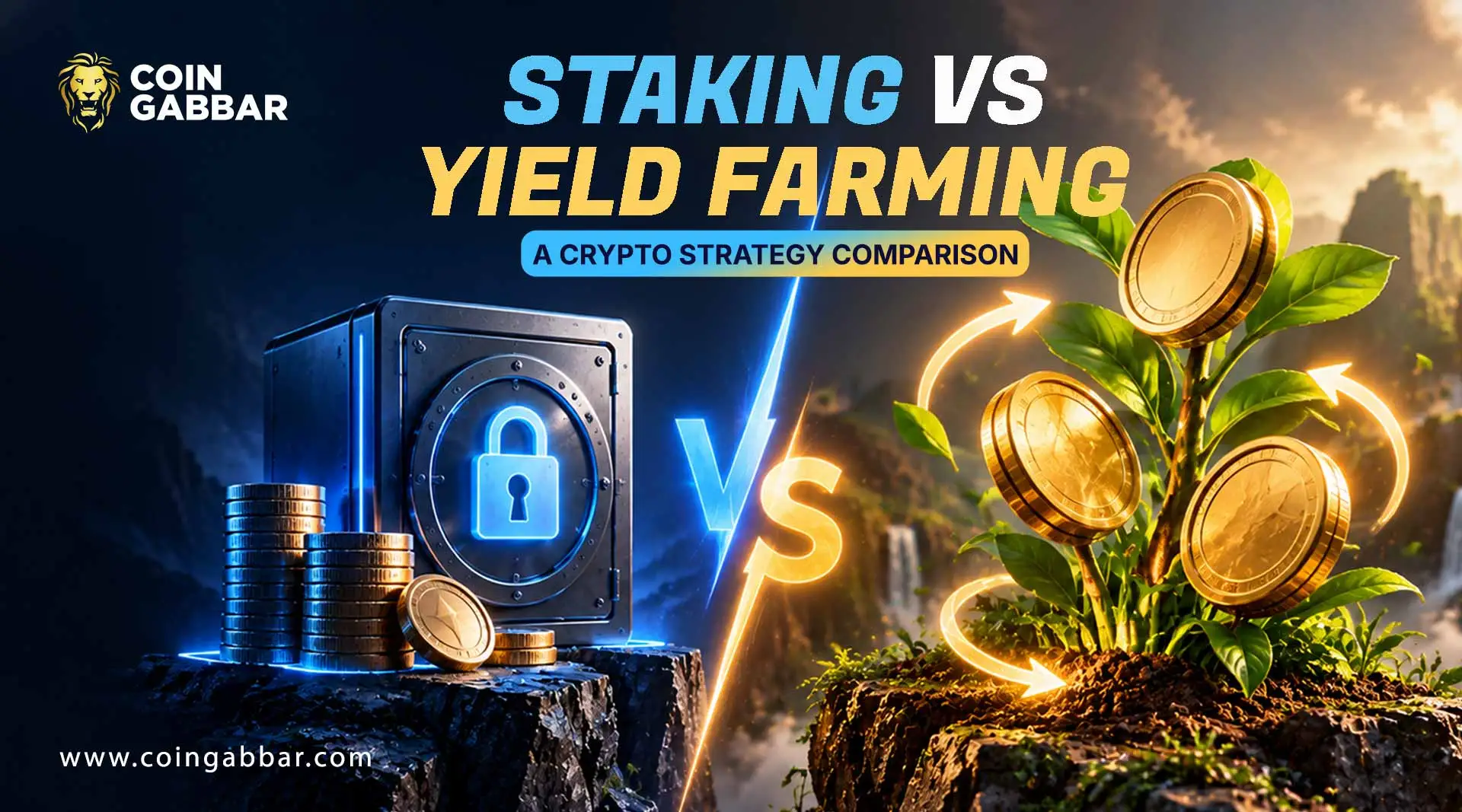
Crypto holders have two go-to ways to make their tokens work for them: staking and yield farming. Both promise passive income. But the paths to get there, and the risks along the way, don't look anything alike.
One rewards you for helping secure a network. The other pays you for supplying liquidity to traders. Turns out, that single difference changes everything about how much you can earn, and how much you can lose.
Here's the thing: neither strategy is automatically "better." This staking vs yield farming comparison breaks both down side by side, using real numbers instead of marketing APYs.
What Is Crypto Staking?
Staking means locking up your crypto to help run a blockchain network. In return, the network pays you rewards for the service.
Think of it like a deposit that does work. You put tokens in, the network uses them to confirm transactions, and you get paid for that.
Turns out, this is how networks like Ethereum and Solana stay secure without relying on energy-heavy mining.
How Staking Works
You commit tokens to a validator or a staking pool. The network then treats your stake as collateral backing the accuracy of new blocks.
And if that validator misbehaves? Part of the stake can get slashed. More on that below.
How Staking Rewards Are Generated
Rewards mostly come from new token issuance, sometimes called inflation, and from a share of network transaction fees. The exact rate shifts depending on how many people are staking at once.
Staking Risks
Slashing risk: a validator that goes offline or acts dishonestly can lose part of the staked funds.
Lockup periods: some networks hold your tokens for days or weeks before letting you withdraw.
Token price risk: rewards are paid in the same token you staked, so a price drop can erase your gains.
What Is Yield Farming?
Yield farming means putting crypto into a DeFi protocol, usually a liquidity pool, to earn rewards from trading activity.
But unlike staking, you're not securing a blockchain here. You're supplying liquidity so other people can trade.
How Yield Farming Works
You deposit two tokens into a pool, say ETH and a stablecoin. Traders swap against that pool, and you collect a slice of every trade that passes through.
Where Yield Farming Rewards Come From
Rewards come from trading fees plus incentive tokens the protocol hands out to attract deposits. Advertised APY (annual percentage yield) usually blends both sources together.
Liquidity Pools and LP Tokens
When you deposit funds, the protocol hands you LP tokens in return. Turns out, these are just a receipt, proof of your share of the pool that you'll need to withdraw later.
Yield Farming Risks
Impermanent loss: when your two deposited tokens move apart in price, you can end up with less value than if you'd simply held them.
Smart contract risk: a bug or exploit in the protocol's code can drain a pool overnight.
Reward token depreciation: incentive tokens often lose value fast as more of them get minted.
Staking vs Yield Farming at a Glance
Factor | Staking | Yield Farming |
Main purpose | Network security | DeFi liquidity |
Complexity | Low to medium | Medium to high |
Return potential | Moderate | Potentially higher |
Main risk | Impermanent loss, smart contracts | |
Management | Low | Higher |
Liquidity | May be locked | Usually more flexible |
Best for | Long-term holders | Active DeFi users |
This table is a snapshot, not the full picture. Every row below gets its own explanation, because a single line can't capture what actually drives your return.
Staking vs Yield Farming: Key Differences
Staking is mostly hands-off. Yield farming asks for constant attention.
Staking risk centers on validator behavior and token price. Yield farming stacks smart contract risk and pool mechanics on top of that.
Basically, staking asks less of you day to day. And here's a stance worth taking: for most beginners, yield farming's added complexity isn't worth the marginal APY bump.
Which Pays More: Staking or Yield Farming?
On paper, yield farming APYs look bigger, sometimes ten times higher than staking rates.
Actually, that's the wrong way to look at it. The real question isn't the advertised APY, it's what survives after costs.
Why a Higher APY Doesn't Always Mean More Profit
Farming APYs are often paid in a young reward token. When that token's price falls, your real yield falls with it, even while the percentage on paper stays exactly the same.
How Fees Eat Into Your Yield
Every deposit, swap, and withdrawal on-chain costs gas. On a busy network, those fees alone can eat a chunk of a modest position's entire return.
How Token Price Swings Change Your Real Return
When we ran the numbers on typical staking and farming setups, the gap between "advertised" and "actual" return was consistently wider on the farming side. Price swings in either deposited asset can push your outcome lower, sometimes well below the sticker APY.
$1,000 Staking vs Yield Farming Example
Staking: $1,000 at an 8% nominal annual reward rate generates roughly $80 in gross rewards over a year, before factoring in any change in the token's price.
Yield farming: $1,000 at an advertised 15% APY sounds like the clear winner. But after gas fees, a slice of impermanent loss, and reward token depreciation, the real return can land close to, or even below, staking's $80.
Methodology Behind This Example
These figures are illustrative, built on industry-typical rates, not pulled from one specific protocol's live numbers.
Staking rate: 8% nominal annual reward, a common mid-range rate seen across major proof-of-stake networks.
Yield farming APY: 15% advertised rate, a typical blended figure combining trading fees and incentive token rewards.
Gas costs: estimated at roughly 1 to 2% of the position for a full deposit-and-withdraw cycle, higher during network congestion.
Impermanent loss: estimated at 2 to 4%, based on a moderate price divergence between the two pooled assets over the year.
Reward token depreciation: estimated at 3 to 5%, reflecting typical early sell pressure on newer incentive tokens.
Turns out, once you stack those costs on top of the 15% headline rate, the real yield farming return can land at or below staking's $80. Actual results still vary by protocol, network conditions, and token price movement, so treat this as a model, not a forecast.
Fees and Hidden Costs
Staking usually charges a small validator commission. Often 5 to 10% of rewards.
Yield farming stacks more costs on top. Deposit gas. Swap gas. Withdrawal gas. Sometimes a protocol performance fee as well.
Basically, every extra step you take costs you something.
Impermanent Loss, Explained Simply
Impermanent loss happens when the two tokens sitting in your liquidity pool move in price relative to each other.
Say you deposit an equal value of Token A and a stablecoin. If Token A doubles in price, the pool rebalances and hands you back less Token A than if you'd just held it outright.
The loss becomes permanent the moment you withdraw at that skewed price. Ouch.
Who Should Choose Staking?
Choose staking if you want simplicity, don't want to babysit a position, and you're comfortable holding the underlying token for the long haul.
It also fits readers who prioritize predictable, if modest, rewards over chasing a bigger number.
Who Should Choose Yield Farming?
Consider yield farming if you already understand DeFi mechanics and can monitor a position regularly.
You'll also need to accept smart contract risk and impermanent loss in exchange for a shot at higher upside.
Can You Combine Staking and Yield Farming?
Actually, yes. Some networks issue liquid staking tokens, tokens that represent your staked position while remaining tradeable.
You can then deposit those liquid staking tokens into a yield farming pool, earning staking rewards and farming rewards at the same time. It does stack an extra layer of smart contract risk on top, though.
Final Verdict
Staking wins on simplicity and predictability. Yield farming wins on raw upside, if everything lines up.
Is the extra risk worth chasing a bigger number on a screen? That's the question every reader here has to answer for themselves.
For most people just starting out, staking is the steadier path. Yield farming fits those who already speak DeFi's language.
Disclaimer
This article is for informational purposes only and isn't financial advice. Crypto staking and yield farming both carry real risk, including possible loss of principal. Always research a protocol thoroughly before committing any funds.
Also read: