What Is a Stock Buyback Funded by Crypto Holdings?


A stock buyback funded by crypto holdings is a share or debt repurchase that a company pays for using proceeds from its own digital asset treasury, rather than from operating cash flow or a fresh bank loan.
Instead of running a traditional software or mining business and buying back stock from product revenue, a crypto treasury company converts part of its Bitcoin or Ethereum reserve into cash, then uses that cash to retire shares, convertible notes, or preferred stock.
This model has grown alongside a wave of listed companies that hold crypto as a primary treasury asset rather than a side investment.
When the token price rises, the paper value of the treasury rises with it, and management can choose to realize some of that gain to support the stock price through a repurchase.
When the token price falls, the same mechanism works in reverse, and the buyback capacity shrinks along with the treasury.
Key Takeaways
A stock buyback funded by crypto holdings happens when a public company sells or borrows against Bitcoin, Ethereum, or other digital assets on its balance sheet to repurchase its own shares or debt. This type of stock buyback funded by crypto holdings is now a recognized capital allocation tool among treasury companies.
Strategy Inc. (MSTR), MARA Holdings, and Bitmine Immersion Technologies are three companies that have publicly used crypto treasury moves to support buyback programs in 2026.
The strategy links a company's stock price directly to crypto market cycles, since a rising token price expands the treasury that can eventually fund repurchases.
Buybacks reduce the outstanding share count, which can support earnings per share, but selling crypto to pay for them also shrinks the treasury investors were buying into.
Regulatory filings such as 10-Qs and 8-Ks are the most reliable way to confirm the size, source, and timing of any crypto-funded buyback.
How Crypto-Funded Buybacks Actually Work
The mechanics generally follow one of two paths.
In the first, a company sells a portion of its Bitcoin or Ethereum on the open market and uses the proceeds directly for a share or note repurchase.
In the second, the company issues new equity through an at-the-market program, uses part of the proceeds to buy more crypto, and separately funds buybacks from cash reserves built up through crypto-related derivative income or opportunistic token sales.
Strategy Inc.'s second quarter 2026 filing shows this blended approach: the company funded bitcoin purchases from ATM stock sales of its Class A common and preferred share in the same period that it ran an active buyback program for its Digital Credit Securities and STRC preferred stock, keeping several capital streams running side by side rather than relying on one source.
Real Examples From 2026
Three 2026 disclosures show how differently this strategy can be executed.
MARA Holdings sold roughly 15,133 bitcoin between March 4 and March 25, 2026, raising about $1.1 billion, and used most of it to repurchase around $1.0 billion of its zero-coupon convertible senior notes due 2030 and 2031 at a discount, capturing close to $88 million in value for the company.
Strategy Inc., the largest corporate holder of Bitcoin, expanded its Digital Credit Securities repurchase authorization from $1.0 billion to $2.0 billion and repurchased $176.3 million of STRC preferred stock in a single week in September 2026, funded from USD cash rather than a fresh token sale, while still holding 845,050 BTC.
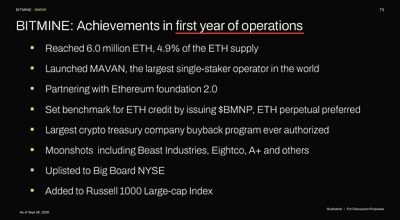
Bitmine Immersion Technologies, an Ethereum-focused treasury company, disclosed in an SEC 8-K filing that it repurchased 6.1 million common shares in one week during July 2026, framing the buyback as a response to a strengthening ETH-to-BTC price ratio rather than a single one-time crypto sale.
Why Companies Choose This Strategy
Management teams generally point to three reasons for funding buybacks this way.
First, if the stock trades at a discount to the value of the crypto and other assets on the balance sheet, buying back shares can be a more efficient use of capital than buying more tokens.
Second, repurchasing convertible debt at a discount, as MARA did, locks in a real gain and reduces future dilution risk from bond conversion.
Third, an active buyback program signals confidence to shareholders during periods of crypto price volatility.
The trade-off is concentration risk.
A company that sells part of its treasury to fund a repurchase has less crypto working for it if prices later recover, and the buyback's success depends heavily on the direction of a single volatile asset class rather than diversified business performance.
Risks and Investor Considerations
A crypto-funded buyback is not the same as a traditional one backed by steady free cash flow.
Since the funding source is a volatile asset, the size and pace of repurchases can change quickly.
A company might pause buybacks entirely during a sharp token price drop, as Strategy has done with new bitcoin purchases at points in 2026, even while continuing smaller preferred-stock repurchases from cash on hand.
Investors evaluating these companies should look past headline buyback numbers and check the funding source disclosed in each filing: was it crypto sale proceeds, ATM equity proceeds, or existing USD cash reserves? The SEC's EDGAR filing database lets anyone verify these details directly from a company's own 8-K and 10-Q filings rather than relying on secondary summaries.
Expert Opinion
Analysts covering digital asset treasury companies generally view crypto-funded buybacks as a capital allocation tool rather than a core investment thesis on their own.
The approach can create real shareholder value when executed opportunistically, such as retiring discounted convertible debt, but it ties a company's equity performance closely to crypto market cycles.
A repurchase funded by token sales during a bull run behaves very differently from one funded during a prolonged drawdown, and the same company can shift between the two within a single year, as the 2026 filings from Strategy, MARA, and Bitmine illustrate.
Ultimately, a stock buyback funded by crypto holdings works best when management treats it as opportunistic, not a fixed commitment.
Disclaimer
This article is for informational purposes only and does not constitute financial, investment, or trading advice. Cryptocurrency and equity markets are volatile, and stock buyback programs funded by digital asset holdings carry risks tied to token price movements, regulatory changes, and company-specific disclosures. Readers should review official SEC filings and consult a qualified financial advisor before making investment decisions.
Also read: