Telegram Cocoon Could Become TON’s Biggest Utility Upgrade Yet


What Is Telegram Cocoon and How Does It Work?
What if the AI running inside your Telegram app could not be spied on — by anyone, including the people powering it?
That is not a hypothetical anymore. Telegram Cocoon is live. Real user requests are being processed right now on a decentralized AI network built entirely on the TON blockchain—and the implications for both privacy-conscious users and $TON holders are significant.
Source: X Account
Here is the full breakdown of what Telegram Cocoon is, how it works, and why it could become one of the most important infrastructure launches in crypto this year.
TL;DR: Telegram launched Cocoon—Confidential Compute Open Network—a decentralized AI platform on TON. GPU owners earn TON tokens for processing private AI tasks. Developers pay in TON for access. All data stays encrypted end-to-end. Telegram is already its first and largest customer.
What Is Telegram Cocoon — And What Does It Actually Do?
At Blockchain Life 2025 in Dubai, Telegram CEO Pavel Durov unveiled Cocoon — short for Confidential Compute Open Network — a decentralized infrastructure initiative combining blockchain, AI, and social media.
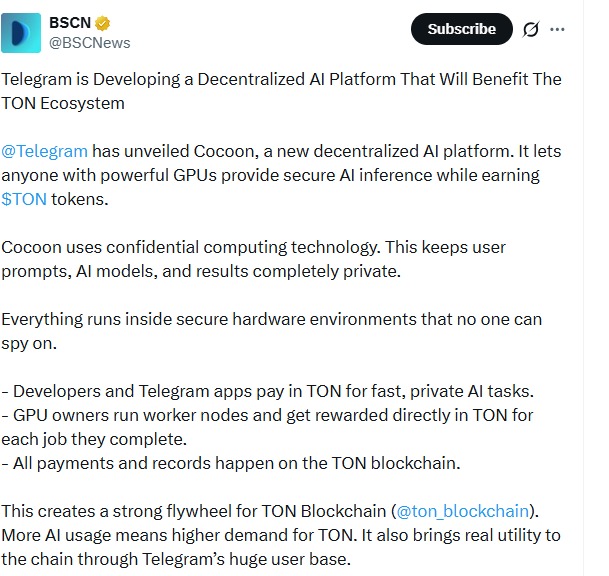
Cocoon works by allowing people who own GPUs to share their computer's processing power with the network. In return, they earn Toncoin — the cryptocurrency of The Open Network blockchain. On the other side, developers and companies use this computing power to run AI programs without relying on big tech companies like Amazon or Google. The system operates like a marketplace for computing power.
The critical difference from every other AI cloud platform: privacy by design at the hardware level.
Cocoon uses a distributed network of Trusted Execution Environment nodes—TEEs—to run AI workloads. This means input data and model outputs stay opaque to everyone, including the node operators themselves.
Your prompt goes in. The answer comes out. Nobody in between sees anything.
Not the GPU owner. Not Telegram. Not the developer. Nobody.
How Cocoon Works — The Three-Layer System
The architecture is clean and easy to follow:
Layer 1 — GPU Providers (Worker Nodes)
The network functions as a marketplace where individuals or data centers contribute GPU computing power and earn Toncoin in return. From the developer side, Cocoon offers access to distributed, cost-effective AI compute resources handled confidentially — data and queries remain encrypted end-to-end so that no party in the chain, including GPU providers, can see the actual content of processed requests.
Layer 2 — Developers and Telegram Apps
Developers access the network and pay in TON for fast, private AI inference. Cocoon routes AI requests through encrypted, distributed nodes, ensuring no centralized entity accesses user data. Telegram's own mini-apps and bots are already integrated — making Telegram simultaneously the largest buyer and biggest promoter of the network.
Layer 3 — TON Blockchain Settlement
Every payment, every job, every reward is recorded on-chain. The project builds on TON blockchain's multi-chain architecture, which processes millions of transactions per second through its sharded design. All settlement is transparent, trustless, and immutable.
Who | What They Do | What They Get |
GPU Owners | Run worker nodes and process AI jobs on TON. | TON tokens for each completed AI job. |
Developers | Submit AI tasks via API to the network. | Fast, private AI inference with low latency. |
Telegram Apps | Integrate and use AI features (summaries, drafting). | Privacy‑first AI experience at scale. |
TON Blockchain | Settles all payments and records job metadata. | Increased demand, usage, and utility for TON. |
Why Cocoon Is Already Live — And What Telegram Built First
According to Pavel Durov, Cocoon went live, and the first AI requests from users are now being processed by the network.
The first real product already using Cocoon? Telegram's own AI summaries feature.
The new AI summaries automatically condense lengthy channel posts, providing quick overviews to help users catch up on news or discussions without reading everything. Instant View pages now feature an AI-generated summary at the top—powered by open-source models executing on Cocoon.
This is not a whitepaper promise. It is a shipped product in the hands of Telegram's one billion users, running on decentralized GPU infrastructure and settled in TON.
Telegram itself is the first major customer and largest promoter of the network, integrating Cocoon's capabilities into its mini-app and bot ecosystem.
The TON Flywheel — Why This Matters for $TON
This is the part every TON holder needs to understand.
Cocoon does not just add a new product to the Telegram ecosystem. It creates a structural demand driver for $TON that compounds with every AI request processed on the network.
The flywheel works like this:
More Telegram users use AI features More Cocoon requests processed More TON paid by developers More GPU owners join to earn TON Network grows More AI features built on Cocoon Repeat.
AlphaTON Capital, a Nasdaq-listed digital asset infrastructure and TON treasury company, announced its intention to make a substantial investment in all the hardware required to support the network—deploying next-generation, high-memory GPU models across strategic data centers, supporting advanced model architectures including DeepSeek and Qwen.
Institutional hardware investment entering a network backed by one billion Telegram users is not a small signal. It is a direct bet that Cocoon's demand for TON will be real, sustained, and growing.
TON powers Telegram's in-app economy, supporting features like creator payouts and ad payments. Cocoon adds a third major demand vector — AI compute payments — to a token that was already powering two significant real-world use cases inside the world's fifth-largest messaging app.
The Honest Risk Assessment
Cocoon is a genuinely exciting infrastructure launch. But real risks exist and deserve direct attention.
The network faces criticism for working only with specific Intel processors, potentially hindering widespread adoption. TEE technology — specifically Intel's Trusted Execution Environments — is the security foundation of Cocoon's privacy guarantees. But requiring specific hardware limits which GPU owners can participate in, at least in the early phase.
Centralization risk is also worth watching. If a small number of large operators—like AlphaTON Capital—supply the majority of compute, the "decentralized" label becomes aspirational rather than descriptive. The network needs broad participation from independent GPU owners to deliver on its promise.
Regulatory uncertainty around decentralized AI compute in key markets is a third consideration. As governments increase scrutiny of both AI platforms and crypto infrastructure, a network combining both could face complex compliance questions.
Future Outlook
Cocoon arrives at a specific moment in the AI-crypto convergence that makes it strategically important beyond its technical specs.
Durov positioned Cocoon as a response to what he described as the gradual erosion of digital freedoms and privacy under centralized AI platforms run by major tech companies. He framed decentralized compute as a way to reduce single points of failure, curb data-profiling or censorship risks, and shift power away from a few large corporations.
"Leveraging Telegram's billion-strong user base and TON's high-performance, scalable blockchain technology, Cocoon has the potential to redefine how billions interact with AI in their everyday digital lives. Cocoon is the convergence of social networking, AI, and decentralized technology at an unprecedented scale.
Whether that scale materializes depends on three things: hardware supply growing beyond a handful of large operators, developer adoption of the Cocoon API beyond Telegram's own mini-apps, and TON's ability to maintain low-cost, high-throughput settlement as AI request volumes grow.
All three conditions are achievable. None are guaranteed. But the foundation—a live network, one billion potential users, and a blockchain with proven throughput—is more credible than most decentralized AI projects have managed at launch.
YMYL Disclaimer: This article is for informational and educational purposes only. It does not constitute financial or investment advice. TON token and all referenced crypto assets carry significant market risk.
Also read:









.webp)




