Tetreum Presale Guide: TET Token & Tetreum Blockchain Explained

Tetreum Presale: What Is This New Blockchain Project?
Introduction
Tetreum Presale has recently become a hot discussion among the crypto community. The blockchain sector is full of different projects launched daily, all promising to become "the next big thing."
Tetreum Blockchain defines itself as an innovative Layer 1 platform built based on TET Token with the emphasis on speed, scalability, and practical use.
It is based on the Proof of Authority (PoA) consensus algorithm and is EVM-compatible – meaning that developers familiar with Ethereum ecosystem will face no problems with working with it.
In this blog post, we will discuss the most important aspects of The Blockchain from its white paper, including the following: what presale is, important takeaways, tokenomics, staking, ecosystem, roadmap, token sale and risks.
What Is the Tetreum Presale?
Through the Tetreum Presale, Tetreum is selling its TET tokens in a staged public sale. The total supply available is set at 1,000,000,000 (1 billion) The tokens, 200,000,000 TET (20%) of which will be sold during the public sale.
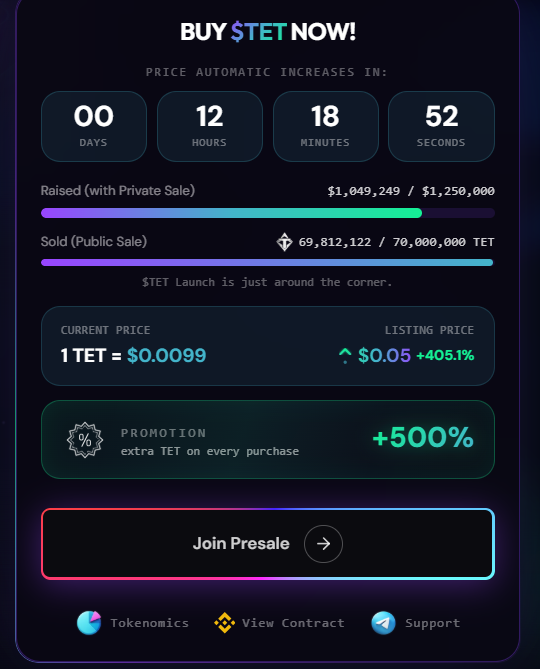
Private Sale funds raised so far: $1,049,249 out of a $1,250,000 target (~84% filled)
Public sale tokens sold: 69,812,122 out of 70,000,000 TET allocated (~99.7% sold)
Current sale price: 1 TET = $0.0099
Stated future listing price: $0.05 (platform claims a +405.1% difference from current price—this is a projection shown by the platform, not a guaranteed outcome)
Active promotion: Platform is offering bonus tokens on purchases during this window
Sale window: Platform shows a live countdown before the price is scheduled to increase
Source: Official Tetreum's Presale Dashboard
As of August 17, 2026, Tetreum's presale platform shows the public sale allocation nearly sold out—around 69.8 million of the 70 million TET tokens available.
The private sale has raised roughly $1.05 million toward its $1.25 million target.
The premise of presale is very simple – those who purchase tokens early on will buy them at a lower price, and as the rounds pass, the price will get higher.
As per the whitepaper, the sale is divided into 5 stages (S1-S5), with 40 million The available for each stage.
Key takeaways
As per the whitepaper, some of the main highlights of Token are as follows:
Fixed Supply: 1 billion TET, ensuring scarcity.
Consensus: PoA-based fast and eco-friendly.
Staking: Lock tokens to earn rewards.
DAO Ready: Governance built-in from launch.
Developer Support: Full EVM compatibility with Ethereum tooling.
Fast Transactions: Finality in seconds, not minutes.
Tokenomics
Sources: Official Tetreum Tokenomics
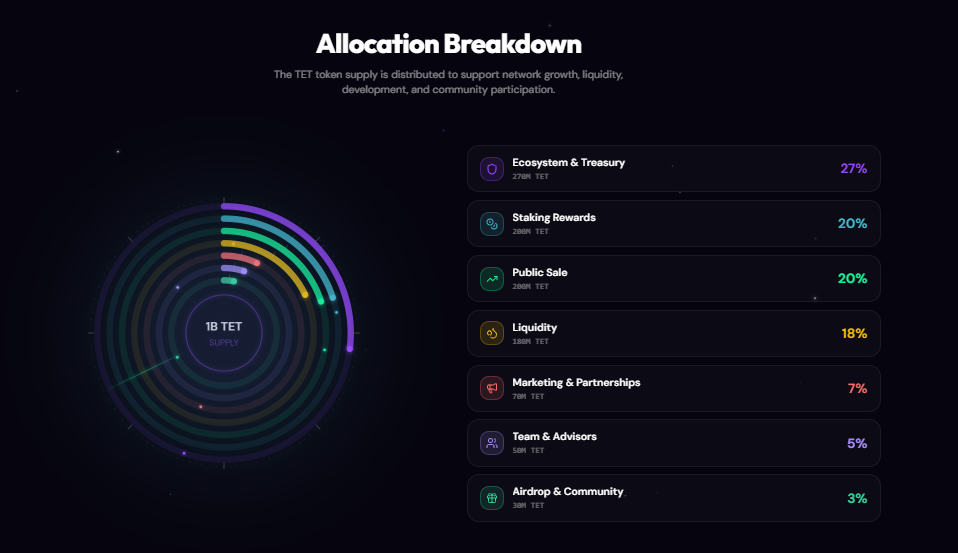
TET token has a fixed supply of 1,000,000,000, with allocation structured as follows:
Allocation | % | Tokens |
Ecosystem & Treasury | 27% | 270,000,000 TET |
Staking Rewards | 20% | 200,000,000 TET |
Public Sale | 20% | 200,000,000 TET |
Liquidity | 18% | 180,000,000 TET |
Marketing & Partnerships | 7% | 70,000,000 TET |
Team & Advisors | 5% | 50,000,000 TET |
Airdrop & Community | 3% | 30,000,000 TET |
This distribution is described as being designed to balance development, liquidity, and community incentives.
Staking Mechanism
Tetreum's staking system is pool-based, with different lock periods and reward percentages:
30 days5% reward
90 days20% reward
180 days50% reward (the whitepaper's example also lists the 180-day pool at 30% both figures appear in the document, so this should be confirmed)
How it works:
The user chooses a pool based on duration.
Tokens are locked into the contract via stake().
On withdrawal after maturity, the reward is added.
Early withdrawal is not allowed, enforcing time commitment.
Reward formula: Reward = (amount × pool.percent) / 100
Ecosystem
TET positions itself to be more than just a token; it is an entire ecosystem for developers, companies, and users:
Developer Tools: EVM compatibility, SDKs (JavaScript, Python, Go), documentation.
Partnership Programs: Grants and technical assistance for early adopters.
Community Centers: Bounties, hackathons, and DAO engagement.
Applications: Payments, staking, governance, DeFi, NFTs.
Roadmap
Phase 1 — Q2 2026 (Completed): Foundation & Development
Smart contract development and comprehensive testing
Platform architecture design and optimization
Multi-layer security audits and penetration testing
Core team expansion and technical infrastructure setup
Initial deployment of validator nodes and consensus configuration
Phase 2 — Q3 2026 (Ongoing): ICO Launch & Community
Launch of WEB3 + WEB2 ICO platform with advanced user features
Reaching ICO funding goals and validating market interest
Launch of TET Testnet and activation of public $TET Faucet
Release of TET SDK for third-party developers
Integration of advanced AI features and automation within smart contracts
FUTURE GOALS
Phase 3 — Q4 2026: Global Scale & Innovation
Deployment of governance portal for DAO proposals and community voting
Implementation of Real-World Asset (RWA) tokenization infrastructure
Launch of multi-chain bridge enabling seamless cross-network transfers
Expansion of DeFi offerings and ecosystem partnerships
Listings on major aggregation platforms like CoinMarketCap and CoinGecko
Phase 4 — Q1 2027: Mainnet & Ecosystem
Official launch of Tetreum Mainnet with full production functionality
Strategic listings on centralized exchanges with deep liquidity
Expansion into international markets with a focus on regulatory compliance
Release of mobile wallet apps for both iOS and Android
Activation of on-chain governance and deployment of treasury tools
The roadmap reflects Tetreum’s commitment to transparency, delivery, and community-centeredness.
Sources: Official Tetreum Roadmap
Tetreum Presale - Token Sale Details
The Tetreum Presale runs across 5 stages, with 40 million TET per stage:
Stage | Price | Allocation | Amount Raised |
S1 | $0.0034 | 40,000,000 TET | $136,000 |
S2 | $0.0050 | 40,000,000 TET | $200,000 |
S3 | $0.0072 | 40,000,000 TET | $288,000 |
S4 | $0.0098 | 40,000,000 TET | $392,000 |
S5 | $0.0130 | 40,000,000 TET | $520,000 |
If all stages are fully subscribed, the total raise would be ~$1,536,000 based on the whitepaper's numbers, though S2's price isn't clearly stated in the document, so this figure should be verified.
Sources: Official Whitepaper
Risks and Mitigation
As is usual in any blockchain venture, there are some risks associated with Tetreum:
Regulatory Risks: there are global uncertainties concerning cryptocurrency regulations.
Smart Contract Risks: even with reviews, bugs may be present.
Market Risk: there could be drastic variations in the value of TET tokens.
Technological Risk: failure of technology or consensus.
Operational Risk: failure to manage operations, for instance, due to a change in leadership.
Risk mitigation methods: regulatory oversight, audit by third parties, and risk management of the treasury, among others.
Conclusion
With the help of Tetreum Presale, Tetreum introduces itself as a quick, EVM-compatible, PoA-powered blockchain that incorporates features like staking and DAO governance.
The whitepaper is ambitious and claims to address several standard Web3 problems: gas fees, scalability, and governance.
However, as with any new crypto project, there can be a gap between claims and reality. A few things worth verifying yourself:
Team members' identities are kept confidential/anonymous in the whitepaper, and the bios themselves contain a name mismatch (the CEO is named "Ghe-jun Dou," but the bio refers to "Seo-jun").
The token sale table has missing or inconsistent numbers (e.g., S2's price).
No verified third-party audit report or independent source is attached to the document.
This doesn't necessarily mean the project is fraudulent, but these are red flags that shouldn't appear in a legitimate project, and they shouldn't be ignored.
Disclaimer
This blog post is based on information provided in the Tetreum whitepaper and is intended for educational/informational purposes only. It is not investment advice, financial advice, or trading advice.
Before participating in any crypto token, presale, or staking program, conduct your own independent research (DYOR), verify official sources, and consult a qualified financial/legal advisor if needed. Crypto investments are high-risk and their value can fluctuate significantly never invest more than you can afford to lose.





.webp)