Top 15 Onchain Apps by Protocol Revenue Ranked by Market Value in 2026


Top 15 Onchain Apps by Protocol Revenue Compared by Valuation Data
Crypto gets judged by price. Up or down that is usually the whole story.
But a smaller group of people is asking a different question: which protocols are actually earning money? Not from token sales or treasury games, but from users paying to use a product.
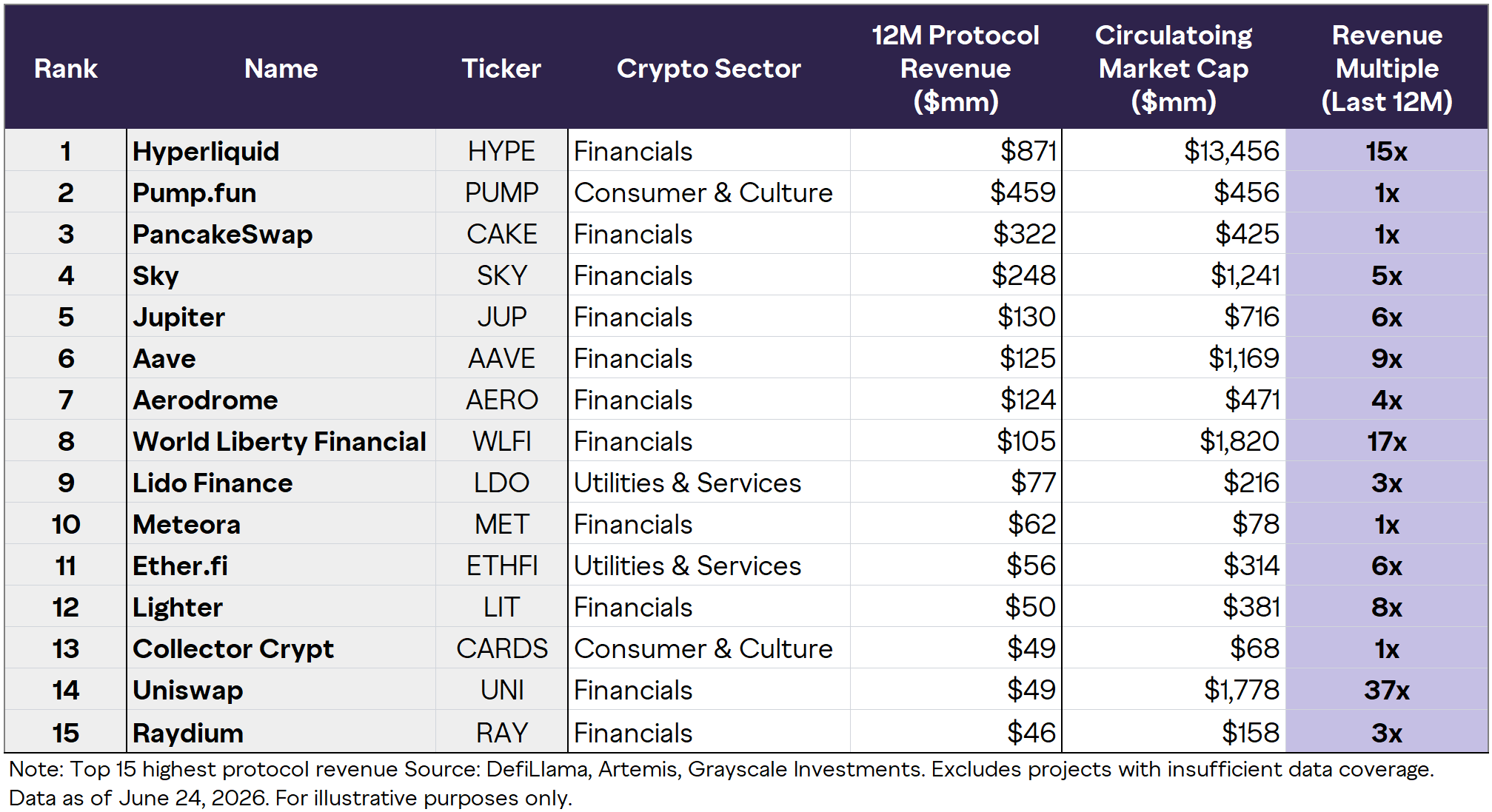
Grayscale's latest Stack report answers that. It ranks the top 15 onchain apps by protocol revenue as of June 24, 2026. What comes out is a list of protocols with real cash flows, low overhead, and revenue multiples that look nothing like what you'd expect in any traditional market.
The 15 Protocols, Broken Down
1. Hyperliquid (HYPE)
Revenue: $871M
Market Cap: $13,456M
Revenue multiple (last 12M): 15x
Hyperliquid is a decentralized perpetuals exchange on its own Layer 1 chain. Traders come here for on-chain derivatives without handing custody to a centralized exchange. $871M in earnings over 12 months puts it at the top of this list by a wide margin.
2. Pump.fun (PUMP)
Revenue: $459M
Market Cap: $456M
Revenue multiple (last 12M): 1x
Pump.fun is a memecoin launchpad on Solana. Anyone can create a token in seconds. The volume of launches has been relentless, and the fees add up. At $459M against a $456M market cap — one of the more striking setups on the list.
3. PancakeSwap (CAKE)
Revenue: $322M
Market Capitalization: $425M
Revenue multiple (last 12M): 1x
PancakeSwap is one of the oldest decentralized exchanges still running at scale, operating mainly on BNB Chain. $322M in annual profit at 1x. The math is simple — and it raises fair questions about whether the market has really thought this one through.
4. Sky (SKY)
Revenue: $248M
Market Cap: $1,241M
Revenue multiple (last 12M): 5x
Sky, formerly MakerDAO, is the protocol behind the USDS stablecoin. Profit comes from stability fees and Real World Asset yield. It is core DeFi infrastructure — the kind that runs quietly in the background while the rest of the market chases trends.
5. Jupiter (JUP)
Revenue: $130M
Market Cap: $716M
On-chain earnings (last 12M): 6x
Jupiter is the leading DEX aggregator on Solana. It routes trades across various liquidity sources for the best available price. As Solana's user base has grown, Jupiter's volume has followed and its $130M in profit reflects that clearly.
6. Aave (AAVE)
Earnings: $125M
Market Capitalization: $1,169M
On-chain earnings (last 12M): 9x
Aave has been one of DeFi's most reliable lending protocols for years, running across various chains. The model is simple: lenders deposit, borrowers pay interest, Aave takes a fee. No gimmicks just a lending market that keeps working.
7. Aerodrome (AERO)
Revenue: $124M
Market Cap: $471M
Aerodrome is the dominant liquidity hub on Base, Coinbase's Layer 2 network. As Base has scaled and attracted more users, Aerodrome has absorbed most of that trading activity. $124M shows how quickly Base has matured as an ecosystem.
8. World Liberty Financial (WLFI)
Revenue: $105M
Market Cap: $1,820M
On-chain earnings (last 12M): 17x
World Liberty Financial is a DeFi lending and governance protocol. At 17x, it carries the highest earnings on the list the market is paying a premium built on future growth expectations rather than current earnings.
9. Lido Finance (LDO)
Revenue: $77M
Market Cap: $216M
On-chain earnings (last 12M): 3x
Lido is the largest liquid staking protocol for Ethereum. Users deposit ETH, get stETH back, and keep earning staking rewards while using that stETH across DeFi. Lido takes a cut of those rewards. Simple product, 3x multiple.
10. Meteora (MET)
Revenue: $62
Market Cap: $78M
On-chain earnings (last 12M): 1x
Meteora is a dynamic liquidity protocol on Solana focused on efficient market making. At 1x, its market cap is almost equal to one year of earning a gap that rarely exists in established markets outside of distressed assets.
11. Ether.fi (ETHFI)
Revenue: $56M
Market Cap: $314M
On-chain earnings (last 12M): 6x
Ether.fi is a non-custodial liquid restaking protocol. Users stake ETH and earn extra yield through EigenLayer restaking without giving up custody. It grew fast as restaking became one of DeFi's major narratives in the last year.
12. Lighter (LIT)
Revenue: $50M
Market Cap: $381M
Profit multiple (last 12M): 8x
Lighter is a decentralized order book exchange built for active traders who want on-chain execution at speed. At 8x, the valuation is moderate compared to peers in the same category.
13. Collector Crypt (CARDS)
Earnings: $49M
Market Cap: $68M
Revenue multiple (last 12M): 1x
Collector Crypt is in the Consumer and Culture sector digital collectibles and trading card mechanics on-chain. $49M in profit against a $68M market cap. Like others at 1x on this list, it earns nearly its entire market cap every year.
14. Uniswap (UNI)
Revenue: $49M
Market Cap: $1,778M
On-chain earnings (last 12M): 37x
Uniswap is the original AMM and still the most recognized DEX in the market. At 37x profit, it is the most expensive protocol on this list by far. That premium reflects brand recognition and ecosystem positioning not cash flow.
15. Raydium (RAY)
Revenue: $46M
Market Cap: $158M
Revenue multiple (last 12M): 3x
Raydium is Solana's core AMM, underpinning a large share of on-chain liquidity on the network. A 3x multiple for a high-volume, established protocol looks measured given how active Solana has been.
Source: X Account
Why These Numbers Matter for Investors
Most crypto assets get priced on narrative. This list prices them on revenue.
In traditional software markets, a 10x to 20x multiple is standard. Several protocols here sit at 1x to 4x generating income from users paying fees, not from token emissions designed to inflate numbers temporarily.
The overhead picture is different too. Onchain protocols do not carry payroll, office costs, or cost of goods the way normal businesses do. A protocol like PancakeSwap generating $322M annually with minimal operating costs has a margin structure most businesses simply cannot match.
Grayscale sees this combination low multiples, high margins, real earnings as a potentially attractive entry point for investors willing to look past price charts.
The CLARITY Act: Why Regulation Is Part of This Story
The biggest weight on onchain app valuations has been regulatory uncertainty. Are protocol tokens securities? Is the SEC or CFTC in charge? These questions have hung over the space for years, suppressing valuations and keeping many institutional investors on the sidelines.
The Digital Asset Market Clarity Act — the CLARITY Act — is designed to fix that. It draws a clear line between SEC and CFTC jurisdiction and creates a defined path for digital assets to operate under a known framework.
For protocols with real earnings, removing that legal uncertainty could unlock a meaningful re-rating. Grayscale points to the CLARITY Act's progress as a key tailwind for onchain finance in the second half of 2026.
Conclusion
Hyperliquid earned $871M last year. Pump.fun and PancakeSwap both trade at 1x earning. Across the list, the pattern is clear real products, real fees, and valuations that look underpriced against what these protocols actually earn.
The CLARITY Act adds a regulatory catalyst on top of fundamentals already in place. Whether or not legislation moves on schedule, the earnings on this list is not speculative. It is already there.
Disclaimer
This blog is for informational purposes only and does not constitute financial or investment advice. All data is sourced from Grayscale Investments, DefiLlama, and Artemis. Crypto investments carry significant risk, including loss of capital. Always do your own research before making any investment decisions.