What Is a DAO? A Beginner's Guide to Decentralized Organizations

Anyone who has spent time in crypto has probably run into the term DAO.
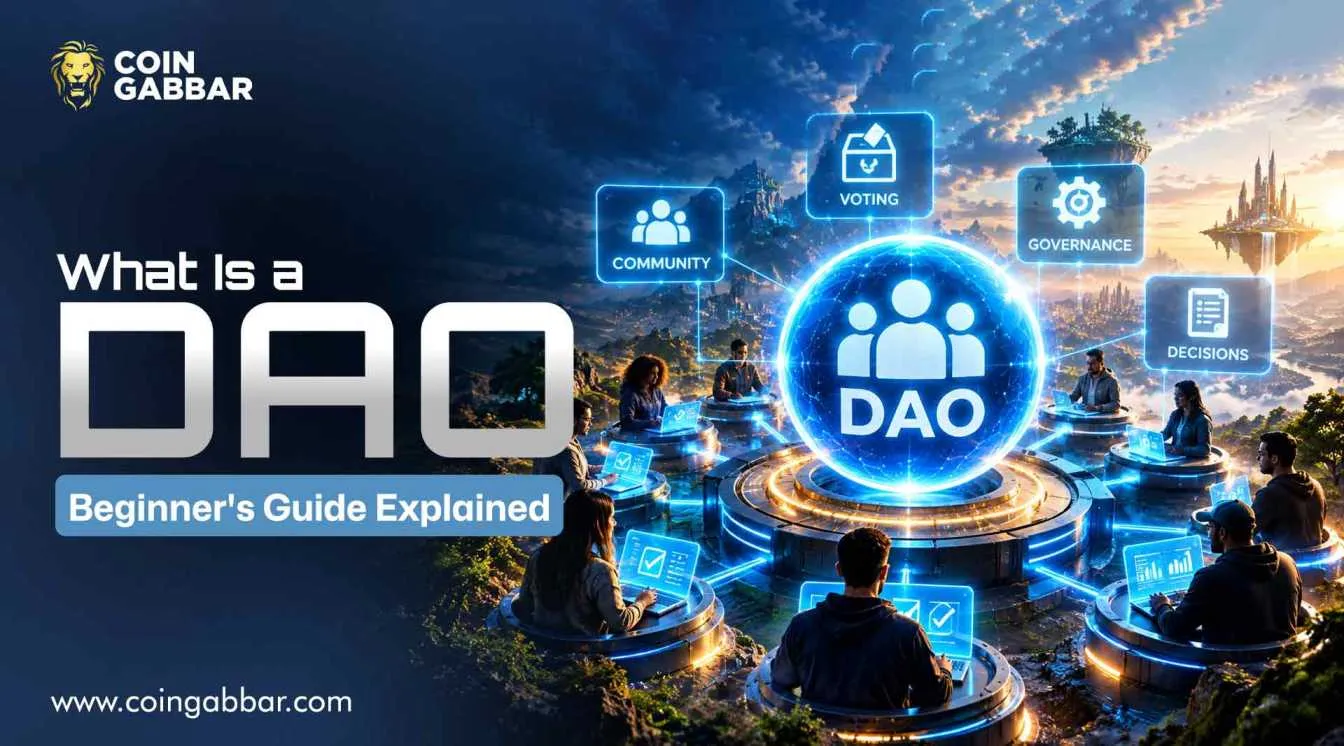
What is a DAO, in plain terms? It stands for Decentralized Autonomous Organization, a group that runs on rules written into blockchain code instead of a boardroom or a CEO.
There is no single owner pulling the strings.
Instead, members hold governance tokens, propose ideas, and vote on what happens next, and the blockchain carries out the winning decision automatically.
This guide breaks down what is a DAO, how it actually works day to day, real examples you can check on-chain, where DAOs show up outside crypto, and the typical roadmap a team follows to launch one.
Key Takeaways
A DAO is a member-governed organization run by smart contracts instead of a central authority.
Governance tokens give members voting rights on proposals covering funds, rules, and upgrades.
Bitcoin is not a DAO since it lacks a governance token and on-chain voting.
Uniswap, Compound, and the original 2016 "The DAO" are commonly cited examples.
Wyoming legally recognizes DAOs as LLCs, one of the few official government frameworks in place.
Launching a DAO follows a roadmap from whitepaper to token design to progressive decentralization.
What Is a DAO?
A DAO is a community-owned organization with no central management.
Its rules live in smart contracts deployed on a blockchain, and every rule change or spending decision has to pass through a vote before the code executes it.
The idea traces back to Ethereum's early design goals, which envisioned organizations that could operate through code and consensus rather than through a legal hierarchy, as laid out in the Ethereum whitepaper.
Membership in a DAO usually means holding a governance token.
The more tokens a wallet holds, the more voting weight it carries on proposals, though some DAOs use one-member-one-vote or reputation-based systems instead of pure token weighting.
How Does a DAO Work?
A DAO functions through five recurring steps.
First, its founding rules are coded into smart contracts and deployed publicly.
Second, people join by acquiring the DAO's governance token.
Third, any qualifying member can submit a proposal, such as funding a project or adjusting a protocol parameter.
Fourth, token holders vote within a set window, and if the proposal clears quorum and the approval threshold, the smart contract executes it automatically, with no manual sign-off needed.
Fifth, every proposal, vote, and treasury movement stays visible on-chain, so anyone can audit the DAO's history.
This structure is what separates a DAO from a normal company. There is no finance department approving a wire transfer; the contract itself releases funds once a vote passes.
Is Bitcoin a DAO?
Bitcoin is not a DAO in the strict sense, though it shares some traits.
Bitcoin has no governance token, no on-chain voting mechanism, and no treasury that members vote to spend.
Its rules change through rough consensus among developers, miners, and node operators, coordinated off-chain through proposals and community discussion, not through binding on-chain votes.
A DAO, by contrast, has a defined membership, a governance token, and proposals that execute automatically once approved.
Bitcoin is better described as a decentralized network or a decentralized protocol rather than a DAO.
Real Examples of a DAO
DAOs generally fall into a few categories.
Protocol DAOs govern decentralized finance platforms, where token holders vote on fee structures, new markets, or treasury grants; Uniswap and Compound are commonly cited protocol DAOs.
Investment DAOs pool member capital to back startups or assets collectively, with votes deciding where the money goes.
Grant and community DAOs fund public goods, open-source development, or creator projects based on member proposals.
Ethereum's own resource on the topic, the official DAO explainer, walks through several of these categories with live examples members can explore directly.
The earliest and most cited case remains "The DAO" from 2016, an investment DAO that raised roughly 150 million dollars in ETH before a code exploit drained about 60 million dollars from it.
That incident led to a contested Ethereum hard fork and remains the reference point for why smart contract audits matter before a DAO goes live.
MakerDAO, now rebranded as Sky, is another frequently cited example, since its token holders vote on collateral types, stability fees, and risk parameters for a decentralized stablecoin system.
What Is a DAO in Crypto, Business, and Government?
In crypto, a DAO usually governs a protocol, treasury, or investment pool through token voting, as described above.
In business, the DAO structure is being adapted by companies that want member-driven decision-making without a traditional executive hierarchy, letting contributors vote on budgets, hiring, or product direction.
In government, a small number of jurisdictions have started recognizing DAOs as legal entities.
Wyoming was the first U.S. state to do this, allowing a DAO to register as a limited liability company with its smart contract identifier listed in the public filing, a process the Wyoming Secretary of State's office documents in its official DAO filing guidance.
The Roadmap to Launching a DAO
Most DAOs follow a similar roadmap from idea to full operation.
It starts with a whitepaper or governance document that defines the mission, membership rules, and voting thresholds.
Next comes smart contract development, where the team builds and audits the contracts that will hold funds and execute votes.
Third, the governance token is designed and distributed, often through a sale, an airdrop, or contribution rewards, since this token becomes the basis for voting power.
Fourth, the DAO launches its governance portal and treasury, opening proposal submission to members.
Fifth, the team decentralizes further over time, handing more control to the community and reducing any remaining founder privileges such as admin keys.
Later roadmap stages typically include expanding into sub-DAOs or working groups for specific functions like grants, marketing, or protocol upgrades, plus periodic audits as the treasury grows.
Benefits and Risks of DAOs
DAOs offer transparency, since every vote and transaction sits on a public ledger, and they let global contributors participate without needing formal incorporation.
They also remove single points of failure in decision-making.
On the risk side, smart contract bugs can be exploited, as the The DAO hack showed.
Voter turnout is often low, which can concentrate real power in a handful of large token holders.
Regulatory treatment of DAOs still varies widely by country, and members should not assume a DAO shields them from personal liability unless it is formally registered, as under Wyoming's framework.
Expert Opinion
Blockchain governance analysts generally view DAOs as a meaningful experiment in collective ownership rather than a finished replacement for traditional companies.
The model works well for protocols and communities that need transparent, rules-based coordination, but voter apathy and concentrated token holdings remain unresolved challenges across most active DAOs today.
Disclaimer
This article is for educational purposes only and does not constitute financial, legal, or investment advice. DAO participation carries smart contract, regulatory, and market risks. Readers should conduct their own research before joining or investing in any DAO.
Also read: