Avalanche News: Hyundai Brings Stablecoins to Global Crypto Payments


Avalanche News: Hyundai First Stablecoin Transfer in Just 7 Minutes
Seven minutes. That's how long it took Hyundai to move $20,000 across two countries — no wire, no correspondent bank, no waiting. If you trade or hold crypto, this is the kind of adoption signal that moves narratives, not just headlines.
Here's what most reports aren't telling you — and what's already scheduled to happen next in Europe.
Hyundai Becomes First Major Korean Firm on Avalanche
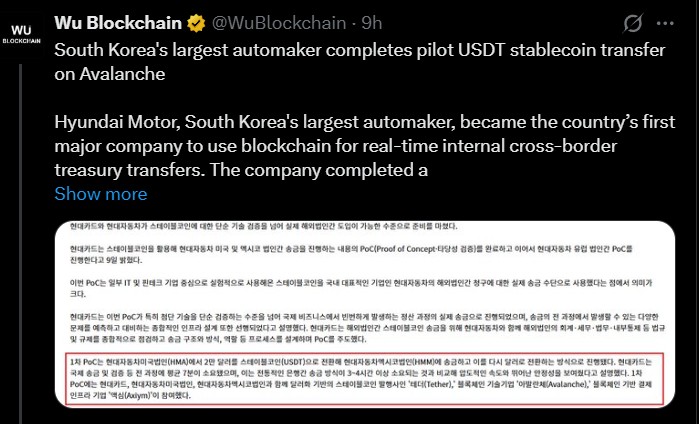
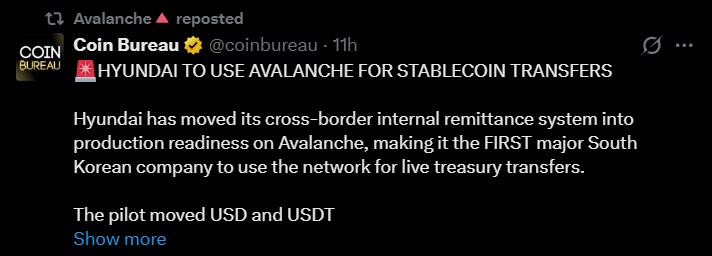
The Motor has completed a live pilot moving stablecoins between two of its overseas subsidiaries, marking the first time a major South Korean conglomerate has used a public blockchain for internal treasury transfers rather than just testing the technology in isolation.
The transfer, led by Hyundai Card, converted $20,000 from Hyundai Motor America into USDT, sent it across the Avalanche network to Hyundai Motor Mexico, then converted it back into dollars. The entire round trip — conversion, transfer, and verification — took roughly seven minutes.
Source: Wu Blockchain
Why This Hyundai Stablecoin Transfer on Avalanche Matters
Traditional interbank transfers for this kind of cross-border settlement typically take three to four hours or longer, depending on banking hours and correspondent routes. Its blockchain-based process cut that down dramatically while holding up on stability and security.
This isn't a sandbox experiment. The Card stated the pilot involved a full regulatory review covering accounting, tax, legal, and internal control requirements across both entities — the kind of groundwork that precedes actual production use, not just a proof-of-concept press release.
Key Details Behind the Pilot
Amount moved: $20,000, converted USD USDT USD
Route: America to Mexico Motors
Settlement time: ~7 minutes versus 3–4+ hours traditionally
Network: Avalanche blockchain
Partners involved: Tether (USDT issuer), Avalanche and payment infrastructure firm Axiym
Beyond the transfer mechanics, the Card emphasized that this pilot was built for actual billing and invoicing between subsidiaries — not a one-off technical demo. The company specifically designed the pilot to settle real intercompany charges that regularly arise in cross-border business operations, rather than simply proving the technology could work.
Before executing the transfer, the Card conducted a full legal and compliance review covering accounting standards, tax treatment, and internal control requirements in both the U.S. and Mexico jurisdictions. This groundwork was meant to anticipate operational issues — such as regulatory reporting and audit trails — that could arise once stablecoin transfers move from testing into routine use.
Notably, stablecoins have so far been used mainly by IT and fintech firms for experimental purposes. The pilot marks one of the first times a traditional, non-tech Korean conglomerate has applied the technology to actual settlement functions, positioning it as a potential template for other legacy industries considering blockchain-based treasury operations.
Source: Official X
What to Watch Next
A second pilot is scheduled for later this month, this time covering European subsidiaries. Unlike the first round, this phase will test settlements in local currencies rather than the U.S. dollar, with Circle and Visa joining as partners.
That detail matters for traders watching stablecoin adoption trends — a multi-currency pilot with Visa and Circle signals that it isn't just testing dollar rails but building toward a broader, currency-agnostic settlement system across its global subsidiary network.
Hyundai Card has also indicated it plans to explore stablecoin use for broader settlement and fund transfer needs across Hyundai Motor Group's international operations, suggesting this pilot could scale well beyond treasury transfers between two entities.
Conclusion
This move shows that stablecoin rails are no longer confined to crypto-native firms — a major automaker just used them for real internal settlement, not a demo. With the European phase bringing in Visa and Circle for multi-currency testing, the next few weeks could offer a clearer read on how fast traditional corporates are willing to move off legacy banking rails.
Disclaimer: This article is for informational purposes only and does not constitute financial, investment, or legal advice. Cryptocurrency markets are volatile and carry risk. Always do your own research before making investment decisions.







